




Back
Rubroshorea curtisii (Dyer ex King) P.S.Ashton & J.Heck. subsp. curtisii
| Family Name: | Dipterocarpaceae |
| Synonyms: | Shorea curtisii Dyer ex King |
| Common Name: | Seraya, Meranti Seraya, Meranti Kampong |
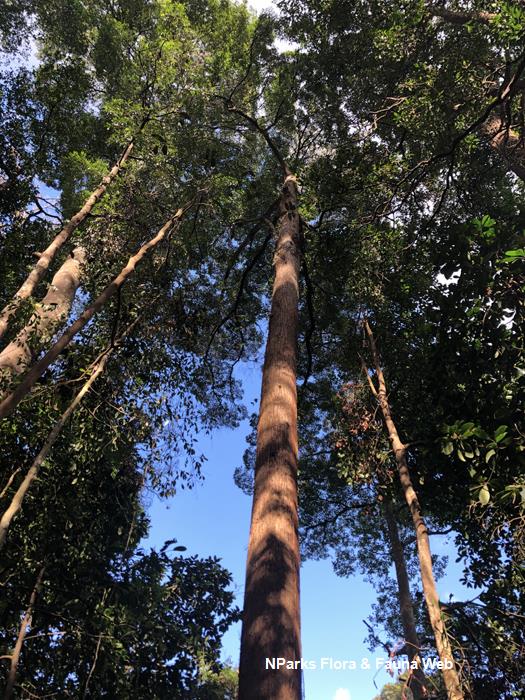
Rubroshorea curtisii subsp. curtisii, also known as Seraya, is an endangered tree in Singapore that can reach up to 70 m tall. It has pale cream yellow or deep crimson flowers and winged fruits. The wood is prized regionally for light to medium construction such as door and window frames.
.jpg)
.jpg)
.jpg)
Name
Classifications and Characteristics
| Plant Division | Angiosperms (Flowering Seed Plants) |
|---|---|
| Plant Growth Form | Tree (Big (>30m)) |
| Lifespan (in Singapore) | Perennial |
| Mode of Nutrition | Autotrophic |
| Plant Shape | Broad / Mushroom / Hemispherical |
| Maximum Height | 70 m |
| Tree or Palm – Trunk Diameter | 2 m |
Biogeography
| Native Distribution | Thailand, Peninsular Malaysia, Singapore, Sumatra, Borneo. |
|---|---|
| Native Habitat | Terrestrial (Primary Rainforest) |
| Preferred Climate Zone | Tropical |
| Local Conservation Status | Native to Singapore (Endangered (EN)) |
Description and Ethnobotany
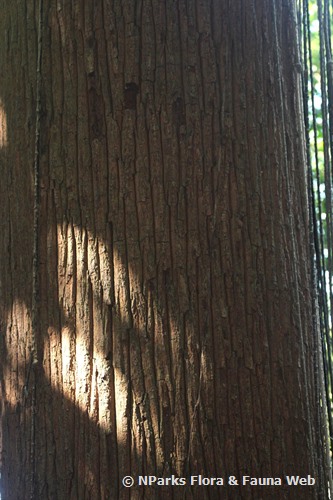
| Growth Form | It is a tree, up to 70 m tall, with large buttresses, up to 1.8 m tall. The trunk can reach up to 2 m in diameter. The bark is deeply fissured. |
|---|---|
| Foliage | The leaves are ovate-lanceolate, measuring 6 – 9 cm long and 2.5 – 3.5 cm wide, and have a leathery texture. Each leaf has 9 – 11 pairs of lateral veins. The midrib is slightly sunken on the upper surface yet prominently on the underside of the leaf. The leaf tip is tapering (acuminate), up to 0.8 cm long, while the leaf base is broadly wedged shaped (cuneate). Domatia are absent. The leaf stalk (petiole) is 1 – 1.3 cm long and may be covered with short hairs. Stipule is obtuse, measuring up to 1 cm long and 0.4 cm wide. |
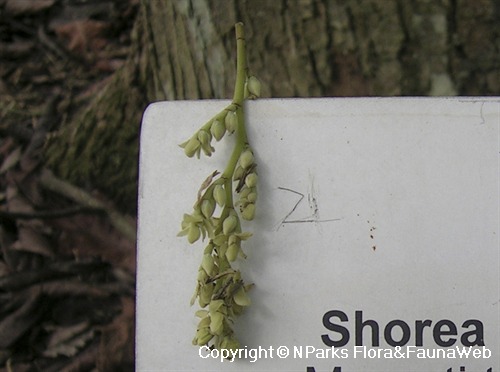
| Flowers | The flowers occur in a cluster (panicle) at the axis or terminal end of the branches. Each inflorescence is up to 6 cm long and bearing up to 12 flowers. The flower buds are small (up to 0.5 cm long). Flowers are small with pale cream yellow or deep crimson petals. Each flower has 15 stamens with subglobose anthers. The connective appendage is short or rudimentary. The ovary is ovoid and hairy. |
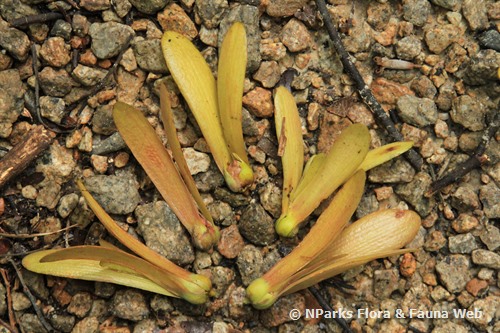
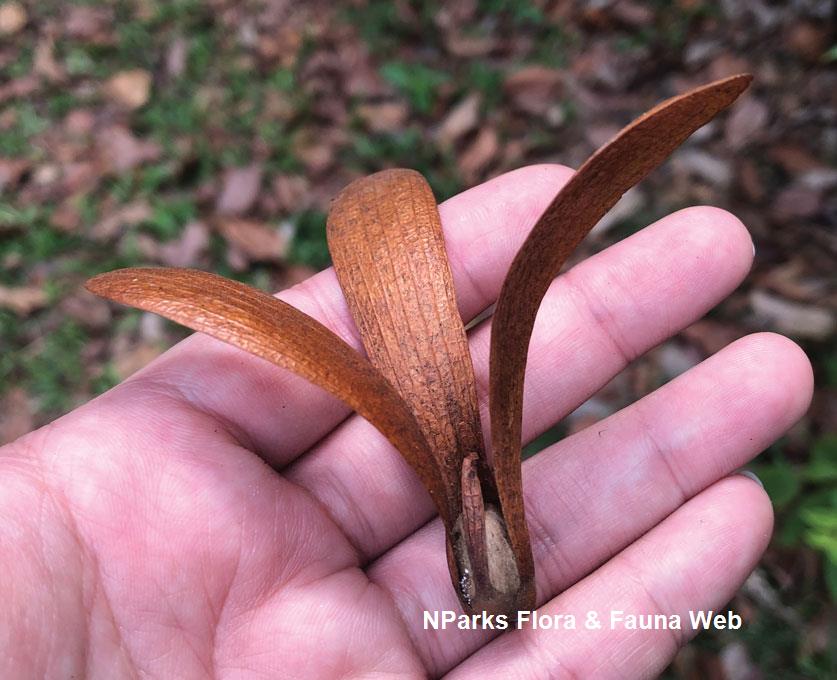
| Fruit | The fruit is winged and dry. They are borne on stalks which are 1 mm long. Each fruit comprises of three wing-like calyx lobes, measuring up to 7 cm long and 1 cm wide, two shorter lobes (up to 4 cm long and 0.3 cm wide) and one oval-shaped nut (up to 1.2 cm long and 0.9 cm wide) with a short style remnant at the tip (about 0.1 mm long). |
| Habitat | It is found in rainforests, especially on ridges, up to 1200 m altitude. |
| Associated Fauna | Flowers are pollinated by insects. |
| Cultivation | It can be propagated by seed. |
| Etymology | The genus epithet comprises of two parts: Rubro, in Latin, means red, while shorea commemorates Sir John Shore (1793-1798), the Governor-General for the British East India Company. The specific epithet commemorates C. Curtis (1853-1928), first Curator of Waterfall Gardens in Penang, Peninsular Malaysia. |
| Ethnobotanical Uses | Timber & Products: It produces dark red meranti timber that is prized regionally for light to medium construction, such as door and window frames, beams, joists, interior furniture, boat building and flooring. Cultural / Religious: Heritage Tree: There is currently one individual of Rubroshorea curtisii listed as Heritage Tree in Singapore. It can be found in Singapore Botanic Gardens. To find out more about this tree, please visit the Heritage Tree Register. |
Landscaping Features
| Landscape Uses | Parks & Gardens, Reforestation |
|---|
Fauna, Pollination and Dispersal
| Pollination Method(s) | Biotic (Fauna) |
|---|
Plant Care and Propagation
| Light Preference | Full Sun, Semi-Shade |
|---|---|
| Water Preference | Moderate Water |
| Plant Growth Rate | Moderate to Slow |
Foliar
| Foliage Retention | Evergreen |
|---|---|
| Mature Foliage Colour(s) | Green |
| Mature Foliage Texture(s) | Leathery |
| Foliar Type | Simple / Unifoliate |
| Foliar Arrangement Along Stem | Alternate |
| Foliar Attachment to Stem | Petiolate |
| Foliar Margin | Entire |
| Foliar Apex - Tip | Acuminate |
| Foliar Base | Cuneate |
Non - Foliar and Storage
| Trunk Type (Non Palm) | Woody |
|---|---|
| Mature Bark Texture | Fissured |
| Root Type | Underground |
Floral (Angiosperm)
| Flower & Plant Sexuality | Bisexual Flowers |
| Flower Colour(s) | Cream / Off-White, Red |
|---|---|
| Flower Grouping | Cluster / Inflorescence |
| Flower Location | Axillary, Terminal |
| Flower Symmetry | Radial |
| Individual Flower Shape | Saucer-shaped |
| Inflorescence Type | Panicle |
| Flowering Period | Every Few Years |
| Flowering Habit | Polycarpic |
Fruit, Seed and Spore
| Mature Fruit Colour(s) | Brown |
|---|---|
| Fruit Classification | Simple Fruit |
| Fruit Type | Indehiscent Dry Fruit , Samara |
| Seed Quantity Per Fruit | Few (1-5) |
References
| References | Ashton, P.S. (1982). Dipterocarpaceae. In: van Steenis, C.G.G.J. (ed.) Flora Malesiana, ser.1, vol. 9, part 2, pp. 237–552, 575–600. The Hague/Boston/London: Martinus Nijhoff/Dr. W. Junk Publishers. Ashton, P.S. (2004). Dipterocarpaceae. In: Soepadmo, E., Saw L.G. & Chung, R.C.K. (eds) Tree Flora of Sabah Sarawak, vol. 5, pp. 63–388. Malaysia: Forest Research Institute Malaysia (FRIM)/Sabah Forestry Department/Sarawak Forestry Department. Ashton, P.S. & Heckenhauer, J. (2022). Tribe Shoreae (Dipterocarpaceae subfamily Dipterocarpoideae) finally dissected. Kew Bull. 77: 885–903. Lemmens, R.H.M.J. and Soerianegara, I. (eds). (1993). Plant Resources of South-East Asia Volume 5 (1). Timber trees: Major commercial timbers. Indonesia: Prosea Foundation. 610 pages. Pooma, R., Poopath, M. and Newman, M.F. (2017). Dipterocarpaceae. In: Santisuk, T. & Balsev, H. (eds) Flora of Thailand, vol. 13, part 4, pp. 557–685. Bangkok: The Forest Herbarium, Royal Forest Department. |
|---|
Image Repository
Others
| Master ID | 30399 |
|---|---|
| Species ID | 4708 |
| Flora Disclaimer | The information in this website has been compiled from reliable sources, such as reference works on medicinal plants. It is not a substitute for medical advice or treatment and NParks does not purport to provide any medical advice. Readers should always consult his/her physician before using or consuming a plant for medicinal purposes. |
.jpg)