






Back
Premna trichostoma Miq.
| Family Name: | Lamiaceae (Labiatae) |
| Common Name: | Kapapar |
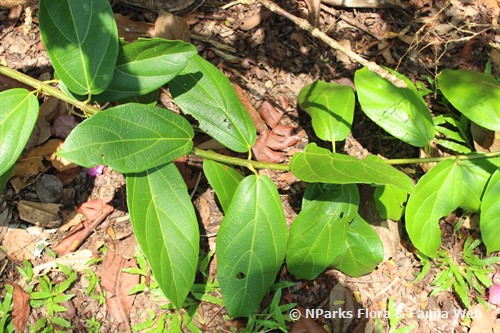
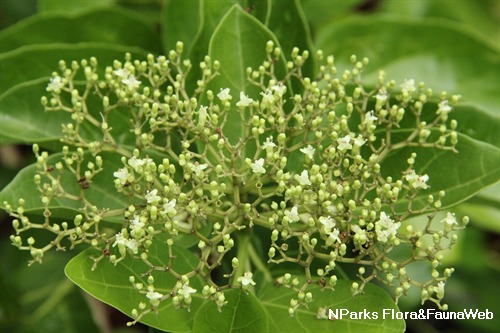
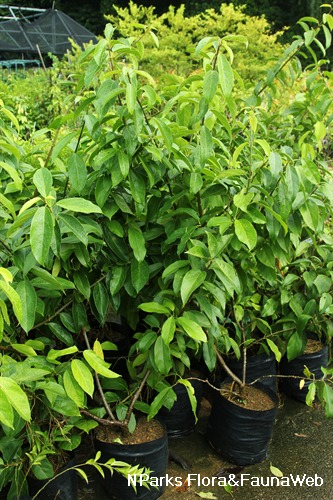
Kapapar or Premna trichostoma is a shrub or small tree that can grow up to 20 m tall. Native to Southeast Asia, including Singapore, and New Guinea, it can be found in kerangas, swamp, mossy and primary forests, often along rivers. It has ovate to elliptic leaves that are leathery or papery, and small whitish-green flowers arranged in clusters 3 - 15 cm long. Its club-shaped fruits turn from white or green to purple, then black when mature. It thrives in full sun and prefers moderate watering.
Name
Classifications and Characteristics
| Plant Division | Angiosperms (Flowering Seed Plants) (Dicotyledon) |
|---|---|
| Plant Growth Form | Shrub, Tree (Medium (16m-30m)), Climber |
| Lifespan (in Singapore) | Perennial |
| Mode of Nutrition | Autotrophic |
| Maximum Height | 1 m to 20 m |
Biogeography
| Native Distribution | Myanmar, Vietnam, Thailand, Peninsular Malaysia, Singapore, Borneo, Philippines, Sumatra, Java, Lesser Sunda Islands, Sulawesi, Maluku and New Guinea |
|---|---|
| Native Habitat | Terrestrial (Primary Rainforest, Freshwater Swamp Forest) |
| Preferred Climate Zone | Tropical |
| Local Conservation Status | Native to Singapore (Presumed Nationally Extinct (NEx)) |
Description and Ethnobotany
| Growth Form | A liana, small tree or shrub, that grows 1 - 20 m tall. It grows up to 40 m long when climbing. Sometimes, plant can be epiphytic. It sometimes roots at the nodes. Most collectors note this plant to be a climber, but it has a free standing woody stem or trunk. |
|---|---|
| Trunk | The outer bark is smooth to scaly, blackish or dark green. It has white sapwood. |
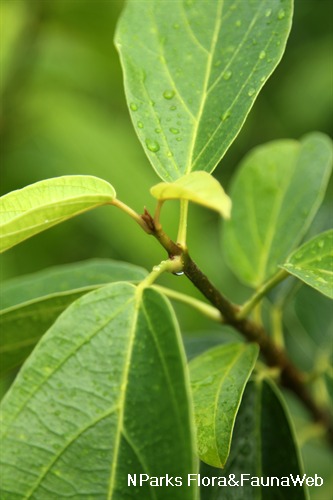
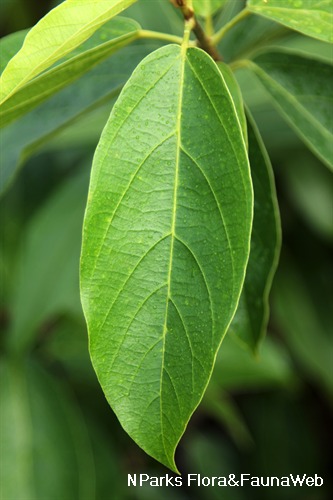
| Foliage | The leaves are arranged opposite to sub-opposite along the stems, ovate to obovate shaped, measuring 3.5 - 18 cm long and 2 - 9.5 cm wide. It has rounded to acuminate apex (leaf tips), cuneate to slightly cordate base, entire margin, leathery to papery texture, pale to dark green. The leaves are glabrous (hairless) when mature, sometimes with hairs on the veins. The leaf has 2 - 9 main side veins, 0.5 - 3.5 cm long petiole covered with hairs and becoming more hairless as it mature. |
| Flowers | FLowers are small, whitish green or pale green with 4 lobes, fragrant. |
| Fruit | Clavoid (club-shaped), measuring 2 - 5 mm long and 1 - 2 mm wide, glabrous (hairless) with glands, white or green turning purple, then to black when mature. Each fruit contains 4 seeds. |
| Habitat | Plant grows in kerangas, swamp forest, mossy forest and primary forest, and often along rivers or in open areas. It grows on clay soil, sometimes on limestone, at 0 - 2600 m altitude. |
Landscaping Features
| Desirable Plant Features | Fragrant (Flowers) |
|---|---|
| Landscape Uses | General, Parks & Gardens, Small Gardens, Hedge / Screening |
Plant Care and Propagation
| Light Preference | Full Sun |
|---|---|
| Water Preference | Moderate Water |
| Plant Growth Rate | Moderate |
| Rootzone Tolerance | Moist Soils, Well-Drained Soils, Fertile Loamy Soils |
| Propagation Method | Seed, Stem Cutting |
Foliar
| Foliage Retention | Evergreen |
|---|---|
| Mature Foliage Colour(s) | Green |
| Mature Foliage Texture(s) | Leathery, Smooth |
| Prominent Young Flush Colour(s) | Green |
| Young Flush Texture(s) | Hairy / Hirsute |
| Foliar Type | Simple / Unifoliate |
| Foliar Arrangement Along Stem | Opposite |
| Foliar Attachment to Stem | Petiolate |
| Foliar Shape(s) | Non-Palm Foliage (Ovate, Obovate, Elliptical) |
| Foliar Venation | Pinnate / Net |
| Foliar Margin | Entire |
| Foliar Apex - Tip | Rounded, Acuminate |
| Foliar Base | Cuneate, Cordate |
| Typical Foliar Size Remarks | 3.5 - 18 cm long x 2 - 9.5 cm wide |
| Typical Foliar Size | 3.5 cm to 18 cm |
Floral (Angiosperm)
| Flower Colour(s) | White |
|---|---|
| Flowering Period | Free-Flowering |
| Flowering Habit | Polycarpic |
| Flowering Calendar | Mar, Apr, May, Jun, Jul, Aug, Sep, Oct |
Fruit, Seed and Spore
| Mature Fruit Colour(s) | Black |
|---|---|
| Mature Fruit Texture(s) | Glossy / Shiny |
| Fruit Type | Fleshy Fruit |
| Seed Quantity Per Fruit | Few (1-5) |
References
| References | <1> de Kok, R. (2013). The genus Premna L. (Lamiaceae) in the Flora Malesiana area. Kew Bulletin 68:55-84. |
|---|
Image Repository
Others
| Master ID | 31635 |
|---|---|
| Species ID | 6034 |
| Flora Disclaimer | The information in this website has been compiled from reliable sources, such as reference works on medicinal plants. It is not a substitute for medical advice or treatment and NParks does not purport to provide any medical advice. Readers should always consult his/her physician before using or consuming a plant for medicinal purposes. |