



Back
Baccaurea pubera (Miq.) Müll.Arg.
| Family Name: | Phyllanthaceae |
| Synonyms: | Baccaurea elmeri Merr., Baccaurea latifolia King ex Hook.f., Baccaurea puberula Merr., Pierardia pubera Miq. |
| Common Name: | Tampoi, Kunkurad, Paih, Sebenggang, Puak, Tampui |
Name
Classifications and Characteristics
| Plant Division | Angiosperms (Flowering Seed Plants) (Dicotyledon) |
|---|---|
| Plant Growth Form | Tree |
| Lifespan (in Singapore) | Perennial |
| Mode of Nutrition | Autotrophic |
| Maximum Height | 20 m |
Biogeography
| Native Distribution | Peninsular Malaysia, Borneo, Sumatra |
|---|---|
| Native Habitat | Terrestrial (Primary Rainforest) |
| Preferred Climate Zone | Tropical |
| Local Conservation Status | Non-native |
Description and Ethnobotany
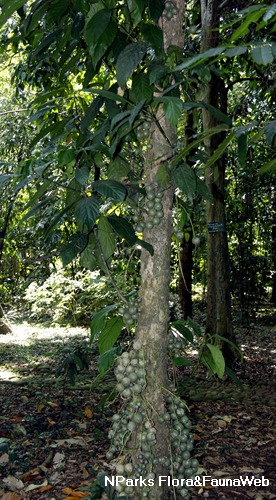
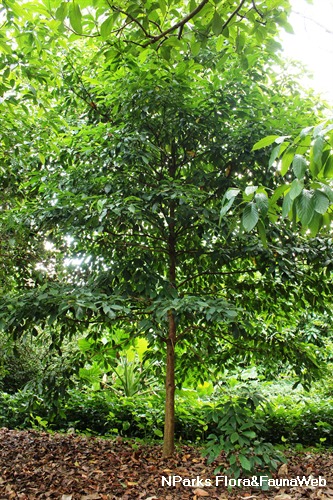
| Growth Form | Grows up to 20 m tall with about 40 cm in diameter. Its bole is sometimes fluted and has buttresses. It has hairy branchlets. |
|---|---|
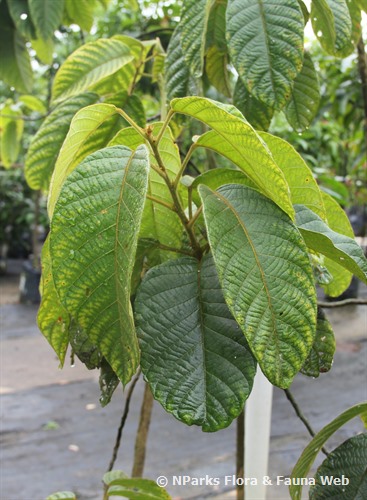
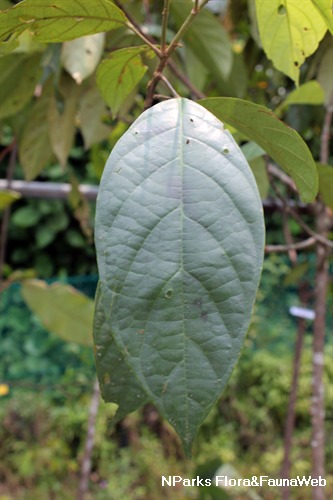
| Foliage | Leaves upper surface dark brown to black while lower surface yellowish-brown when dry; hairy on both upper and lower surfaces, lamina elliptic, 13-36 by 5-15 cm, texture papery to leathery; petiole 3-13 cm long, hairy; stipule 5-11 by 4-8 mm, hairy, ciliated margin; base round to attenuate; apex acuminate and 4-10 mm long. |
| Flowers | Staminate inflorescence: axillary, 1-3 in a cluster, 0.5 to 16 cm long, hairy, flowers are along inflorescence; bracts 1 per every branchlet, triangular to lanceolate, hairy, margin ciliated. Staminate fowers are 1 - 3 mm in diameter, colour lime-green or whitish-yellow or pale green, hairy, sepals about 4 or 5, ovate-obovate shape, stamens 4 or 5, glabrous. Pistillate inflorescence: borne on stems, stigmas caducous but sepals persistent. Pistillate flowers have 5 sepals, yellow. |
| Fruit | Shape globose to pear-like, 5 or 6 seeds, brown to pale yellow, fleshy, hairy on the outside, almost glabrous inside, pericarp thickness of 2-5 mm. |
| Etymology | Pubera means hairy in Latin. |
| Ethnobotanical Uses | Edible Plant Parts : Edible Fruits |
Fauna, Pollination and Dispersal
| Fauna Pollination Dispersal Associated Fauna | Bird-Attracting Plant |
|---|---|
| Pollination Method(s) | Biotic (Fauna) |
| Seed or Spore Dispersal | Biotic (Fauna) |
Plant Care and Propagation
| Light Preference | Full Sun |
|---|---|
| Water Preference | Moderate Water |
| Plant Growth Rate | Moderate |
| Rootzone Tolerance | Heavy Clay Soils |
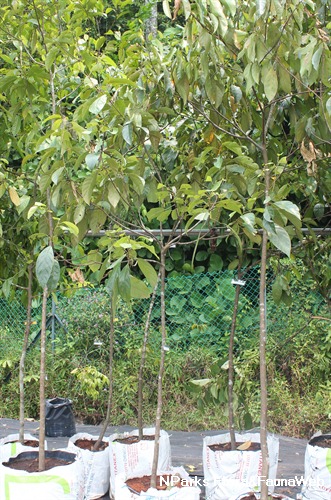
| Propagation Method | Seed |
Foliar
| Mature Foliage Colour(s) | Green |
|---|---|
| Mature Foliage Texture(s) | Papery, Leathery |
| Foliar Type | Simple / Unifoliate |
| Foliar Arrangement Along Stem | Alternate |
| Foliar Attachment to Stem | Petiolate |
| Foliar Shape(s) | Non-Palm Foliage (Ovate, Obovate, Elliptical) |
| Foliar Venation | Pinnate / Net |
| Foliar Margin | Entire, Ciliate / Hairy |
| Foliar Apex - Tip | Acuminate |
| Foliar Base | Rounded / Obtuse, Attenuate |
| Typical Foliar Size | 10 cm to 35 cm |
Non - Foliar and Storage
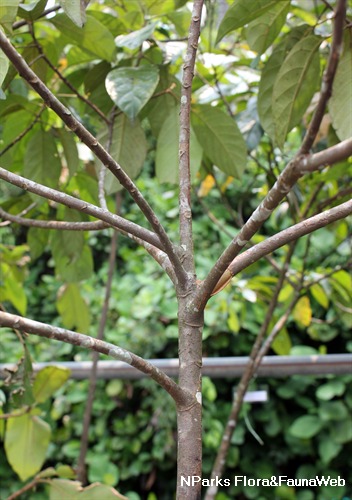
| Bark Colour(s) | When it is fresh, the bark is pale-brown to grey, turning to brown or brown-red when dry; the inner bark is reddish-brown. |
|---|---|
| Mature Bark Texture | Smooth |
Floral (Angiosperm)
| Flower & Plant Sexuality | Unisexual Flowers , Dioecious |
| Flower Colour(s) | Green - Light Green, White |
|---|
| Flower Grouping | Cluster / Inflorescence |
| Flower Location | Axillary |
| Flower Colour(s) Remarks | lime green to pale green, or whitish yellow |
Fruit, Seed and Spore
| Mature Fruit Colour(s) | Brown |
|---|---|
| Mature Fruit Texture(s) | Hairy / Hirsute |
| Fruit Classification | Simple Fruit |
| Fruit Type | |
| Seed Description | Globose to ellipsoidal shaped, flattened, yellow to orange arillode;, brown seed coat. |
Image Repository
Others
| Master ID | 32585 |
|---|---|
| Species ID | 6997 |
| Flora Disclaimer | The information in this website has been compiled from reliable sources, such as reference works on medicinal plants. It is not a substitute for medical advice or treatment and NParks does not purport to provide any medical advice. Readers should always consult his/her physician before using or consuming a plant for medicinal purposes. |