






Back
Cymbidium atropurpureum (Lindl.) Rolfe
| Family Name: | Orchidaceae |
| Synonyms: | Cymbidium finlaysonianum var. atropurpureum, Cymbidium pendulum var. atropurpureum |
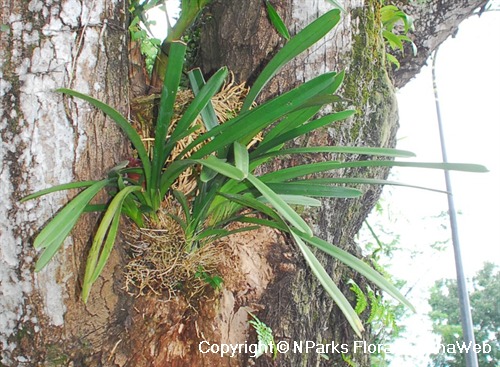
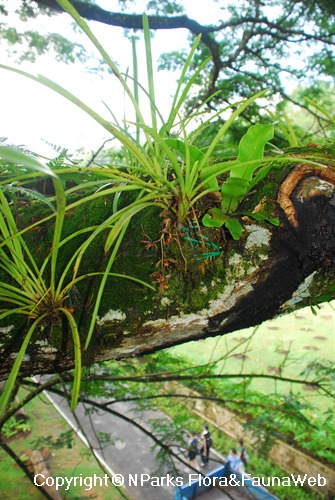
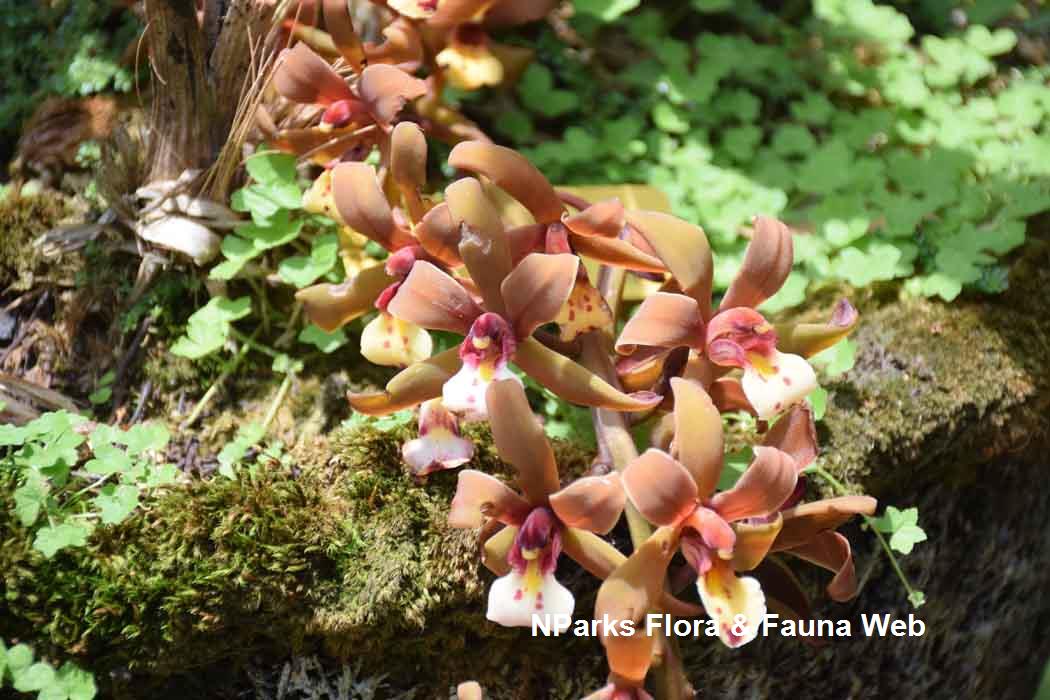
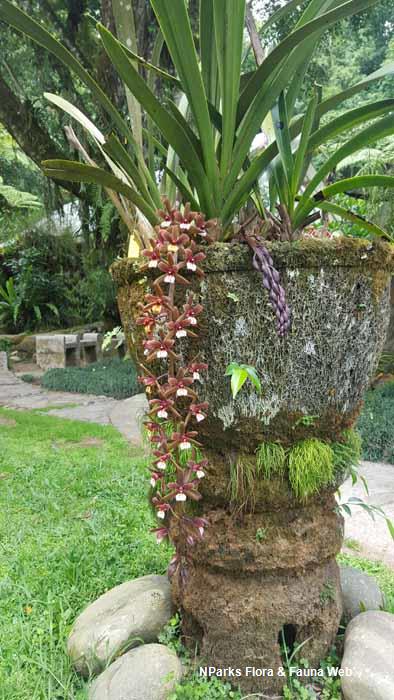
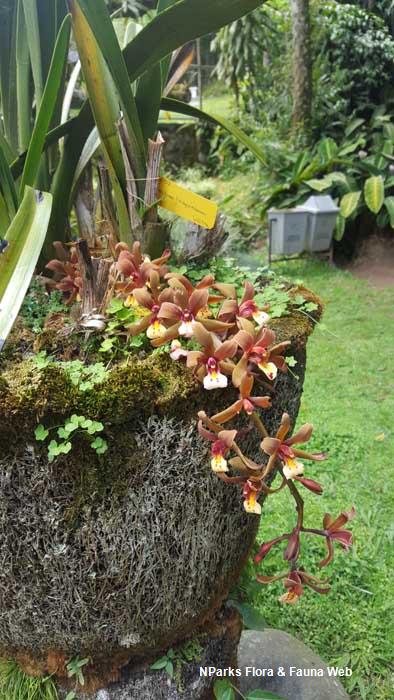
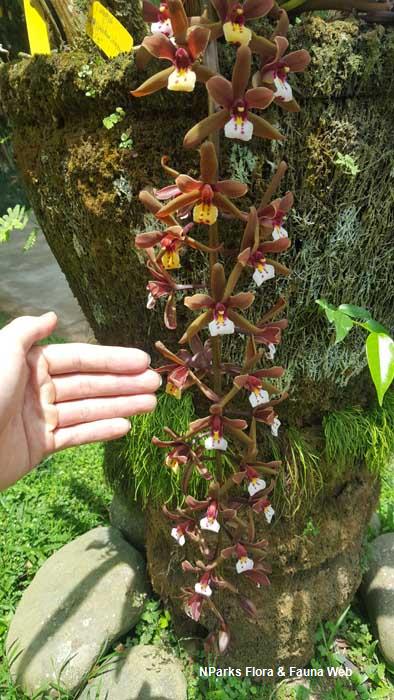
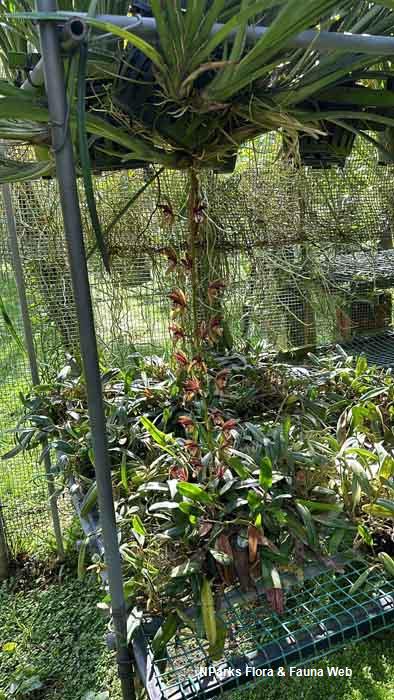
Cymbidium atropurpureum is an epiphytic orchid distinguised by its striking maroon flowers on long pendant-like clusters and produce a coconut-like fragrance. This species grows well under filtered sunlight with regular watering and is typically found growing on trees and occasionally on rocks in lowland evergreen and riverine forests. Its eye-catching flowers make it an excellent choice for urban parks and streetscape plantings.
Name
Classifications and Characteristics
| Plant Division | Angiosperms (Flowering Seed Plants) (Monocotyledon) |
|---|---|
| Plant Growth Form | Epiphyte |
| Lifespan (in Singapore) | Perennial |
| Mode of Nutrition | Autotrophic |
| Plant Shape | Weeping / Pendulous |
| Maximum Height | 0.5 m to 1 m |
Biogeography
| Native Distribution | China (Hainan), Vietnam, Thailand, Peninsular Malaysia, Singapore, Sumatra, Java, Philippines. |
|---|---|
| Native Habitat | Terrestrial |
| Preferred Climate Zone | Tropical |
| Local Conservation Status | Native to Singapore (Critically Endangered (CR)) |
Description and Ethnobotany
| Growth Form | An epiphytic orchid with ovoid-shaped pseudobulbs. |
|---|---|
| Foliage | Each pseudobulb stem usually has 7 - 9 leathery linear leaves , measuring 50 - 90 cm long and 1.5 - 4 cm wide. Leaf blade unequally bilobed, and has obtuse tip. |
| Stems | It has pseudobulb stems of up to 10 cm long and 6 cm wide. |
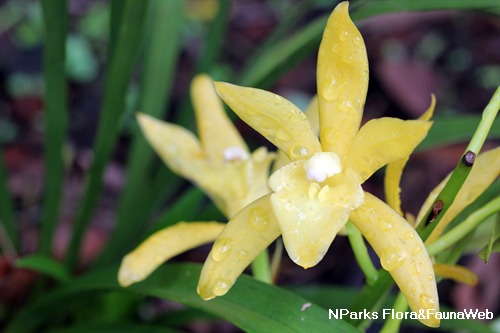
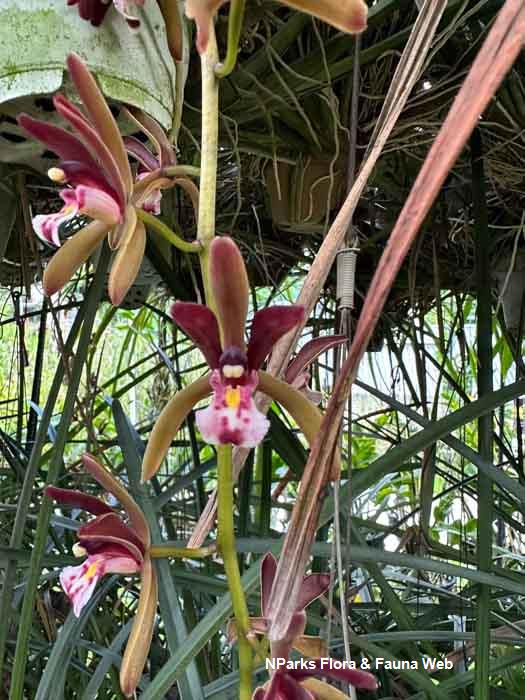
| Flowers | The pendulous inflorescence is about 28 - 75 cm long with 10 - 33 flowers. Flower is typically coconut-scented, measuring 3.5 - 4.5 cm in diameter, with dark purple to maroon narrowly elliptic petals. Its sepals are deep maroon to dull yellow-green, and the white lip turns yellow when aging. |
| Habitat | It is found on the forks of forest trees (where the branches split) and occasionally on the rocks, as well as in evergreen and riverine forests, at an altitude up to 1200 m. |
| Etymology | The genus epithet Cymbidium means boat-like, which refers to the shape of the orchid's lip resembling a boat. The specific epithet atropurpureum means dark-purple, describing the flower colour. |
Landscaping Features
| Desirable Plant Features | Fragrant (Flowers), Ornamental Flowers |
|---|---|
| Landscape Uses | Parks & Gardens, Small Gardens, Suitable for Hanging Baskets |
| Thematic Landscaping | Fragrant / Aromatherapy Garden |
Plant Care and Propagation
| Light Preference | Semi-Shade |
|---|---|
| Water Preference | Moderate Water |
| Plant Growth Rate | Moderate |
| Rootzone Tolerance | Well-Drained Soils |
Foliar
| Foliage Retention | Evergreen |
|---|---|
| Mature Foliage Colour(s) | Green |
| Mature Foliage Texture(s) | Leathery |
| Prominent Young Flush Colour(s) | Green |
| Young Flush Texture(s) | Leathery |
| Foliar Type | Simple / Unifoliate |
| Foliar Arrangement Along Stem | Alternate |
| Foliar Attachment to Stem | Petiolate |
| Foliar Shape(s) | Non-Palm Foliage (Elliptical) |
| Foliar Venation | Parallel |
| Foliar Margin | Entire |
| Foliar Apex - Tip | Obtuse |
| Typical Foliar Size | 3.5 cm to 4.5 cm |
Floral (Angiosperm)
| Flower & Plant Sexuality | Bisexual Flowers |
| Flower Colour(s) | Purple, White |
|---|---|
| Flower Texture(s) | Smooth |
| Flower Grouping | Cluster / Inflorescence |
| Flower Location | Axillary |
| Flower Symmetry | Bilateral |
| Individual Flower Shape | Labiate / Lipped |
References
| References | <1> Cymbidium atropurpureum (Lindl.) Rolfe. e-Flora of Thailand. https://botany.dnp.go.th/eflora/floraspecies/html?tdcode=05816 (Accessed 6 January 2026) |
|---|
Image Repository
Others
| Master ID | 32676 |
|---|---|
| Species ID | 7088 |
| Flora Disclaimer | The information in this website has been compiled from reliable sources, such as reference works on medicinal plants. It is not a substitute for medical advice or treatment and NParks does not purport to provide any medical advice. Readers should always consult his/her physician before using or consuming a plant for medicinal purposes. |