




Back
Hanguana rubinea Škorničk. & P.C.Boyce
| Family Name: | Hanguanaceae |
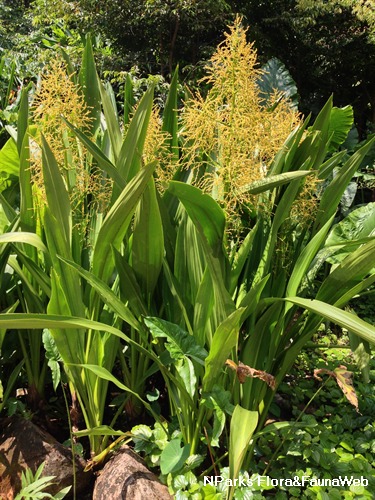
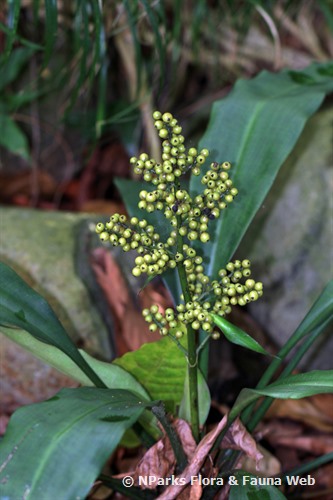
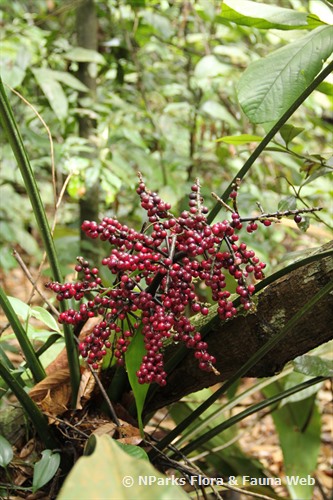
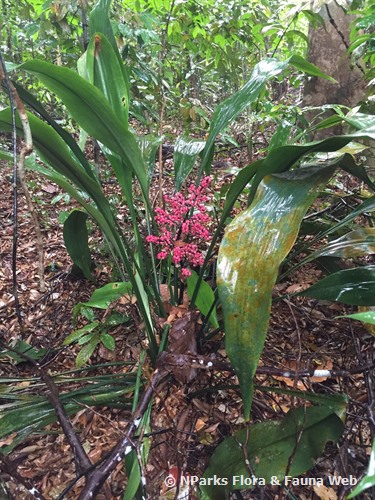
Hanguana rubinea is a herbaceous plant that can grow to about 1.5m tall and is critically endangered in Singapore. It has long, narrow leaves measuring 65-95 cm in length. Its striking ruby-red fruits are borne on erect stalks up to 50 cm tall. The species is apomictic, meaning that female plants produce fruit and seeds without pollination. The resulting offspring are genetically identical to the mother plant. Its seeds are likely to be dispersed by birds. First described as a new species in 2015, the species’ discovery highlights the thriving biodiversity amidst the city state’s highly urbanised landscape.
Name
Classifications and Characteristics
| Plant Division | Angiosperms (Flowering Seed Plants) (Monocotyledon) |
|---|---|
| Plant Growth Form | Herbaceous Plant |
| Lifespan (in Singapore) | Perennial |
| Mode of Nutrition | Autotrophic |
Biogeography
| Native Distribution | Singapore, Sumatra |
|---|---|
| Native Habitat | Terrestrial (Primary Rainforest, Secondary Rainforest) |
| Preferred Climate Zone | Tropical |
| Local Conservation Status | Native to Singapore (Critically Endangered (CR)) |
Description and Ethnobotany
| Growth Form | It is a dioecious, herbaceous plant, reaching up to 1.5 m tall. |
|---|---|
| Foliage | The leaves can grow up to 1.65 m tall. The leaf blade is leathery, narrowly elliptic, reaching 65–95 cm long × 12–16 cm wide, with attenuate base and elongated tip. |
| Flowers | The inflorescence is an erect panicle. Only female inflorescences have been observed. |
| Fruit | The fruit are 0.9-1 cm in diameter, borne on erect fruiting stalk up to 50 cm tall. The fruit ripen from bright green through creamy-white to dark pink-red or ruby-red and the pulp exudes yellow juice when disturbed. |
| Habitat | It can be found in primary or partially disturbed primary lowland forest on slopes or near small/ seasonal streams. |
| Associated Fauna | It is likely dispersed by birds through observations from camera traps. |
| Cultivation | It is propagated by seeds. |
| Etymology | The genus Hanguana is derived from Hanguana kassintu, the Sundanese vernacular name for a plant in this genus. The specific epithet rubinea is from Latin meaning ruby-red, referring to the colour of the ripe fruit. |
Landscaping Features
| Desirable Plant Features | Ornamental Fruits |
|---|---|
| Landscape Uses | Parks & Gardens |
Fauna, Pollination and Dispersal
| Fauna Pollination Dispersal Associated Fauna | Bird-Attracting Plant (Fruits) |
|---|---|
| Pollination Method(s) | Abiotic |
| Seed or Spore Dispersal | Biotic (Fauna) (Vertebrates (Birds)) |
Plant Care and Propagation
| Light Preference | Semi-Shade |
|---|---|
| Water Preference | Moderate Water |
| Rootzone Tolerance | Moist Soils |
| Propagation Method | Seed |
Foliar
| Mature Foliage Colour(s) | Green |
|---|---|
| Mature Foliage Texture(s) | Leathery |
Floral (Angiosperm)
| Flower Grouping | Cluster / Inflorescence |
|---|
Fruit, Seed and Spore
| Mature Fruit Colour(s) | Red |
|---|---|
| Seed Quantity Per Fruit | Few (1-5) |
References
| References | Irsyam, A.S.D., Galingging, A., Wijaya, K., Dewi, A.P., Peniwidiyanti, Al Anshori, Z., Hariri, M.R., Rosleine, D. & Leong-Škorničková, J. (2025). Hanguana rubinea Škorničk. & P.C.Boyce (Hanguanaceae), a new record for indonesia. Reinwardtia 24(1): 33‒39. Leong-Škorničková, J. & Boyce, P.C. (2015). Hanguana in Singapore demystified: an overview with description of three new species and a new record. Gardens’ Bulletin Singapore. 67. 1. pp 1-28 Niissalo, M.A., Leong-Škorničková, J., Šída, O. & Khew, G.S. (2020). Population genomics reveal apomixis in a novel system: uniclonal female populations dominate the tropical forest herb family, Hanguanaceae (Commelinales). AoB Plants. 12. 6. pp 1- 13 |
|---|
Image Repository
Others
| Master ID | 32826 |
|---|---|
| Species ID | 7239 |
| Flora Disclaimer | The information in this website has been compiled from reliable sources, such as reference works on medicinal plants. It is not a substitute for medical advice or treatment and NParks does not purport to provide any medical advice. Readers should always consult his/her physician before using or consuming a plant for medicinal purposes. |