


Back
Alangium longiflorum var. hirsutum (Bloemb.) W.J.de Wilde & Duyfjes
| Family Name: | Cornaceae |
| Synonyms: | Alangium hirsutum Bloemb. |
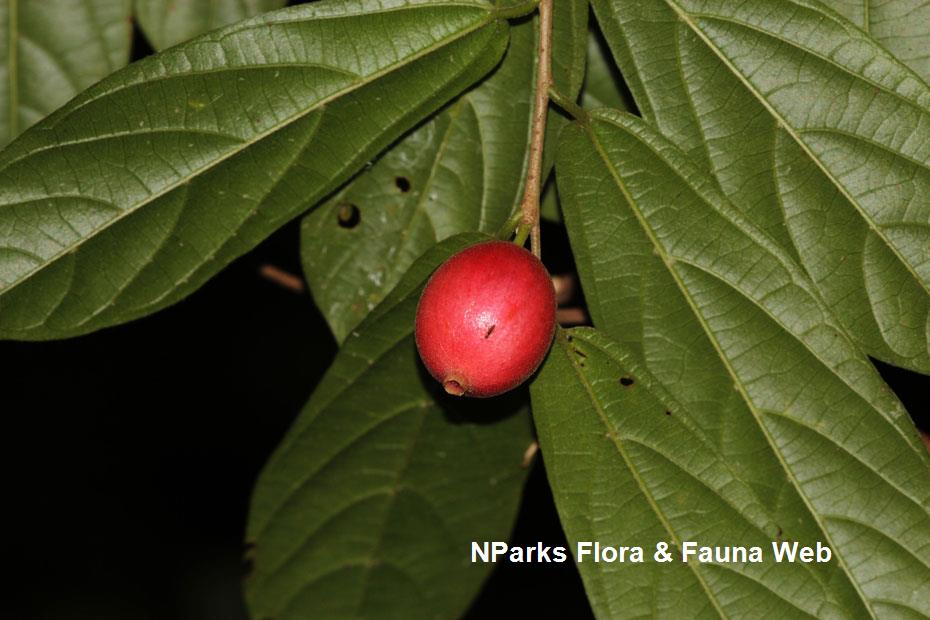
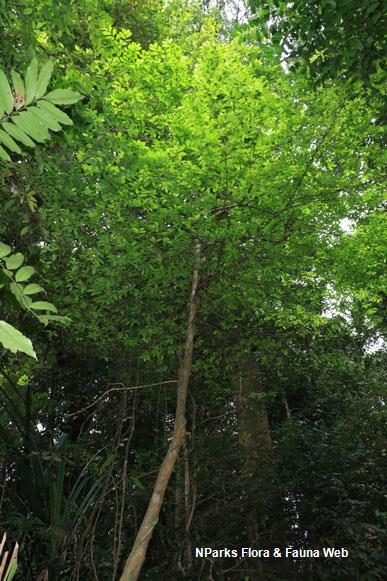
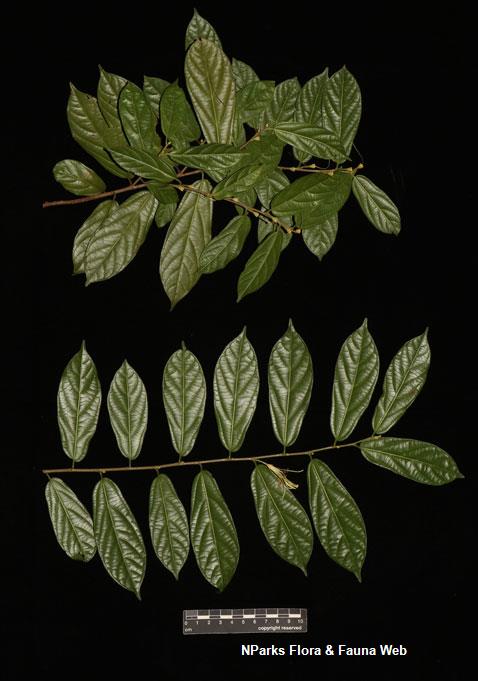
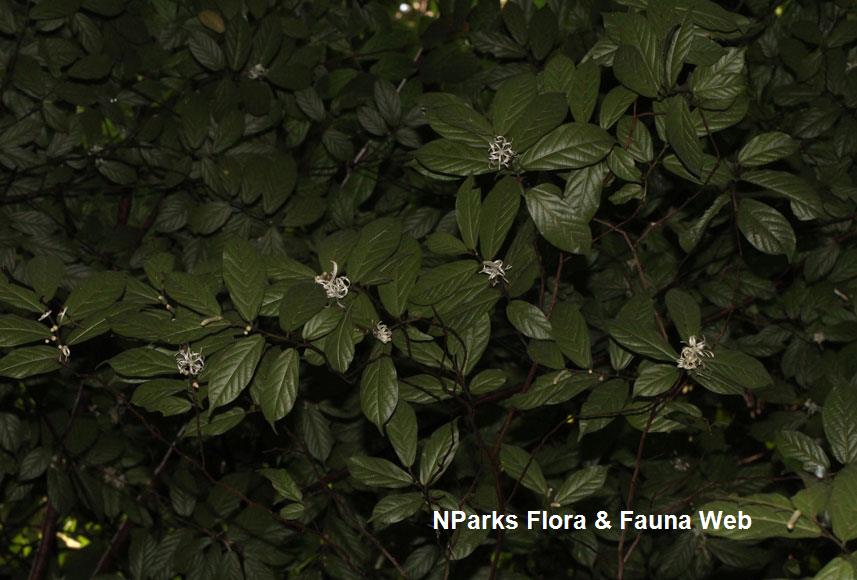
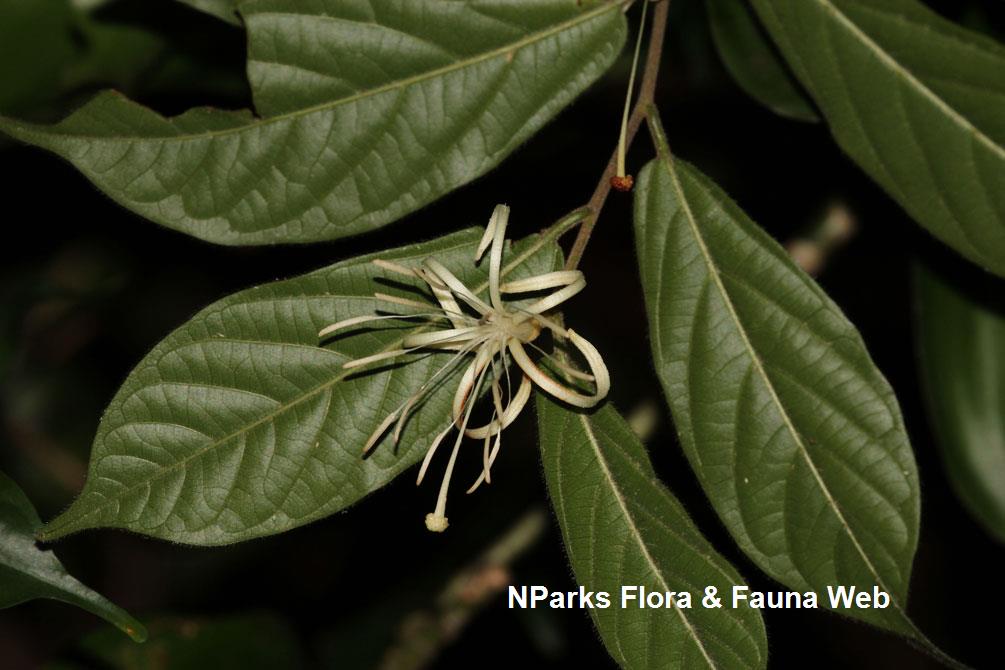
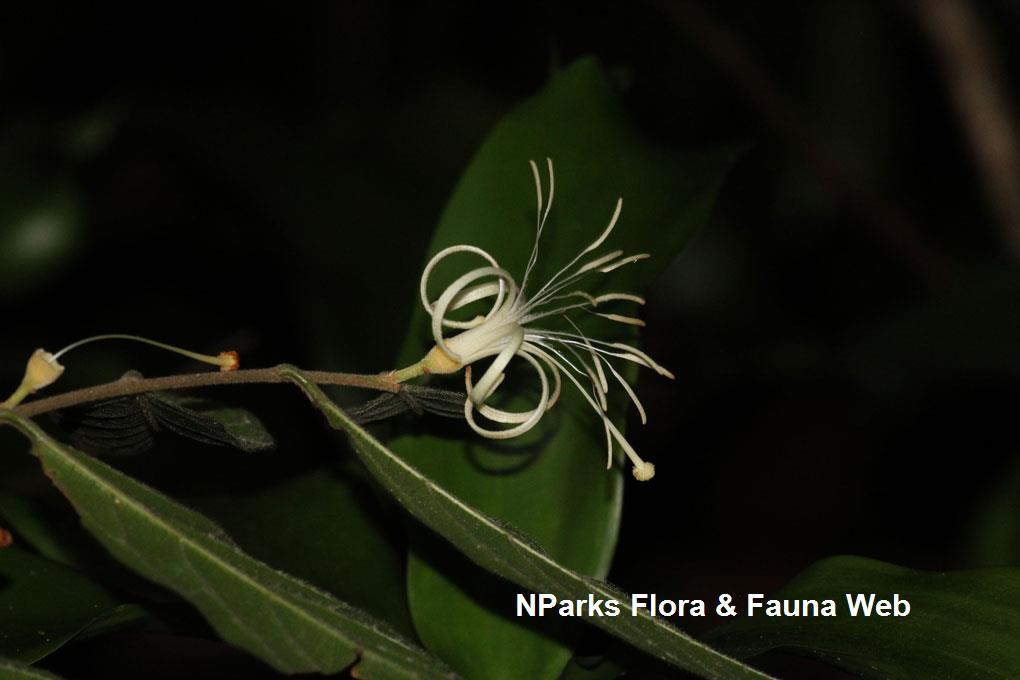
Alangium longiflorum var. hirsutum is a large shrub to small tree native to Singapore. Growing between 2 - 12 m tall, it produces grey-brown bark, spines often found on its trunk. Leaves are elliptic-obovate or oblong-obovate, densely to sparsely hairy. Flowers are white, fragrant, covered in pale or brown short hairs, 5-7 recurved petals with 14- 17 shorter, thread-like filaments. The fruit is a pink to red, thinly hairy, elliptic drupe with juicy flesh surrounding the seed.
Name
Classifications and Characteristics
| Plant Division | Angiosperms (Flowering Seed Plants) (Dicotyledon) |
|---|---|
| Plant Growth Form | Tree (Small (6m-15m)), Shrub |
| Maximum Height | 12 m |
Biogeography
| Native Distribution | Sumatra, Peninsular Malaysia, Singapore, Borneo |
|---|---|
| Native Habitat | Terrestrial (Primary Rainforest, Secondary Rainforest) |
| Preferred Climate Zone | Tropical |
| Local Conservation Status | Native to Singapore (Critically Endangered (CR)) |
Description and Ethnobotany
| Growth Form | It is a large shrub to small-sized tree with grey-brown bark, grows between 2 - 12 m tall, spines often found along the trunk. |
|---|---|
| Foliage | Leaves are elliptic-obovate or broadly spoon-shaped, densely to sparsely hairy, measuring 6 - 15 cm long by 2.5 - 7 cm wide. |
| Flowers | Flowers are held singly or on an inflorescence of up to 3, covered in pale or brown short hairs, fragrant. Petals are linear, in 5 - 7, recurved measuring 20 - 30 mm long. Filaments in 14 - 17, slender, thread-like, straight, hairy at the middle, measuring 10 - 20 mm, shorter than the petals. |
| Fruit | The fruit is a pink to red, elliptic drupe with juicy flesh, measuring 20 - 35 mm long by 15 - 20 mm in diameter with thin hairs on the outside. |
| Habitat | Occurs commonly on lowland forest on hillsides at 400 m altitude. <1> |
| Cultivation | It can be propagated by seed. |
| Etymology | The genus, Alangium, derived from the Malabar plant name alangi. The species epipthet, longiflorum, Latin, longus = long, flos = flower. The varietal epipthet, hirsutum, Latin, hirsutus meaning hairy; referring to the leaves. |
Landscaping Features
| Desirable Plant Features | Fragrant (Flowers) |
|---|---|
| Usage Hazard - Cons | Spines/Thorns - Trunk |
Plant Care and Propagation
| Light Preference | Full Sun |
|---|---|
| Water Preference | Moderate Water |
| Plant Growth Rate | Moderate |
| Rootzone Tolerance | Fertile Loamy Soils, Well-Drained Soils |
| Propagation Method | Seed |
Foliar
| Foliage Retention | Evergreen |
|---|---|
| Foliar Type | Simple / Unifoliate |
| Foliar Arrangement Along Stem | Alternate |
| Foliar Attachment to Stem | Petiolate |
| Foliar Shape(s) | Non-Palm Foliage (Elliptical, Obovate, Oblong) |
| Foliar Venation | Reticulate |
| Foliar Margin | Entire |
| Foliar Apex - Tip | Acuminate, Acute |
| Foliar Base | Oblique / Asymmetrical, Rounded / Obtuse |
Non - Foliar and Storage
| Stem Type & Modification | Woody |
|---|
Floral (Angiosperm)
| Flower & Plant Sexuality | Bisexual Flowers , Bisexual Flowers |
| Flower Colour(s) | White |
|---|
| Flower Grouping | Solitary, Cluster / Inflorescence |
| Flower Location | Axillary |
| Flower Symmetry | Radial |
| Flowering Habit | Polycarpic |
Fruit, Seed and Spore
| Mature Fruit Colour(s) | Pink, Red |
|---|---|
| Mature Fruit Texture(s) | Hairy / Hirsute |
| Fruit Classification | Simple Fruit |
| Fruit Type |
References
| References | <1> de Wilde, W.J.J.O & Duyfjes, B.E.E. (2021) Alangium. In: Kiew, R., Chung, R.C.K., Saw, L.G. & Soepadmo, E. (ed.) Cornaceae. Flora of Peninsular Malaysia, ser. II: Seed Plants, vol. 8, pp. 154-156. Selangor: Forest Research Institute Malaysia. |
|---|
Image Repository
Others
| Master ID | 34194 |
|---|---|
| Species ID | 8607 |
| Flora Disclaimer | The information in this website has been compiled from reliable sources, such as reference works on medicinal plants. It is not a substitute for medical advice or treatment and NParks does not purport to provide any medical advice. Readers should always consult his/her physician before using or consuming a plant for medicinal purposes. |
_lowres.jpg)