



Back
Artocarpus griffithii (King) Merr.
| Family Name: | Moraceae |
| Synonyms: | Artocarpus nitidus Trécul subsp. griffithii (King) F.M.Jarrett |
Artocarpus griffithii is a critically endangered tree in Singapore. It can reach up to 35 m tall and exhibits foliage dimorphism, where the appearance of young juvenile leaves differs from that of mature leaves.

Name
Classifications and Characteristics
| Plant Division | Angiosperms (Flowering Seed Plants) |
|---|---|
| Plant Growth Form | Tree |
| Lifespan (in Singapore) | Perennial |
| Mode of Nutrition | Autotrophic |
| Maximum Height | 35 m |
Biogeography
| Native Distribution | From India, Malesia to New Guinea |
|---|---|
| Native Habitat | Terrestrial |
| Preferred Climate Zone | Tropical |
| Local Conservation Status | Native to Singapore (Critically Endangered (CR)) |
Description and Ethnobotany
| Growth Form | It is a tree which can reach up to 35 m tall and sometimes develop buttresses. It produces white sap when any part of the plant is injured. |
|---|---|
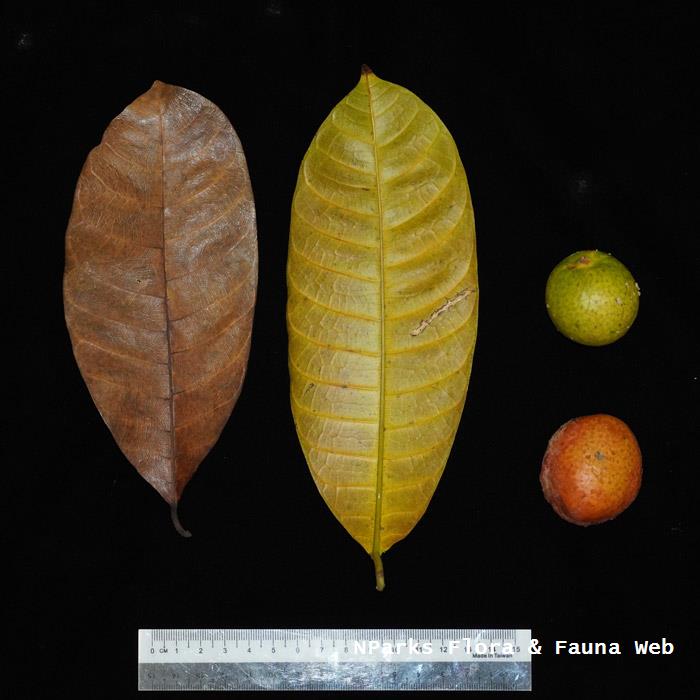
| Foliage | Leaves are leathery. Mature leaves are elliptic, about (3-) 6 – 18 (-33) cm long and (1.5 -) 3.5 – 9 cm wide, while young leaves are pinnately lobate. Both the leaf tip and leaf base are variable. The leaf tip can be tapering (acuminate), caudate, acute, obtuse or rounded. While the leaf base can be wedge shaped (cuneate), narrow (subattenuate), rounded to subcordate. Both the upper surface and lower surface of the leaf can be glabrous or sparsely covered with hairs on the midrib and veins. Each leaf has 7 – 10 lateral veins. Petiole is short (0.5–2.5 cm long), and sparsely covered with whitish to brownish appressed hairs. Stipule is 0.2 – 0.4 cm long, falls out early and covered with whitish to brownish appressed hairs. |
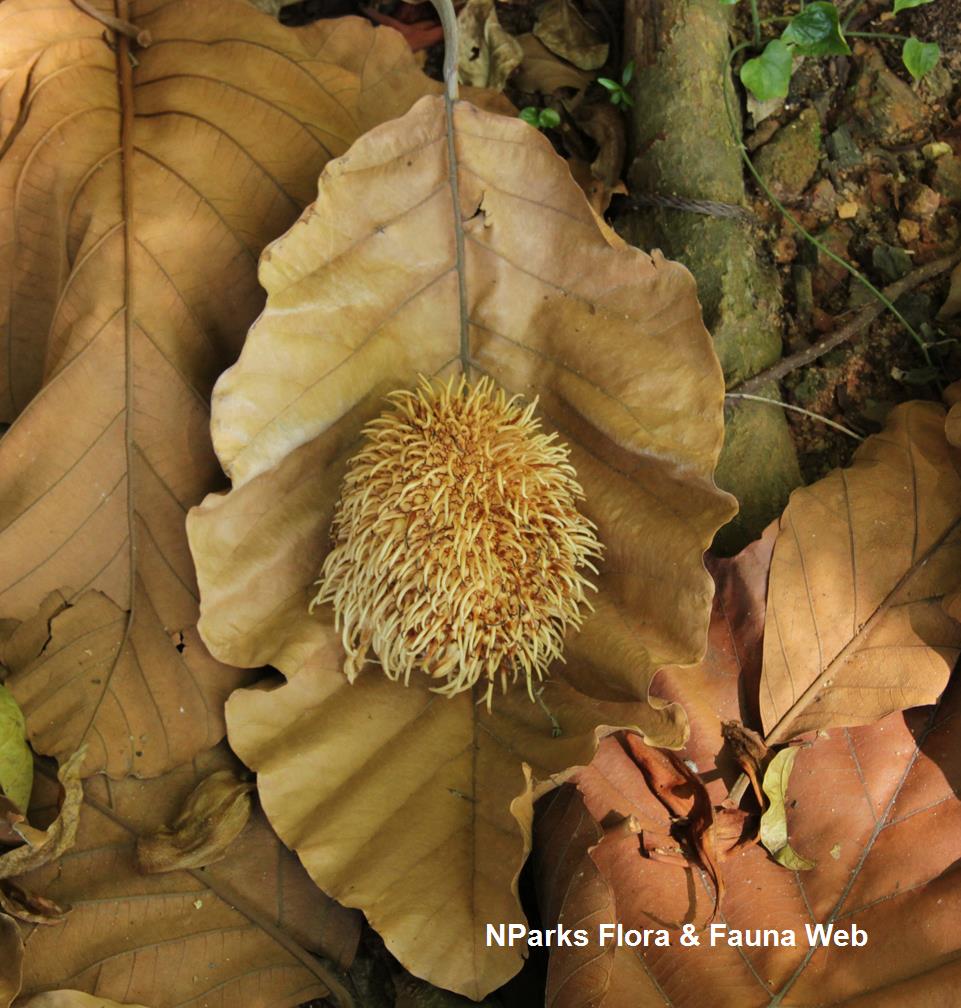
| Flowers | Inflorescence occurs at the axillary position. Male inflorescence is subglobose, narrowly ellipsoid to club-shaped (clavate) while female inflorescence is subglobose to ellipsoid. |
| Fruit | Fruit is subglobose, up to 3 – 4 cm diameter, and can be sparsely or densely covered with velvety hairs. |
| Habitat | It is found in rainforest, up to 1600 m altitude. |
| Associated Flora | Flowers are pollinated by insects. |
| Cultivation | t can be propagated by seed. |
| Etymology | The genus epithet Artocarpus comes from the Greek words 'artos', meaning bread and 'karpos', meaning fruit. |
Fauna, Pollination and Dispersal
| Pollination Method(s) | Biotic (Fauna) |
|---|
Plant Care and Propagation
| Light Preference | Full Sun |
|---|---|
| Water Preference | Moderate Water |
| Plant Growth Rate | Moderate |
Foliar
| Foliage Retention | Evergreen |
|---|---|
| Mature Foliage Colour(s) | Green |
| Foliar Attachment to Stem | Petiolate |
| Foliar Apex - Tip | Acuminate, Caudate, Acute, Obtuse, Rounded |
| Foliar Base | Cuneate, Rounded / Obtuse |
Non - Foliar and Storage
| Root Type | Underground |
|---|
Floral (Angiosperm)
| Flower Grouping | Cluster / Inflorescence |
|---|---|
| Flower Location |
Fruit, Seed and Spore
| Mature Fruit Texture(s) | Velvety / Furry / Tomentose |
|---|
References
| References | Berg, C.C., Corner, E.J.H. & Jarrett, F.M. (2006). Moraceae – Genera other than Ficus. Flora Malesiana, ser. 1, Seed Plants, vol. 17, pt. 1. Leiden: Nationaal Herbarium Nederland. |
|---|
Image Repository
Others
| Master ID | 34413 |
|---|---|
| Species ID | 8826 |
| Flora Disclaimer | The information in this website has been compiled from reliable sources, such as reference works on medicinal plants. It is not a substitute for medical advice or treatment and NParks does not purport to provide any medical advice. Readers should always consult his/her physician before using or consuming a plant for medicinal purposes. |
_lowres.jpg)
_lowres.jpg)
_lowres.jpg)