






Back
Anthurium polyschistum R.E.Schult. & Idrobo
| Family Name: | Araceae |
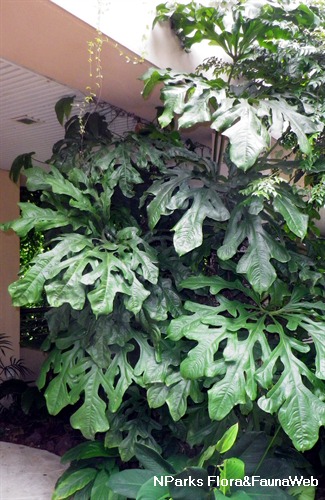
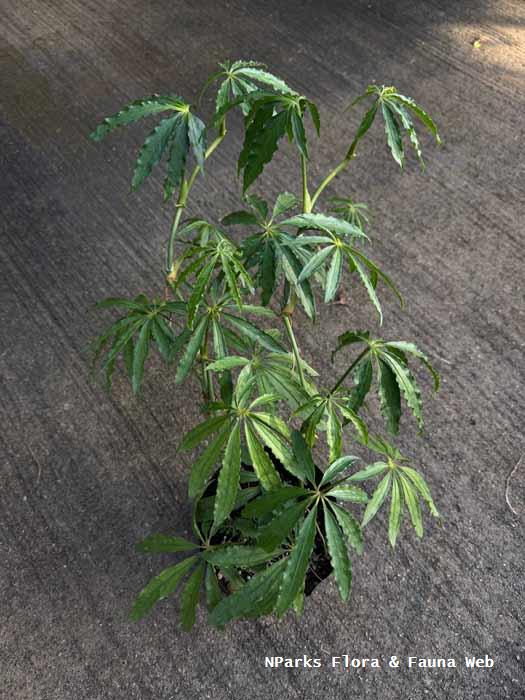
Anthurium polyschistum is a slender, creeping or climbing aroid native to Colombia, Ecuador & northeastern Bolivia. It produces deeply lobed palmate leaves with 11–15 linear, elliptic or ovate wavy-margined lobes. This plant prefers semi-shade, moist, well-draining media, and high humidity.


Name
Classifications and Characteristics
| Plant Division | Angiosperms (Flowering Seed Plants) (Monocotyledon) |
|---|---|
| Plant Growth Form | Climber, Creeper |
| Lifespan (in Singapore) | Perennial |
| Mode of Nutrition | Autotrophic |
Biogeography
| Native Distribution | Colombia, Ecuador & northeastern Bolivia |
|---|---|
| Native Habitat | Terrestrial (Primary Rainforest) |
| Preferred Climate Zone | Tropical |
| Local Conservation Status | Non-native (Horticultural / Cultivated Only) |
Description and Ethnobotany
| Growth Form | It is a slender, herbaceous, creeper, root climber or hemi-epiphyte. |
|---|---|
| Roots | Adventitious roots aid in climbing up surfaces and provide support. |
| Foliage | The leaves are palmatisect (palmately lobed with lobes almost extending to the base) with 11–15 linear, elliptic or ovate lobes, each being 8–15 cm long × 5-15 mm wide. The petiole (leaf stalk) is smooth or shallowly grooved, giving it a C-shaped cross-section. Cataphylls (scale leaves) are 3–4 cm long and triangular in shape. The leaflet margins can be entire or wavy. |
| Stems | The stem is smooth, green and thin (5–7 mm thick). The internodes can be relatively long, measuring 6–10 cm. |
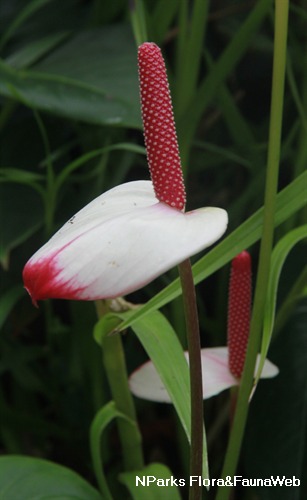
| Flowers | The inflorescence is a slender, green spadix (6–14 cm long × 3–6 mm thick) subtended by a green, lance-shaped spathe. The peduncle (inflorescence stalk) is green and 8–28 cm long. |
| Fruit | The fruit is an upside-down egg-shaped, wine-coloured berry. This species rarely fruits in cultivation. |
| Habitat | It can be found in tropical rainforests from 0 to 100 m above sea level. |
| Cultivation | This species grows well in semi-shaded conditions with moist, well-drained soil. Maintain high humidity and avoid strong winds. It can be propagated by cuttings. |
| Etymology | The genus Anthurium is Greek for 'flower-tail', which refers to the tail-like spadix. The specific epithet polyschistum is derived from the Greek poly "much" and chistum, "cleft" or "divided," referring to the palmatisect leaves. |
Landscaping Features
| Desirable Plant Features | Ornamental Foliage |
|---|---|
| Landscape Uses | Parks & Gardens, Small Gardens, Indoor Plant, Vertical Greenery / Green Wall, Container Planting |
| Thematic Landscaping | Naturalistic Garden |
Plant Care and Propagation
| Light Preference | Semi-Shade |
|---|---|
| Water Preference | Moderate Water, Occasional Misting |
| Plant Growth Rate | Moderate to Slow |
| Rootzone Tolerance | Easy to Grow, Moist Soils, Well-Drained Soils |
| Maintenance Requirements | Moderate |
| Pest(s) | Chewing Insects |
| Propagation Method | Stem Cutting (Herbaceous) |
Foliar
| Foliage Retention | Evergreen |
|---|---|
| Mature Foliage Colour(s) | Green |
| Mature Foliage Texture(s) | Smooth |
| Prominent Young Flush Colour(s) | Green - Light Green |
| Foliar Modification | Flower/Fruit Bract, Scale-like |
| Foliar Type | Simple / Unifoliate |
| Foliar Arrangement Along Stem | Spiral |
| Foliar Attachment to Stem | Petiolate |
| Foliar Shape(s) | Non-Palm Foliage (Palmate) |
| Foliar Margin | Palmately Lobed, Entire - Wavy / Undulate, Entire |
| Foliar Apex - Tip | Acuminate |
| Foliar Base | Attenuate |
| Typical Foliar Area | Microphyll ( 2.25cm2 - 20.25 cm2 ) |
| Leaf Area Index (LAI) for Green Plot Ratio | 3.5 (Shrub & Groundcover - Monocot) |
Non - Foliar and Storage
| Stem Type & Modification | Herbaceous |
|---|---|
| Root Type | Underground (Fibrous Root), Aboveground (Aerial Root) |
Floral (Angiosperm)
| Flower & Plant Sexuality | Bisexual Flowers , Monoecious |
| Flower Colour(s) | Green |
|---|
| Flower Grouping | Cluster / Inflorescence |
| Flower Location | Axillary |
| Flower Symmetry | Radial |
| Inflorescence Type | Spathe & Spadix |
| Ovary Position | Superior / Hypogynous |
| Flowering Habit | Polycarpic |
Fruit, Seed and Spore
| Mature Fruit Colour(s) | Purple |
|---|---|
| Fruit Classification | Simple Fruit |
| Fruit Type | Fleshy Fruit , Berry |
| Seed Quantity Per Fruit | Few (1-5) |
References
| References | Madison, M. (1978). The species of Anthurium with palmately divided leaves. Selbyana, Vol. 2, No. 2/3, pp. 239-282 |
|---|
Image Repository
Others
| Master ID | 34566 |
|---|---|
| Species ID | 8979 |
| Flora Disclaimer | The information in this website has been compiled from reliable sources, such as reference works on medicinal plants. It is not a substitute for medical advice or treatment and NParks does not purport to provide any medical advice. Readers should always consult his/her physician before using or consuming a plant for medicinal purposes. |