New e-publication on biodiversity in Pulau Ubin details two discoveries new to science and 27 new records for Singapore
- Results from extensive biodiversity surveys covering 11 taxonomic groups on Pulau Ubin show several notable findings, including two discoveries new to science and 27 new records for Singapore; new e-publication consolidates findings into a one-stop reference guide.
- The Cryptic Painted Frog (formerly known as Cinnamon Bush Frog) successfully establishes a breeding population on Pulau Ubin, boosting the prospects of the species’ long-term survival.
Singapore, 20 June 2026 – The National Parks Board (NParks) released the first e-publication to document in detail the rich biodiversity of Pulau Ubin today, titled An Update of the Biodiversity in Pulau Ubin. A compilation of findings from comprehensive biodiversity surveys covering 11 taxonomic groups, the e-publication features notable discoveries such as two fauna species that are new to science, and 27 new flora and fauna records for Singapore. NParks also announced that the Cryptic Painted Frog (Nyctixalus crypticus sp. nov.), formerly known as the Cinnamon Bush Frog, has successfully established a breeding population on Pulau Ubin, following its introduction to the island in 2024. These findings underscore the richness of Pulau Ubin's natural heritage and the importance of sustained conservation efforts.
NParks also shared that the Ubin School initiative continues to see encouraging growth, with an expanding network of educators and students deepening their connection to the island's natural environment and cultural heritage. To enable the community to follow the latest updates on the island, new social media pages for the Friends of Ubin Network (FUN)[1] programme were also launched today.
These updates were shared at Ubin Day 2026, which was graced by Guest-of-Honour Second Minister for National Development, Ms Indranee Rajah. She was hosted by Minister of State for National Development & Trade, Mr Alvin Tan. To celebrate the occasion, they joined FUN members and the community to plant 30 trees at Jalan Jelutong earlier today.
Updates on the biodiversity of Pulau Ubin
First e-publication to comprehensively document biodiversity surveys on Pulau Ubin
NParks has compiled the detailed findings of biodiversity surveys covering 11 taxonomic groups, into a new e-publication titled An Update of the Biodiversity in Pulau Ubin – the first of its kind to document the island's biodiversity and provide updated baseline inventories of key taxa of flora and fauna.
Of the 11 taxonomic groups surveyed, one focused on flora while 10 focused on terrestrial fauna across the island. These findings provide a holistic overview of Pulau Ubin's natural heritage that is essential for developing practical and relevant conservation and heritage management strategies for the island.
For more information on the surveys in the e-publication, please refer to the Annex A.
The fauna surveys recorded over 1,300 native species, including 26 new records for Singapore and two species new to science – a spider and a scarab beetle - reflecting the rich biodiversity that Pulau Ubin continues to harbour. Notable among these are the scarab beetle, Anomala sp. aff. matricula (sp. nov.), one of the two species new to science, and a wasp, the Psenulus yoshimotoi, a new record for Singapore and only known to the island.
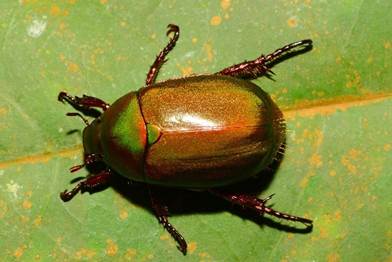
Anomala sp. aff. matricula (sp. nov.)
(Credit: Cheong Loong Fah) | 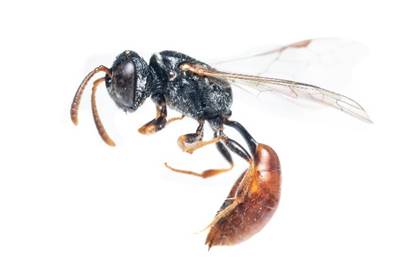
Psenulus yoshimotoi
(Credit: Zestin Soh) |
The flora surveys recorded over 550 native species, increasing the inventory baseline by more than 260 species since the last baseline surveys in 1992 and 2003. Among the findings is the first record of the Ficus subulata in Singapore, which was found growing in several small patches of secondary forest on Pulau Ubin. The surveys also documented several Critically Endangered species, notably Actinoscirpus grossus, which had been presumed Nationally Extinct until its rediscovery in 2023 prompted an update to its conservation status, and a small population of the Critically Endangered orchid Thrixspermum amplexicaule.
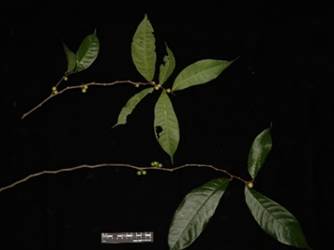
Ficus subulata
(Credit: Cerlin Ng, NParks Flora & Fauna Web)
| 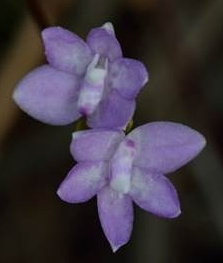
Thrixspermum amplexicaule
(Credit: NParks) |
The e-publication An Update of the Biodiversity in Pulau Ubin has been published online, now accessible on Pulau Ubin’s webpage: https://file.go.gov.sg/epub-ubin-2026.pdf
For more information on the notable species discovered from surveys in the e-publication, please refer to the Annex B.
Successful establishment of a breeding population of the Cryptic Painted Frog
Listed as Vulnerable in the Singapore Red Data Book, the Cryptic Painted Frog (Nyctixalus crypticus sp. nov.) is a nocturnal rainforest species that was previously confined to the Bukit Timah and Central Catchment Nature Reserves and their surrounding Nature Parks. As part of NParks' Species Recovery Programme, the species was successfully introduced into the Singapore Botanic Gardens between 2017 and 2018. Conservation efforts were then extended to Pulau Ubin in 2024. With assistance from members of the Herpetological Society of Singapore (HSS), the Cryptic Painted Frog tadpoles were introduced at two sites on the island in June 2024, and March 2025, supported by artificial phytotelm[2] habitats. Adult frogs were also collected and translocated from the Nature Reserves on the mainland to Pulau Ubin in July 2025.
In August 2025, NParks observed four Cryptic Painted Frog tadpoles in one artificial phytotelm, alongside a clutch of eggs in another phytotelma, indicating that the adult frogs from the introduced batch of tadpoles were adapting well to their new habitat and breeding successfully.
The first Ubin-bred Cryptic Painted Frog was subsequently observed in October 2025, marking an expansion of the species’ distribution in Singapore. NParks has since more than doubled the number of artificial phytotelms on the island to further support the population.
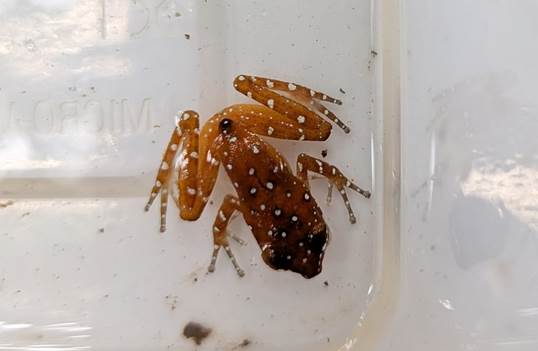
First Ubin-bred Cryptic Painted Frog (Credit: NParks)
The positive trajectory was further affirmed in April 2026, when a survey recorded a total of 31 tadpoles in the various phytotelms, up from 12 tadpoles in October 2025, offering an encouraging outlook for the species’ long-term survival. As an indicator of ecosystem health, the Cryptic Painted Frog’s successful introduction on Pulau Ubin also provides valuable insights into the condition of the island's habitats.
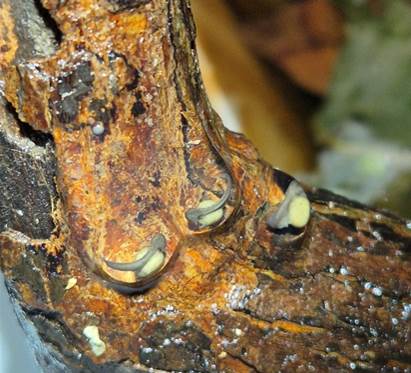
Developing embryos of the
Cryptic Painted Frog (Credit: NParks) | 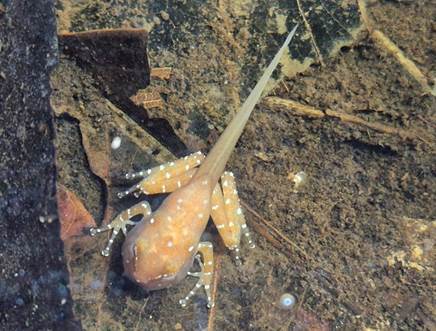
Froglet of the Cryptic Painted Frog
(Credit: NParks) |
A research project to acoustically monitor the calling patterns of the Cryptic Painted Frog with the aim of better understanding the species' behaviour on the island is currently being conducted by a group of youths from NParks’ Youth Stewards for Nature (YSN) programme. With reference calls provided by HSS, the project seeks to establish baseline calling patterns for the species and examine how calling activity relates to environmental conditions and indicators of breeding, such as the presence of egg clutches.
For more information about the Species Recovery Efforts for the Cryptic Painted Frog, please refer to Factsheet A.
Updates on the Ubin School initiative
The Ubin School initiative, first rolled out in 2024, has engaged over 300 students and 20 schools to date. Building on the success of the pilot with biology student teachers from the National Institute of Education (NIE), the initiative has since been expanded to include Ministry of Education (MOE) schools as well as Education Officers from MOE HQ, bringing the total number of educators engaged to over 200. The programme with NIE biology student teachers has also become an annual arrangement, with the most recent learning journey in February 2026.
This allows student teachers to familiarise themselves with the logistical and pedagogical aspects of planning and conducting educational activities on Pulau Ubin, so that they can bring a deeper understanding of the island’s rich biodiversity, heritage and culture into their future classrooms.
Beyond student teachers, several schools that have taken part in learning journeys on Pulau Ubin have also translated their experiences into action. By engaging educators and students not just as visitors but as contributors, the Ubin School initiative fosters the community stewardship that is central to Singapore's City in Nature vision.
Launch of Friends of Ubin Network official social media pages
To give the public greater access to updates on the Friends of Ubin Network (FUN) initiatives and key visitor information on Pulau Ubin, the community-led Pesta Ubin Facebook and Instagram pages have been refreshed and will be launched as the official FUN social media pages today. Members of the public can follow community-led initiatives and stay informed about activities on the island throughout the year. The pages seek to raise awareness of Pulau Ubin’s vibrant community and foster greater community involvement in the conservation and stewardship of the island.
Facebook: https://www.facebook.com/pulauubinday, Instagram: https://www.instagram.com/pesta.ubin
Ubin Day 2026
Ubin Day is a culmination of Pesta Ubin, a festival organised by NParks, FUN members and the community. First held in 2002, this is the 15th edition of Ubin Day, celebrating the different facets of the island. During the two-week-long Pesta Ubin this year, more than 1,000 participants took part in close to 40 activities on Pulau Ubin. Participants learnt more about Pulau Ubin’s rich biodiversity and natural history through themed guided walks for photography and birdwatching, kampung heritage tours, an art workshop, and more. For more information on Pesta Ubin, please visit https://go.gov.sg/pestaubin.
- End -
[1] FUN was formed in 2014 and comprises community stakeholders including nature enthusiasts, architects, historians, students, bloggers, Ubin villagers, educators, members from the nature and heritage communities, as well as representatives from recreational groups.
[2] Phytotelms are water-filled cavities in large trees or fallen rotting logs that are rare microhabitats in the forest.
Annex A – Details on the surveys in the e-publication
Note: Nine of the 11 groups studied (details tabulated below) were part of the Comprehensive Ubin Biodiversity Survey (CUBS), which commenced in January 2018.
| S/N | Taxon | Paper | Duration of survey | Remarks |
|---|
| 1 | Vascular plants | An update on the vascular flora of Pulau Ubin, Singapore | 2002 – 2024 | - |
| 2 | Beetles | On the coleopteran fauna of Pulau Ubin, Singapore | 2018 – 2021 | - |
| 3 | Bees, wasps and ants | Bees, wasps, and ants of Pulau Ubin, Singapore
(Insecta: Hymenoptera) | 2018 – 2019 | Part of CUBS |
| 4 | Butterflies | Butterfly survey of Pulau Ubin, Singapore | 2018 – 2020 |
| 5 | Crickets, grasshoppers and katydids | Orthoptera in Pulau Ubin: unravelling diversity using systematic sampling and qualitative boat surveys | 2018 – 2019 |
| 6 | Dragonflies and damselflies | Diversity, distribution and habitat characteristics of odonates (Insecta: Odonata) in Pulau Ubin, Singapore | 2018 – 2019 |
| 7 | Leaf insects and stick insects | Stick and leaf insects in Pulau Ubin, Singapore, in 2018–2020 | 2018 – 2020 |
| 8 | Moths | Moths of Pulau Ubin, Singapore – a first assessment highlights many new records for the island and Singapore | 2018 – 2021 |
| 9 | Spiders | Diversity of Spiders (order Aranae) in Pulau Ubin, Singapore | 2018 – 2020 |
| 10 | Birds | The significance of Pulau Ubin for Singapore’s avifauna, with a focus on species of conservation concern | 2018 – 2019 |
| 11 | Amphibians, reptiles and mammals | Updated Inventory of Amphibians, Reptiles and Mammals of Pulau Ubin, Singapore | 2018 - 2021 |
Annex B – Notable discoveries from the e-publication
New to science
| S/N | Taxon | Species |
|---|
| 1 | Araneae (Spiders) | Piranthus kohi |
| 2 | Coleopteran (Beetles) | Anomala sp. aff. matricula (sp. nov.) |
New to Singapore
| S/N | Taxon | Species |
|---|
| 1 | Araneae (Spiders) | Serendib muadai |
| 2 | Araneae (Spiders) | Meotipa picturata |
| 3 | Araneae (Spiders) | Hersilia sundaica |
| 4 | Araneae (Spiders) | Tetragnatha ceylonica |
| 5 | Araneae (Spiders) | Phintella lepidus |
| 6 | Araneae (Spiders) | Dipoena turriceps |
| 7 | Lepidoptera (Moths) | Zeuzera indica |
| 8 | Lepidoptera (Moths) | Avatha garthei |
| 9 | Lepidoptera (Moths) | Tetridia vinacealis |
| 10 | Lepidoptera (Moths) | Corgatha sp. nr. Nigripalpis |
| 11 | Coleopteran (Beetles) | Colpodes sp. |
| 12 | Coleopteran (Beetles) | Platydema nuciferae |
| 13 | Coleopteran (Beetles) | Derosphaerus aeruginosus |
| 14 | Coleopteran (Beetles) | Euhemicera kaszabi |
| 15 | Coleopteran (Beetles) | Euhemicera hayashii |
| 16 | Coleopteran (Beetles) | Haplosomoides plicata |
| 17 | Coleopteran (Beetles) | Monolepta laticornis |
| 18 | Coleopteran (Beetles) | Dejanira quadripunctata |
| 19 | Coleopteran (Beetles) | Rondibilis lineaticollis |
| 20 | Coleopteran (Beetles) | Similosodus cf. flavicornis |
| 21 | Coleopteran (Beetles) | Euplynes cf. aurocinctus |
| 22 | Coleopteran (Beetles) | Phaedis purpureostriatus |
| 23 | Hymenoptera (Bees, wasps, and ants) | Nomada adusta |
| 24 | Hymenoptera (Bees, wasps, and ants) | Psenulus yoshimotoi |
| 25 | Vascular flora | Ficus subulata |
| 26 | Odonata (Dragonflies) | Indothemis carnatica |
| 27 | Lepidoptera (Butterflies) | Danaus affinis malayanus |
About National Parks Board (NParks)
The National Parks Board (NParks) is responsible for enhancing and managing the urban ecosystems of our City in Nature. We are the lead agency for greenery, biodiversity conservation, and wildlife and animal health, welfare and management. We also work closely with the community to enhance the quality of our living environment.
NParks manages parks, nature reserves, the Singapore Botanic Gardens, Pulau Ubin and the Sisters' Islands Marine Park. Adding to this is the extensive network of Nature Ways, and Park Connector Network that links major parks, nature areas and residential estates island-wide. NParks also manages millions of trees, including those along roads and in our parks, gardens and state land.
NParks has developed an urban biodiversity conservation model, which aims to conserve representative ecosystems in land-scarce Singapore. NParks also monitors and coordinates measures to enhance the presence of biodiversity in our urban landscape.
The Animal & Veterinary Service, a cluster within NParks, is the main touch-point for animal-related issues, as well as the first responder for animal-related feedback. By improving the standards of the animal and veterinary sectors, we aim to safeguard animal health and welfare in Singapore.
NParks is working closely with partners in the landscape, horticulture, veterinary and animal sectors to increase productivity, and provide training for all levels of the workforce. Enhancing competencies of the industry will support Singapore’s vision of being a City in Nature.
For more information, visit www.nparks.gov.sg and www.facebook.com/nparksbuzz
 A Singapore Government Agency WebsiteHow to identify


 ) or https:// as an added precaution. Share sensitive information only on official, secure websites.
 Related news


