
Facts & Figures
FY2025
(AS OF 31 MARCH 2026)
NParks operations
NParks Staff Strength
- 1,265
- Staff strength as at 30 September 2025

Plant Health
- 43,885
- Import permits issued
- 66
- Post-entry inspections conducted
Regional Parks and Greenery Maintained by NParks
- 90
- Number of regional parks
- 326
- Number of neighbourhood parks
- 424km
- Total mileage of park connectors maintained
Total area maintained
- 3,368.10
- Parks, playgrounds, open spaces, fitness corners and park connectors*
- 3,347
- Nature reserves (gazetted)
- 42
- Istana and Parliament House grounds
- 2,015.77
- Roadside greenery
- 4,656.86
- State land greenery as of Mar 2025**
* Excludes Bukit Timah Nature Reserve, Central Catchment Nature Reserve, Sungei Buloh Wetland Reserve and Labrador Nature Reserve which have been computed under “Nature Reserves”.
** Greenery on vacant land taken over from agencies
Animal Health and Welfare
Licences, Permits, and Health Certificates Issued for Animal Trade
 5,130
- Animals (excluding livestock)
 292
- Biologics
 50
- Birds
 1,778
- Products (blood, sera, urine, clinical specimens)
 5,547
- Ornamental fish (import permits)
 2,946
- Ornamental fish (export health certificates)
Total15,743
Dog Licensing and Enforcement
- ~93,000
- Dog licences issued
- ~15,000
- New licences issued
- ~78,000
- Renewed licences (includes multi-year licences)

Cat Licensing and Enforcement
- ~28,000
- Cat licences issued
- ~28,000
- New licences issued
Cat licensing was introduced in September 2024 as part of the Cat Management Framework.

Licensing Veterinarians and Veterinary Centres
 681
- Number of veterinarians
 119
- Number of veterinary centres
Types of Animal Disease Surveyed in Breeding Facilities
- 4
- Ornamental bird breeders surveyed
- Avian influenza
- Newcastle disease
- 38
- Ornamental fish breeders surveyed
- Aeromonas salmonicida
- Chytrid fungus
- Epizootic haematopoietic necrosis virus
- Infectious haematopoietic necrosis virus
- Infectious spleen and kidney necrosis virus
- Koi herpes virus
- Megalocytivirus
- Spring viraemia of carp virus
- Viral haemorrhagic septicaemia
- White spot disease
NParks’ Animal Biosurveillance Programmes
- Aeromonas salmonicida
- African swine fever
- Anaplasmosis
- Antimicrobial resistance
- Avian influenza
- Babesiosis
- Bluetongue
- Bovine tuberculosis
- Brucellosis
- Campylobacteriosis
- Canine distemper
- Chytridiomycosis
- Classical swine fever
- Contagious bovine pleuropneumonia
- Coronaviruses
- Cryptococcosis
- Cryptosporidiosis
- Escherichia coli O157:H7
- Ehrlichiosis
- Epizootic ulcerative syndrome
- Foot and mouth disease
- Heartworm
- Koi herpes virus
- Leishmaniosis
- Leptospirosis
- Lyme disease
- Newcastle disease
- Nipah virus disease
- Parvovirus
- Plasmodium knowlesi
- Psittacosis
- Rabies
- Rickettsial disease
- Spring viraemia of carp virus
CUGE Training Programmes
The Centre for Urban Greenery and Ecology (CUGE) was established by NParks as a regional centre of excellence to advance an urban and green living environment, as well as a one-stop training and knowledge hub in urban greenery and ecology.
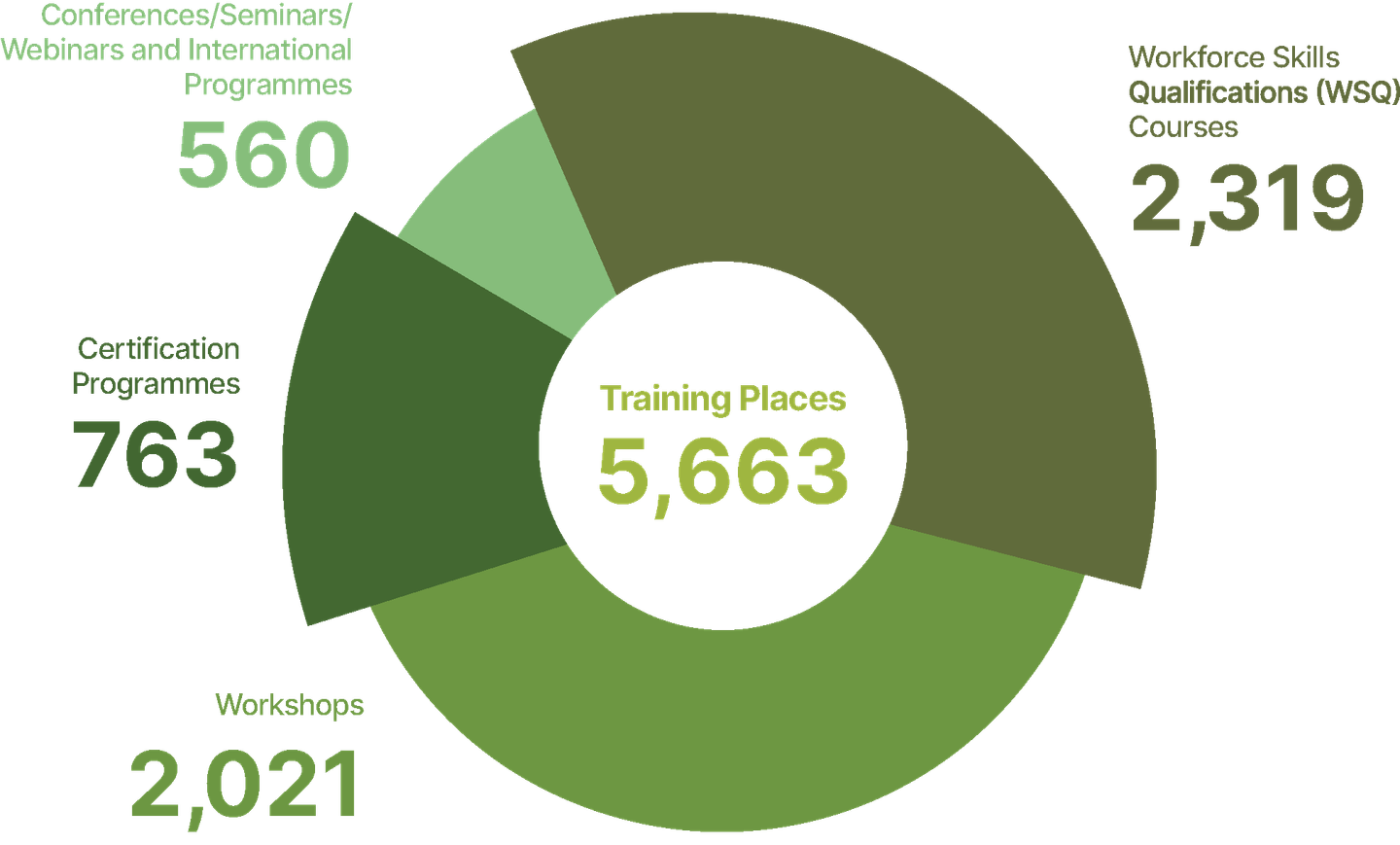
Workforce Skills Qualification (WSQ) Courses
WSQ Courses for Landscape Workers#
(Level 1)
- Plant Health Management and Disease Control
- Plant Identification
- Plant Pruning
WSQ Courses for Landscape Supervisors#
(Level 3)
- Hazards and Risk Control, and Policy Management
- Plant Health Management and Disease Control
- Plant Identification
- Soil and Media Assessment and Remediation
WSQ Courses for Landscape Technicians#
(Level 2)
- Chainsaw Operation and Maintenance
- Hazards and Risk Control, and Policy Management*
- Horticultural Chemical Usage*
- Plant Health Management and Disease Control*
- Plant Propagation and Production
- Plant Pruning*
- Soil and Media Assessment and Remediation
- Tree Climbing and Aerial Rescues
- Tree Health Management
- Tree Pruning
- Turf Maintenance*
WSQ Courses for Landscape Managers
(Level 4)
- Budgeting
- Environmental Management in Landscape Operations
- Hazards and Risk Control, and Policy Management
- Horticultural Chemical Usage
- Horticultural Maintenance Programme
- Plant Health Management and Disease Control
- Project Management
- refers to the Approved list of Courses for PWM Pathway for Landscape
Workshops
- A Guide to Grow Healthy Plants
- Advanced Tree Climbing with SRS
- Advanced Tree Decay Assessment
- Butterfly Gardens — Ecology to Practical Design
- Designing a Nature Playgarden
- Designing Therapeutic Horticulture Programmes for Children with Special Needs
- Dragonflies and Damselflies: Ecology, Conservation and Wetlands Creation
- Edible Gardens in Our City in Nature
- Formative Pruning for Young Trees
- Fundamental Tree Management Programme
- Introduction to Contemplative Landscape Model Design Application
- Introduction to Therapeutic Horticulture and Therapeutic Garden
- Landscape Safety Orientation Programme (Bengali)
- Landscape Safety Orientation Programme (Chinese)
- Landscape Safety Orientation Programme (English)
- Landscape Safety Orientation Programme (Tamil)
- Playground Safety Management Workshop
- Pneumatic Blowpipe and Dart Gun New Operator Course
- Pneumatic Blowpipe and Dart Gun Refresher Course
- Refresher for ISA Arborist
- Resistance Drilling Equipment
- Therapeutic Garden Design
- Therapeutic Horticulture for Seniors
- Tree Decay — The Fundamentals
- Tree Felling
- Tree Inspection — Advanced
- Tree Inspection — Failure Documentation and Analysis
- Tree Inspection — The Basics
- Trees and Construction — Understanding the Arboriculture Impact
- Tropical Tree Identification, Biology and Physiology
- Urban Greenery Management
- Understanding Soil and Its Importance to Plants
Certification Programmes
- Animal Health Professional Certification Programme
- Animal Health Professional Certification Programme (Refresher)
- Animal Management Certification Programme — Basic
- Animal Management Certification Programme Intermediate Electives — Mammals (Refresher)
- Animal Management Intermediate Elective — Mammals
- Animal Management Intermediate Elective — Reptiles
- Certificate in Basic Plant Recognition Programme (Module 1 to Module 10)
- Certificate in Field Epidemiology (Refresher)
- Certified Parks Manager
- Certified Practising Horticulturist Programme
- Chainsaw Operations and Maintenance (Refresher)
- ISA Certified Arborist Preparatory Programme
- ISA Tree Risk Assessment Qualification (TRAQ) Renewal Online
- ISA Tree Risk Assessment Qualification Programme
- Pneumatic Blowpipe and Dart Gun Refresher Course
- Tree Climbing and Aerial Rescue Level 2 (Refresher)
Seminars/Webinars and International Programmes
- Managing Nature in Development Webinar for Development Agencies
- Managing Nature in Development Webinar for Qualified Professionals
- The Physiological Costs Of Group Movement And Collective Decision-Making
National Day Awards
Public Administration Medal (Silver)
- Dr Chang Siow FoongDirector-General / Animal and Veterinary Service Cluster
- Ms Kwok Swee Cheng JessicaGroup Director / Industry Standards and Regulatory & Enforcement and Investigation
Public Administration Medal (Bronze)
- Dr Chee Lijun, Diana MarieDirector / Animal & Vet Programme OfficeAnimal and Veterinary Policy & Planning
- Ms Koh Ah ChinDeputy Financial Controller (Budget & Accounts)Finance and Procurement
Commendation Medal
- Ms Yeo Chin Sze JancyDeputy Director / Garden City FundCommunications and Community Engagement
- Mr Lim Hann YawDeputy Director / ConservationConservation
- Ms Azza Dina binte Ab AzizSenior Manager / Community in Bloom and EngagementHorticulture and Community
- Mr Lim Chung FeeDeputy Director / Corporate Strategy & PlanningCorporate Strategy and Planning
- Ms Koh Shu YuenSenior Manager / StreetscapeStreetscape
- Ms Sim Bee LanSenior Manager / ParksParks Central
Efficiency Medal
- Ms Seah Wee HuangSenior Executive / ProcurementFinance and Procurement
- Mr Wong Keng KiangSenior Technical OfficerIndustry Standards and Regulatory
- Ms Ho Cheng HweiSenior Officer / HortParkHorticulture and Community
- Ms Lim Yn SheaoSenior Officer / Graphic DesignParks Development and Design
- Ms Hasnah binte IbrahimInvestigation OfficerEnforcement and Investigation
Long Service Medals
- Ms Sophianne Mohamad AraibExecutive DirectorJurong Lake Gardens, HortPark and Plant Science & HealthGroup DirectorJurong Lake Gardens & HortPark
- Ms Lim Yen NgohSenior Manager / Nursery ManagementHorticulture and Community
- Mr Pan Chyau YeongSenior Manager / ITInformation Technology
- Mr Azman bin AhmadSenior Officer / StreetscapeStreetscape
- Mr Ng Wee Liang DannySenior ExecutiveCommunity Animal Management
- Mr Tong Weng YoongAdmin ExecutiveCentre for Animal and Veterinary Sciences
- Mr Lim Kiat Fong DennisCoordinating Director / Festival, Events and Exhibitions & Visitor Management and SecuritySingapore Botanic Gardens
- Mr Aw Lek Meng BenjaminSenior Executive / Visitor ServicesSingapore Botanic Gardens
- Mr Poh Yew KwangDirector / Industry Development and StandardsIndustry Standards and Regulatory
- Ms Lim May YenDeputy Director (Garden City Fund & Assets)Finance and Procurement
- Ms Tan Tiew KhimManager / Greenery and Development PlanningPolicy & Planning
- Mr Rajendran s/o ThangayanAssistant Officer / Conservation (Outreach)Conservation
Awards and Accolades
Excellent Service Award
Attractions
16 Star, 8 Gold and 7 Silver
MND Minister’s Award 2025
Bidadari Park
Municipal Services Awards 2025
Team Category
Pigeon Management Project
Road Repurposing Projects (Tuan Sheng and Choa Chu Kang Terrace)
Certificate of Commendation
(Team Category)
Tampines Boulevard Project
Certificate of Appreciation (Team Category)
Joint Ops at Sims Ave Park Connector and Guillemard Road Open Space
Parks North East — Punggol Fire Station Collaboration Team
Pek Kio Park
Pet Cat Sterilisation Support Programme
PST Awards 2025
Dare to Do Award
Leveraging AI Analytics for Wildlife Monitoring
GreenGov.SG Targets and Performance
NParks’ sustainability efforts are guided by the GreenGov.SG initiative, which establishes clear, whole-of-government targets for the public sector. We are committed to not only accelerating our progress toward these goals8 but also pioneering new strategic measures to ensure we play our part in Singapore’s national decarbonisation and sustainability agenda.
Greenhouse Gas Emissions
Target: Peak emissions around 2025 and achieve net zero emissions around 2045
| Measure | FY2022 | FY2023 | FY2024 | FY2025 |
|---|---|---|---|---|
| Fuel consumption from corporate vehicle usage (L) | NA9 | Diesel: 23,423; Petrol: 11,633 | Diesel: 16,591; Petrol: 17,818 | Diesel: 15,249; Petrol: 15,823 |
| Direct Scope 1 emissions (t CO₂e)[calculated from fuel consumption from corporate vehicle usage] | 91 | 86 | 96 | |
| Indirect Scope 2 emissions (t CO₂e)[calculated from NParks’ electricity consumption] | 11,219 | 11,817 | 11,28710 | 10,683 |
| Total emissions intensity from Scope 2 emissions (t CO₂e/sqm) | 0.077 | 0.077 | 0.059 | 0.046 |
- Energy, water and waste data from FY2018 to FY2023 has been restated.
- Data not available for FY2022, as NParks only began tracking fuel consumption from corporate vehicle usage in FY2023.
- We have used the 2024 electricity Grid Emissions Factor of 0.402 kg CO₂/kWh as published by the Singapore Energy Market Authority.
Electricity Consumption
(GRI 302-1, 302-3)
Target: 10% reduction in Energy Utilisation Index (EUI) by 2030, compared to an average of 2018–2020 levels
| Measure | 2030 target | Baseline (average of 2018–2020) | FY2022 | FY2023 | FY2024 | FY2025 |
|---|---|---|---|---|---|---|
| EUI (kWh/sqm)11 | 155.13 | 172.37 | 183.74 | 186.43 | 146.56 | 115.01 |
| Total electricity consumption (kWh) | NA | 23,642,552 | 27,231,838 | 28,813,474 | 28,076,987 | 26,573,947 |
| Total building electricity consumption (kWh)12 | 10,005,478 | 12,240,388 | 13,902,235 | 11,201,882 | 8,845,725 |
- EUI is calculated for NParks’ standard infrastructure with meaningful gross floor area (GFA), which includes offices and facilities but excludes open public spaces such as parks.
- Total building electricity consumption is similarly calculated for NParks’ standard infrastructure with meaningful GFA.
Water Consumption
(GRI 303-3, 303-4, 303-5)
Target: 10% reduction in Water Efficiency Index (WEI) by 2030, compared to an average of 2018–2020 levels
| Measure | 2030 target | Baseline (average of 2018–2020) | FY2022 | FY2023 | FY2024 | FY2025 |
|---|---|---|---|---|---|---|
| WEI (L/person/day)13 | 239.21 | 265.78 | 225.91 | 400.78 | 361.95 | 372.45 |
| Total water consumption (kL) | NA | 787,026 | 1,014,198 | 974,001 | 887,746 | 1,078,738 |
| Total building water consumption (kL)14 | 363,811 | 292,324 | 241,218 | 209,230 | 230,697 |
- WEI is calculated for NParks’ standard infrastructure with meaningful gross floor area (GFA), which includes offices and facilities but excludes open public spaces such as parks.
- Total building water consumption is similarly calculated for NParks’ standard infrastructure with meaningful GFA.
Waste Generation
(GRI 306-3)
Target: 30% reduction in Waste Disposal Index (WDI) by 2030, compared to 2022 levels
| Measure | 2030 target | Baseline (FY2022) | FY2023 | FY2024 | FY2025 |
|---|---|---|---|---|---|
| WDI (kg/person/day)15 | 0.266 | 0.383 | 0.279 | 0.239 | 0.260 |
| Total waste (kg) | NA | 197,531 | 165,750 | 136,296 | 163,387 |
- NParks’ total waste and WDI are calculated based on only the amount of waste generated by NParks’ offices and non-public accessible facilities, as NParks does not have data on the amount of waste generated within parkland, for which disposal is carried out by NEA’s Division of Public Cleanliness (DPC) instead of NParks.
Materiality Assessment
(GRI 2-29, 3-1, 3-2)
In FY2024, NParks conducted a comprehensive materiality assessment to identify the impacts of our activities on the economy, environment, and people. The process comprised four key steps, beginning with the identification of ESG material issues through desktop research, horizon scanning, and peer benchmarking. This was followed by a prioritisation exercise involving stakeholder mapping and engagement through surveys and interviews, drawing on input from 400 survey responses and 16 stakeholder interviews across a broad range of stakeholder groups.
Key considerations included alignment with core national responsibilities, contribution to national strategic priorities, and relevance to NParks’ key organisational functions and management practices. The proposed material topics were subsequently validated by Senior Management and the Board.
For FY2025, Senior Management and the Board conducted an internal review of the 10 material topics identified in FY2024, assessing their continued relevance against NParks’ current strategic context and stakeholder priorities. The topics were reaffirmed as relevant for this reporting year. A comprehensive materiality assessment exercise, including stakeholder engagement, will be conducted once every three years.
A total of 10 material topics were identified from the materiality assessment.
Transforming into a City in Nature
- Nature Conservation
- Veterinary Standards and Animal Management
- Climate Resilience
- Sustainable Resource Management
Building Capacity and Cultivating Connection
- Partnerships, Participation and Park Experiences
- Strategic Alliances
- Talent and Career Development
- Workplace Safety and Well-being
Strengthening Governance and Enabling Innovation
- Good Governance
- Digital Innovation
Beyond our material topics, NParks also tracks other important areas16, including sustainable construction, waste management, and emissions and energy management. While these were assigned a lower priority in the materiality assessment, they remain directly relevant to our operations, and we recognise our accountability for our impacts in these areas. Relevant disclosures are therefore included in this report.
Understanding the risks and opportunities associated with our material topics is equally important to how we manage them. By anticipating potential challenges and identifying opportunities to build resilience, we are better positioned to respond proactively. For more information, please refer to pages 9 to 12 of NParks’ Sustainability Report 2024/2025.
Read the Sustainability Report 2024/2025 (opens in a new tab)- The topics are (1) Sustainable Construction and Waste Management, (2) Emissions and Energy Management, (3) Visitor Experience, (4) Sustainable Procurement, and (5) Data Security and Privacy.
Stakeholder Engagement
(GRI 2-28, 2-29)
NParks recognises that strong partnerships are built through ongoing and meaningful engagement with our stakeholders. Regular interactions foster a sense of place and shared ownership, encouraging communities to play an active role in shaping their living environment.
Stakeholders are identified as individuals or groups who are affected, or may be affected, by NParks’ activities. The table below summarises our key stakeholder groups, with a detailed list of membership associations provided in the Annex.
| Stakeholder Categorisation | Stakeholder Group | Channel of Engagement |
|---|---|---|
| Internal Stakeholders | Employees | Events, surveys, workshops and townhalls to understand needs, while building organisational identity and promoting awareness |
| Board Members | Quarterly meetings to provide strategic oversight and policy direction | |
| Government and Industry Stakeholders | Ministries and Government Agencies | Inter-agency meetings to align policies and initiatives across Whole-of-Government (WOG) |
| Industry Associations | Dialogue sessions and training facilitate feedback on sectoral issues and contributions to national and international policy discussion | |
| Community and Educational Stakeholders | Local Community | Regular engagements and workshops to promote stewardship, collect feedback, and foster collaboration |
| Institutes of Higher Learning (IHL) | Regular meetings and surveys to enable knowledge exchange and develop research collaboration | |
| Environmental and Conservation Partners | International organisations | Annual meetings and conferences to strengthen global conservation efforts and biodiversity policy engagements |
| Wildlife Organisations | Surveys and discussions to provide insights into conservation, animal welfare and wildlife management | |
| Nature Groups | Events and partnerships to support policy refinement and strategic research collaboration | |
| Animal Groups | Regular focus group discussions and engagements to provide practical insights for policy development | |
| Professional and Commercial stakeholders | Veterinary Professionals | Licensing briefings and surveys to promote regulatory compliance and professional development |
| Pet Services and Retail | Focus groups and surveys to ensure regulatory compliance and address operational challenges | |
| Import, Export & Transshipment | Communication platforms and site visits to ensure adherence to licensing and regulatory requirements | |
| Business and Operational Partners | Donors | Regular meetings and events to foster financial and in-kind support while promoting NParks’ vision |
| Tenants | Tenant engagement meetings to align service delivery with operational standards and sustainability goals | |
| Contractors/Suppliers/Service Providers | Surveys and communication to ensure quality control and integration of sustainable practices |