







Back
Monodora myristica (Gaertn.) Dunal
| Family Name: | Annonaceae |
| Synonyms: | Annona myristica Gaertn., Monodora borealis Scott-Elliot, Monodora claessensii De Wild., Monodora grandiflora Benth. |
| Common Name: | African Nutmeg, Jamaica Nutmeg, Calabash Nutmeg, Ehuru |
Name
Classifications and Characteristics
| Plant Division | Angiosperms (Flowering Seed Plants) (Dicotyledon) |
|---|---|
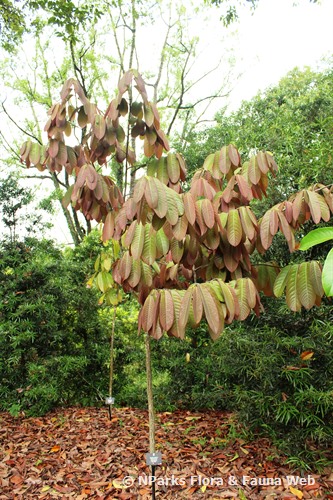
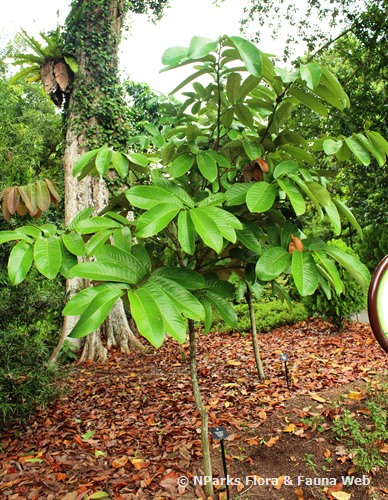
| Plant Growth Form | Tree (Big (>30m), Medium (16m-30m)) |
| Lifespan (in Singapore) | Perennial |
| Mode of Nutrition | Autotrophic |
Biogeography
| Native Distribution | West Africa |
|---|---|
| Native Habitat | Terrestrial |
| Preferred Climate Zone | Tropical |
Description and Ethnobotany
| Growth Form | A medium to large sized tree grows up to 35 m tall. |
|---|---|
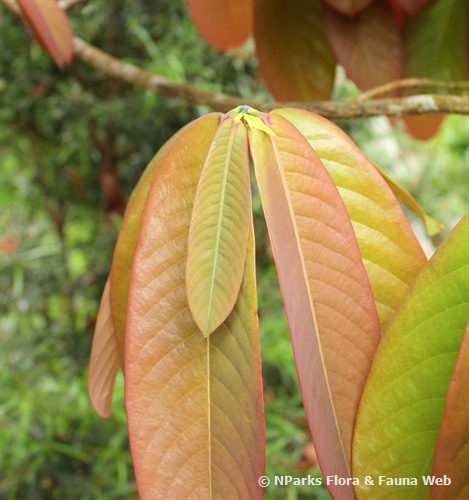
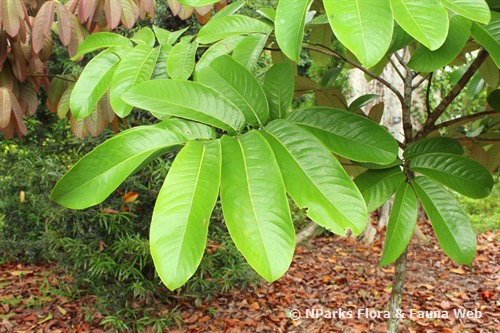
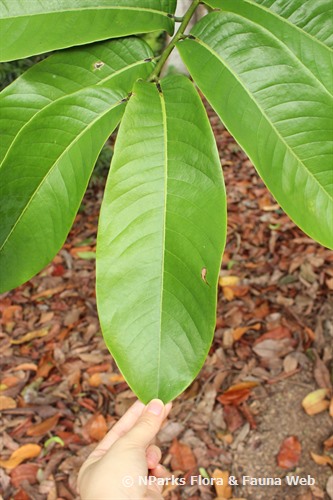
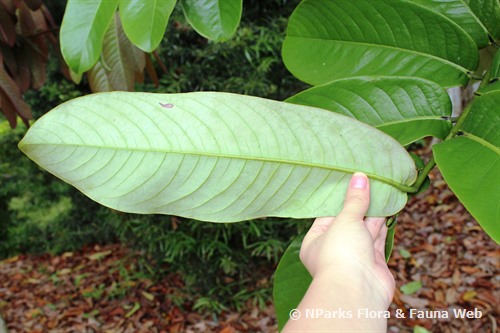
| Foliage | The simple, alternate leaves are oblong to elliptical, measuring up to 45 cm long and 20 cm wide. Upperside (adaxial surface)of the leaf is dark-green, while the underside (abaxial surface) is paler. New leaves are purplish in color. |
| Flowers | The aromatic flowers are pendant with a long pedicle measuring up to 20 cm long. The outer three petals are yellow with red spots and waved edges. The inner three petals form a cone in the center of the flower, paler-yellow with purplish red spots. |
| Fruit | The large and woody fruit is a berry, globose, measuring about 20 cm in diameter. Numerous seeds are embedded in creamy-white pulp which has a sweet scent. |
| Etymology | Monodora means 'only one gift' in Greek, indicating the solitary fruit. myristica is the genus name of the nutmeg, probably alluding that the seeds of this plant have a similar scent and taste of the real nutmeg. |
| Ethnobotanical Uses | Edible Plant Parts : Edible Fruits, Edible Seeds Food (Herb or Spice): Seeds have a scent similar to the nutmeg, and are used to flavor food in African cuisine. Medicinal: Seeds and bark are used in treatments of headache, digestive problems, eye diseases, etc. Timber & Products: The wood is suitable for carpentry works. Others: Seeds are also used to make aromatic necklaces. |
Landscaping Features
| Desirable Plant Features | Ornamental Flowers, Ornamental Foliage, Ornamental Fruits |
|---|---|
| Landscape Uses | Parks & Gardens |
Fauna, Pollination and Dispersal
| Pollination Method(s) | Biotic (Fauna) (Insects (Ant, Beetle, Fly, Thrip, Wasp)) |
|---|---|
| Seed or Spore Dispersal | Biotic (Fauna) |
Plant Care and Propagation
| Light Preference | Full Sun |
|---|---|
| Water Preference | Moderate Water |
| Plant Growth Rate | Moderate |
| Rootzone Tolerance | Moist Soils, Well-Drained Soils |
| Propagation Method | Seed, Sucker, Air-Layering |
Foliar
| Foliage Retention | Evergreen |
|---|---|
| Mature Foliage Colour(s) | Green |
| Prominent Young Flush Colour(s) | Purple |
| Foliar Type | Simple / Unifoliate |
| Foliar Arrangement Along Stem | Alternate |
Floral (Angiosperm)
| Flower Colour(s) | Red, Yellow / Golden |
|---|---|
| Flower Grouping | Solitary |
Fruit, Seed and Spore
| Mature Fruit Colour(s) | Green |
|---|---|
| Mature Seed Colour(s) | Brown |
| Seed Quantity Per Fruit | Numerous (>20) |
Image Repository
Others
| Master ID | 32834 |
|---|---|
| Species ID | 7247 |
| Flora Disclaimer | The information in this website has been compiled from reliable sources, such as reference works on medicinal plants. It is not a substitute for medical advice or treatment and NParks does not purport to provide any medical advice. Readers should always consult his/her physician before using or consuming a plant for medicinal purposes. |