













Back
Fagraea auriculata Jack
| Family Name: | Gentianaceae |
| Common Name: | Pelir Musang, Bira Bira |
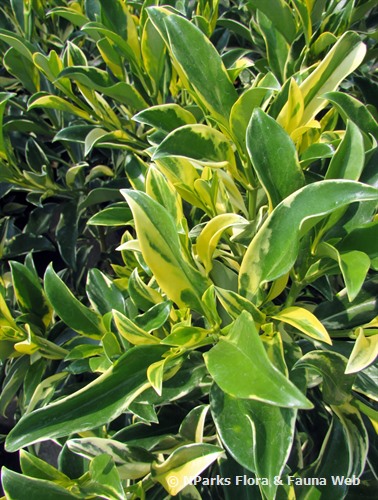
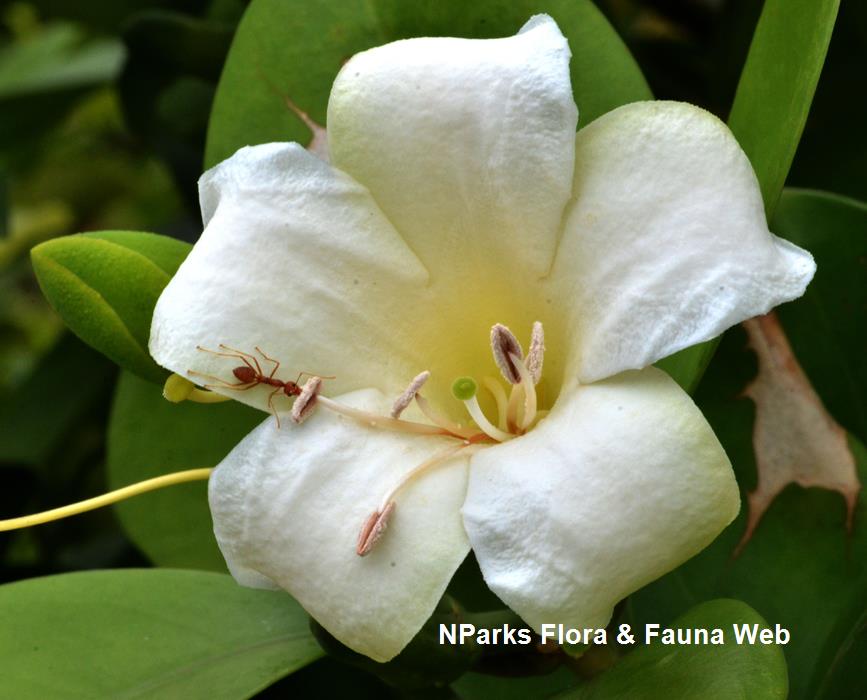
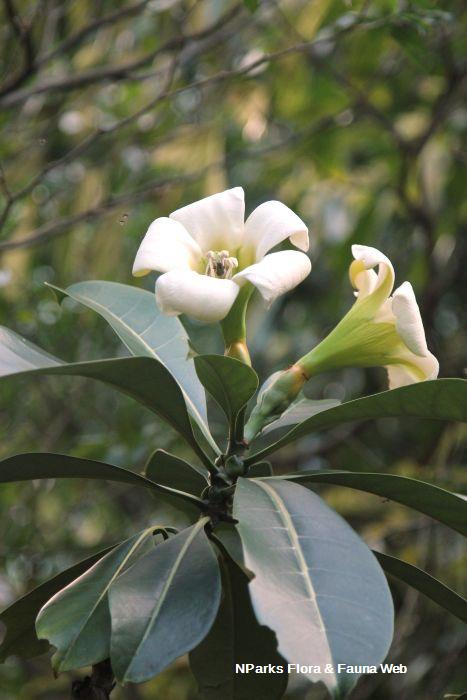
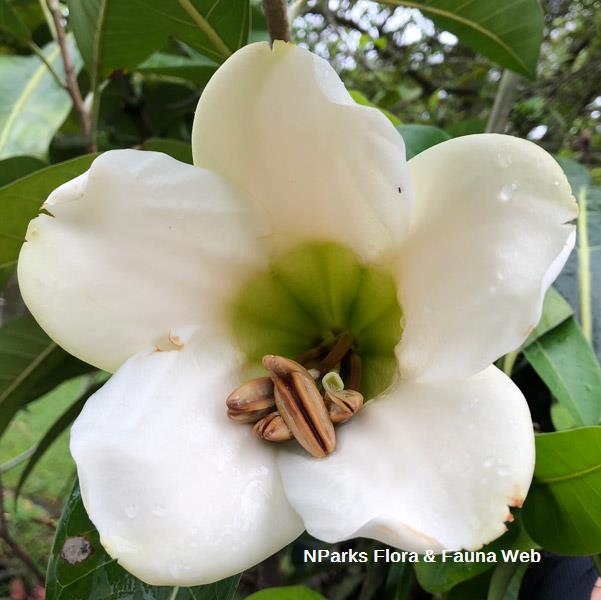
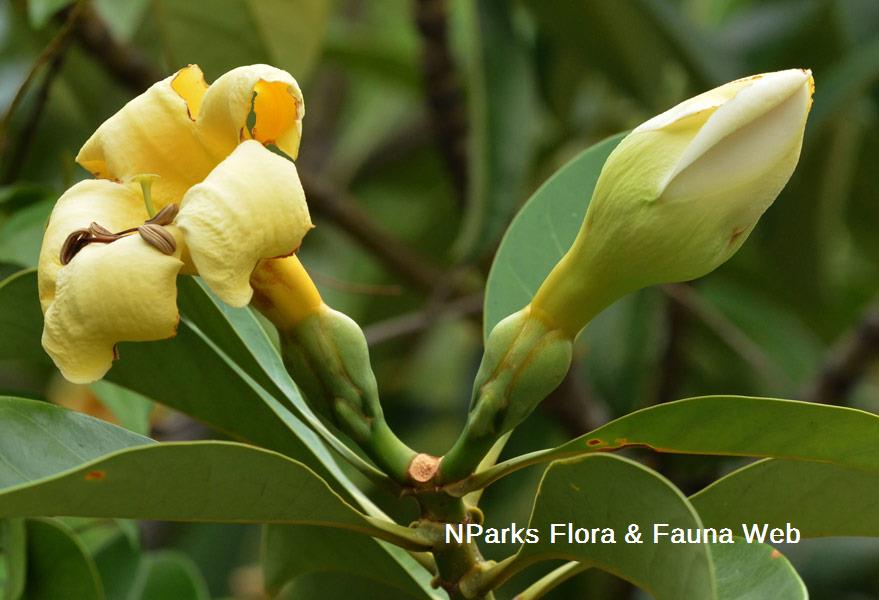
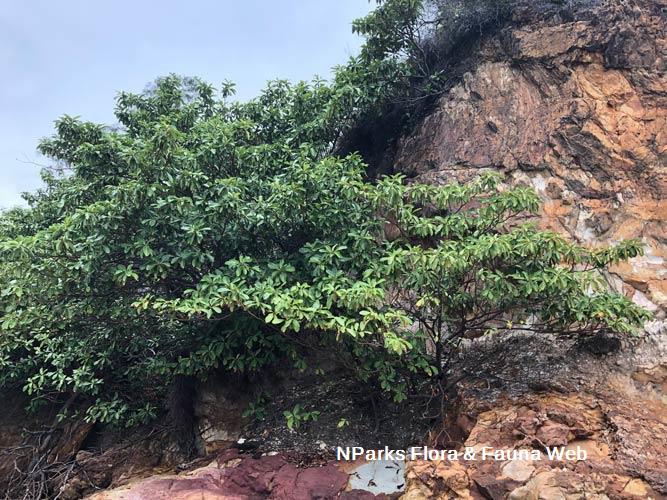
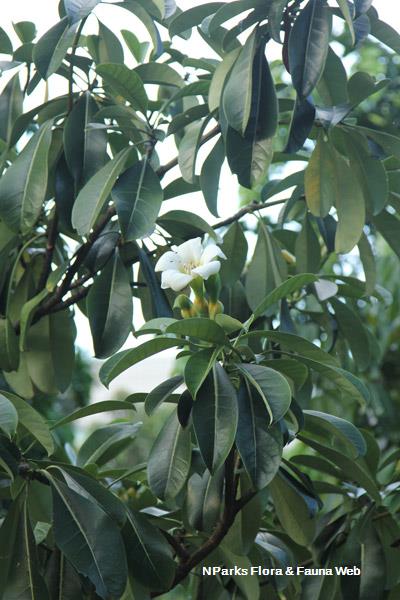
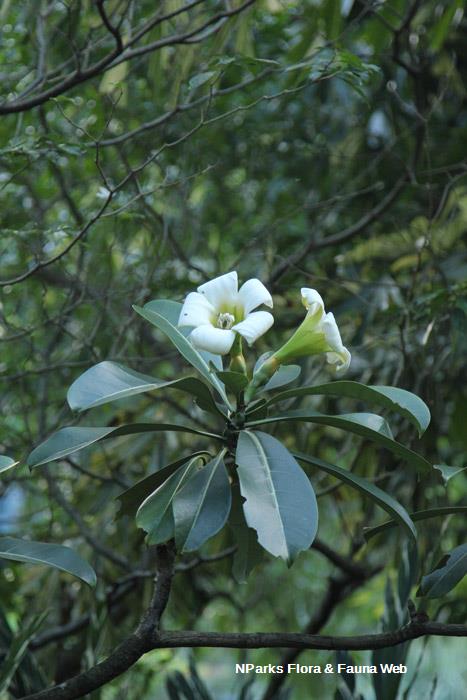
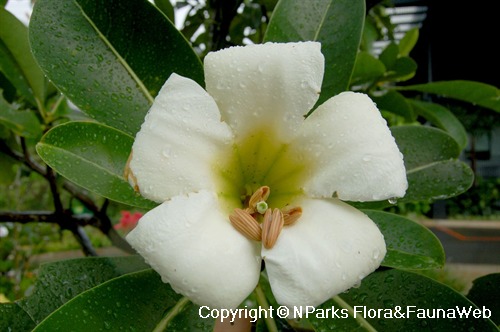
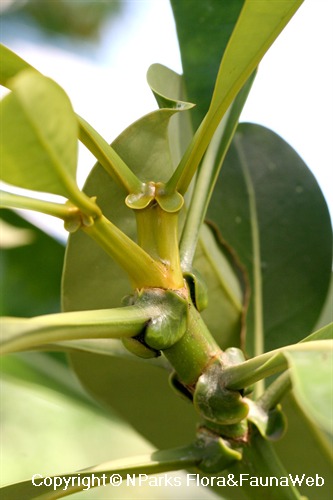
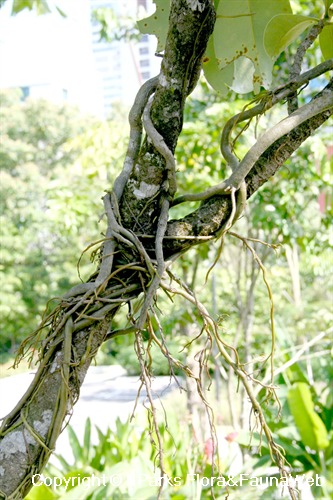
Known locally as Pelir Musang, Fagraea auriculata is a shrub or small tree that can be found in coastal habitats and produces trumpet-shaped flowers that can reach up to 30 cm in diameter. The flowers fade from white to yellow, releasing a sweet fragrance from dawn to dusk. Its species epithet, auriculata, is Latin for “lobed like an ear” and refers to the shape of the lobed stipules at the base of its large leaves. Often beginning life as an epiphyte (hemi-epiphyte), it is drought tolerant and can grow on cliffs and rocks.
Name
Classifications and Characteristics
| Plant Division | Angiosperms (Flowering Seed Plants) (Dicotyledon) |
|---|---|
| Plant Growth Form | Shrub, Tree, Epiphyte |
| Lifespan (in Singapore) | Perennial |
| Mode of Nutrition | Autotrophic |
| Plant Shape | Irregular, Open |
| Maximum Height | 18 m |
Biogeography
| Native Distribution | Cambodia, Vietnam, Peninsular Malaysia, Singapore, Sumatra, Java and Borneo |
|---|---|
| Native Habitat | Terrestrial (Coastal Forest), Shoreline (Coastal Cliff) |
| Preferred Climate Zone | Tropical, Sub-Tropical / Monsoonal |
| Local Conservation Status | Native to Singapore (Critically Endangered (CR)) |
Description and Ethnobotany
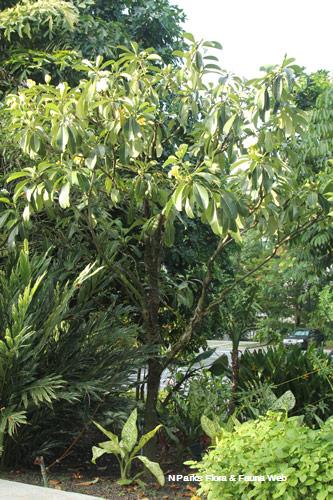
| Growth Form | It is a small tree to large terrestrial shrub (5–18 m tall) or hemi-epiphyte. |
|---|---|
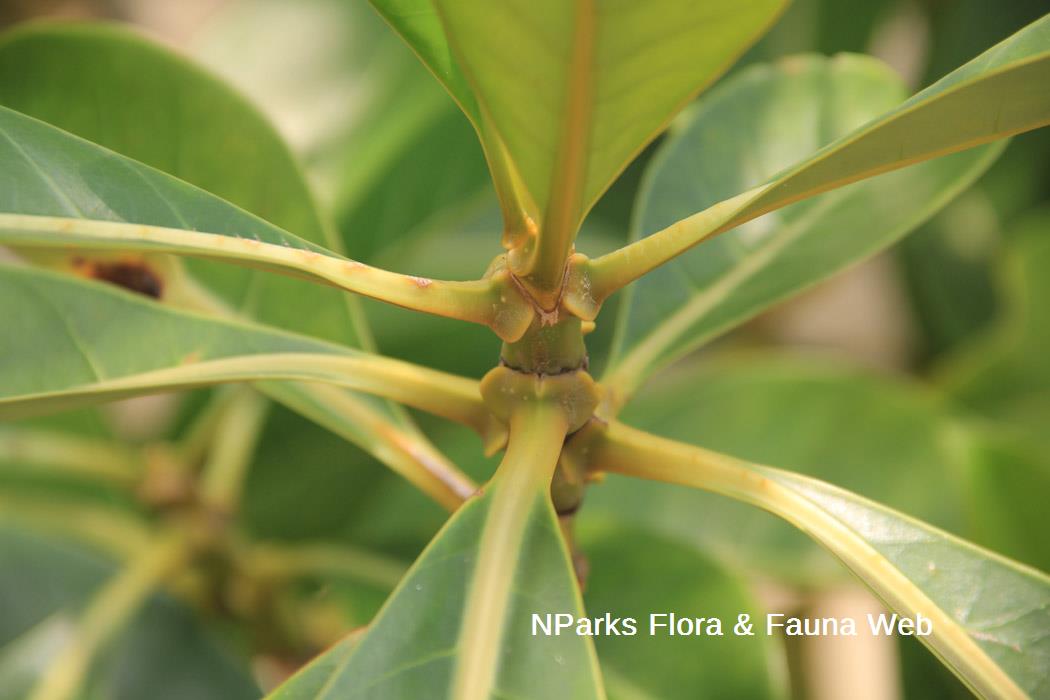
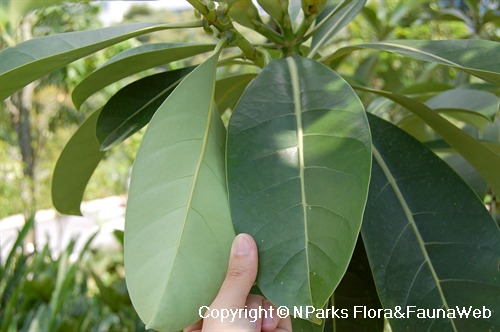
| Foliage | The leaves are elliptic to oblanceolate, about (12–) 18 – 27 (–31) cm long and (4.5–) 5.5 – 9 (–11) cm wide, with two auricles at base of the leaf stalk. |
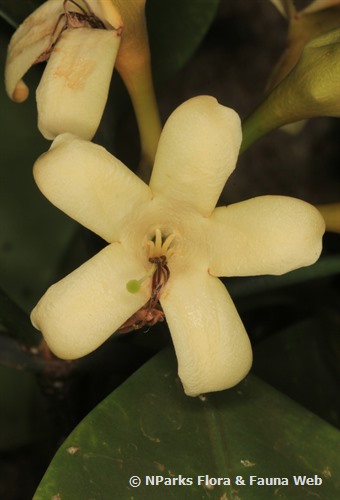
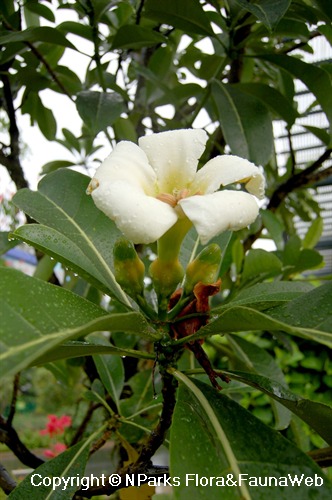
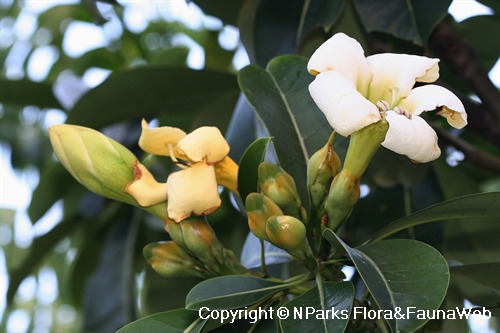
| Flowers | Its large, tubular, fragrant flowers develop singly, or in small clusters, maturing from white to cream to yellow. |
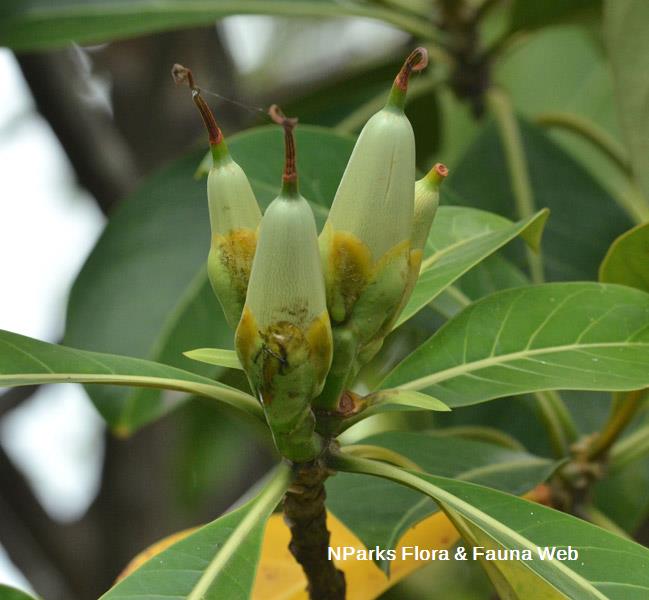
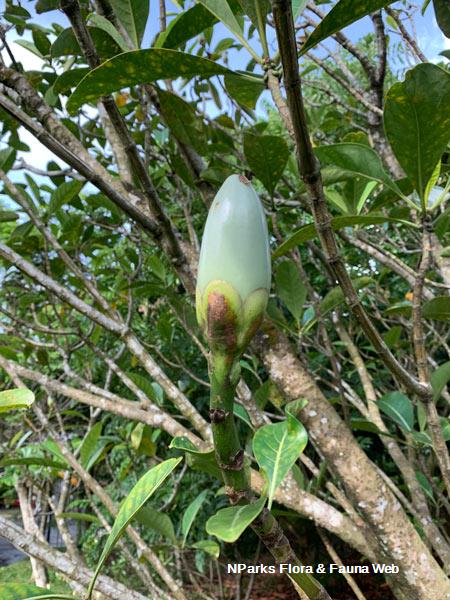
| Fruit | Its fruits are narrowly ellipsoid, about (65–) 80 – 125 mm long and 25 – 35 (–60) mm diameter, and greyish-white when ripe. Its tiny seeds are embedded in the fleshy fruit pulp. |
| Habitat | It grows in coastal forests, behind beaches and rocky outcrops, as well as swamp forests and limestone and quartz outcrops in coastal lowlands. |
| Cultivation | It can be propagated by seed, root cuttings, stem cuttings and air-layering. |
| Etymology | Latin Fagraea, commemorating John Theodores Fagraeus (1729–1797), a Swedish physician and botanist; Latin auriculata, lobed like an ear, referring to the pair of lobed stipules at the base of the leaf stalk. |
| Ethnobotanical Uses | Medicinal: Bark used to treat ulcers. Others: Sticky substance under fruit epidermis used as glue in Sumatra. |
Landscaping Features
| Landscaping | It is suitable for streetscapes, parks and gardens for its attractive, large flowers, thick leaves, and tolerance to hot and dry conditions. |
|---|---|
| Desirable Plant Features | Ornamental Flowers, Fragrant (Flowers) (Day, Dawn / Dusk), Ornamental Foliage |
| Landscape Uses | Coastal Plant, General, Suitable for Roadsides, Parks & Gardens, Small Gardens, Focal Plant |
Fauna, Pollination and Dispersal
| Fauna Pollination Dispersal Associated Fauna | Bird-Attracting Plant |
|---|---|
| Pollination Method(s) | Biotic (Fauna) |
| Seed or Spore Dispersal | Biotic (Fauna) |
Plant Care and Propagation
| Light Preference | Full Sun |
|---|---|
| Water Preference | Moderate Water, Little Water |
| Plant Growth Rate | Slow |
| Rootzone Tolerance | Fertile Loamy Soils, Well-Drained Soils, Saline Soils / Salt Spray, Drought Tolerant, Moist Soils |
| Maintenance Requirements | Moderate |
| Propagation Method | Stem Cutting, Air-Layering, Seed, Root Cutting |
Foliar
| Foliage Retention | Evergreen |
|---|---|
| Mature Foliage Colour(s) | Green |
| Mature Foliage Texture(s) | Leathery, Thick |
| Foliar Type | Simple / Unifoliate |
| Foliar Arrangement Along Stem | Opposite |
| Foliar Attachment to Stem | Petiolate |
| Foliar Shape(s) | Non-Palm Foliage (Oval, Obovate) |
| Foliar Venation | Pinnate / Net |
| Foliar Margin | Entire |
| Foliar Apex - Tip | Cuspidate |
| Foliar Base | Acute |
| Typical Foliar Area | Notophyll ( 20.25cm2 - 45 cm2 ) |
| Leaf Area Index (LAI) for Green Plot Ratio | 3.0 (Tree - Intermediate Canopy) |
Non - Foliar and Storage
| Trunk Type (Non Palm) | Woody |
|---|---|
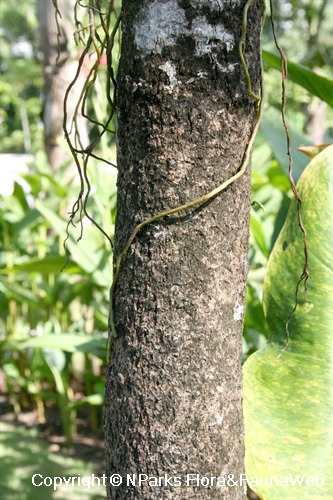
| Mature Bark Texture | Scaly |
| Stem Type & Modification | Woody |
| Root Type | Underground (Tap Root, Fibrous Root), Aboveground (Aerial Root) |
Floral (Angiosperm)
| Flower & Plant Sexuality | Bisexual Flowers |
| Flower Colour(s) | Cream / Off-White, White, Yellow / Golden |
|---|---|
| Flower Grouping | Cluster / Inflorescence |
| Flower Location | Terminal |
| Flower Symmetry | Radial |
| Individual Flower Shape | Trumpet-shaped |
| Flower Size - Remarks | Large, 30cm long by 30cm wide |
| Flowering Opening Time | Time-Independent |
| Flower Lifespan on Plant | 1 Day |
| Flowering Habit | Polycarpic |
| Inflorescence Size Remarks | Flower matures from white to cream to yellow. |
| Flowering Period Remarks | Yearly, June - July |
Fruit, Seed and Spore
| Mature Fruit Colour(s) | Silver / Grey |
|---|---|
| Mature Fruit Texture(s) | Glossy / Shiny, Waxy |
| Fruit Classification | Simple Fruit |
| Fruit Type |
Image Repository
Others
| Master ID | 717 |
|---|---|
| Species ID | 2012 |
| Flora Disclaimer | The information in this website has been compiled from reliable sources, such as reference works on medicinal plants. It is not a substitute for medical advice or treatment and NParks does not purport to provide any medical advice. Readers should always consult his/her physician before using or consuming a plant for medicinal purposes. |