








Back
Thottea grandiflora Rottb.
| Family Name: | Aristolochiaceae |
| Common Name: | Bunga Semubut, Geroboh, Kerubut, Seburut, Sel-wohl, Telinga Kelawar |
Name
Classifications and Characteristics
| Plant Division | Angiosperms (Flowering Seed Plants) (Dicotyledon) |
|---|---|
| Plant Growth Form | Shrub |
| Lifespan (in Singapore) | Perennial |
| Plant Shape | Irregular |
| Maximum Height | 2 m |
Biogeography
| Native Distribution | Myanmar, Peninsular Malaysia, and Singapore |
|---|---|
| Native Habitat | Terrestrial (Primary Rainforest, Secondary Rainforest, Freshwater Swamp Forest) |
| Preferred Climate Zone | Tropical |
| Local Conservation Status | Native to Singapore (Vulnerable (VU)) |
Description and Ethnobotany
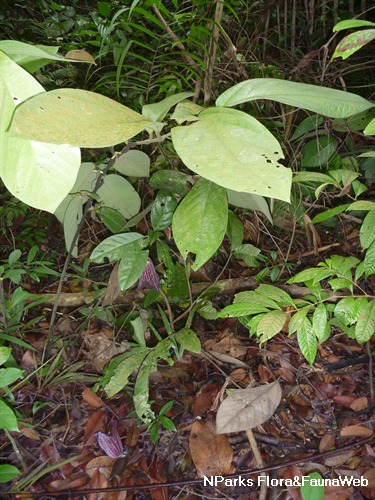
| Growth Form | It is an erect shrub up to 2 m tall. Its branches are round and covered with fine hair. |
|---|---|
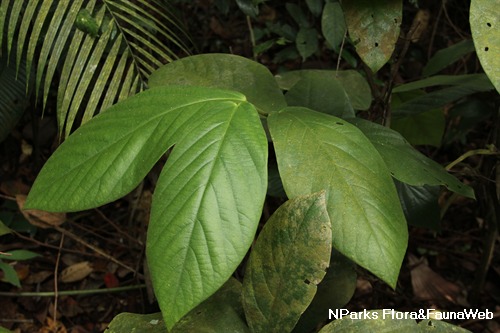
| Foliage | Its alternate, stalked leaves have leathery leaf blades that are drop-shaped, elliptic or lance-shaped, 15–45 by 9–25 cm, often hairy above, and always hairy below. |
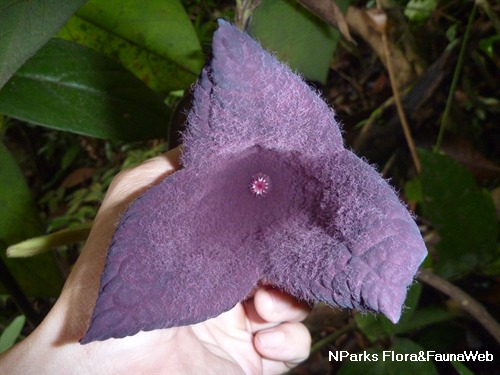
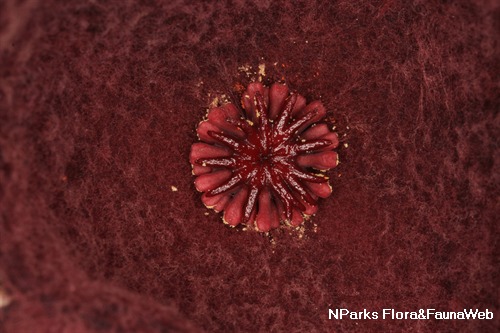
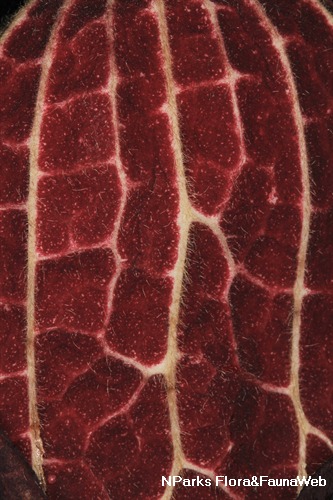
| Flowers | Its flowering clusters are 1–7 cm long and usually found at the lower part of the stem. Its funnel-shaped perianth is deep red wine-coloured with purple blotches. |
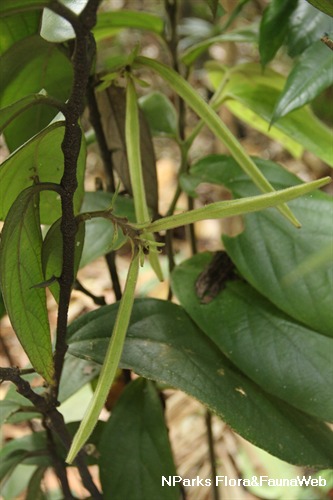
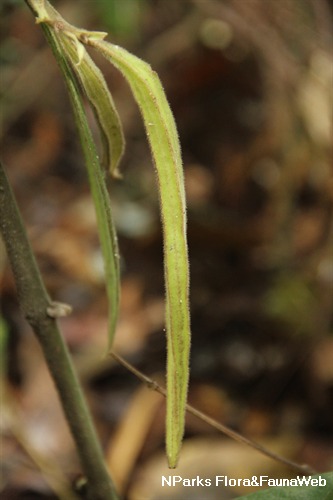
| Fruit | Its fruits are slender capsules up to 15 cm long, and either straight or twisted. They are 4-angled and covered with hair. Its seeds are ellipsoid, 3-angled, with wrinkled surface. |
| Habitat | It grows in lowland and hill forests up to 600 m in altitude. |
| Associated Fauna | Its flowers are insect-pollinated. |
| Cultivation | It can be propagated by seed. |
| Etymology | Latin Thottea, commemorating Otto greve Thott (1703–1785), a Danish Minister; Latin grandiflora, large flowers, referring to the plant’s big and showy flowers |
| Ethnobotanical Uses | Medicinal: Its roots serve as a tonic for women after confinement and are effective against fever, ague and dysentery. |
Landscaping Features
| Landscaping | It is suitable for parks for its ornamental and unique flowers. |
|---|---|
| Desirable Plant Features | Ornamental Flowers |
| Landscape Uses | Parks & Gardens, Small Gardens |
Fauna, Pollination and Dispersal
| Pollination Method(s) | Biotic (Fauna) |
|---|---|
| Seed or Spore Dispersal | Abiotic |
Plant Care and Propagation
| Light Preference | Semi-Shade, Full Shade |
|---|---|
| Water Preference | Moderate Water |
| Rootzone Tolerance | Moist Soils, Well-Drained Soils, Fertile Loamy Soils |
| Propagation Method | Seed |
Foliar
| Foliage Retention | Evergreen |
|---|---|
| Mature Foliage Colour(s) | Green |
| Mature Foliage Texture(s) | Hairy / Hirsute, Leathery |
| Foliar Type | Simple / Unifoliate |
| Foliar Arrangement Along Stem | Alternate |
| Foliar Shape(s) | Non-Palm Foliage (Obovate, Lanceolate, Elliptical) |
| Foliar Venation | Pinnate / Net |
| Foliar Margin | Entire |
| Leaf Area Index (LAI) for Green Plot Ratio | 4.5 (Shrub & Groundcover - Dicot) |
Floral (Angiosperm)
| Flower & Plant Sexuality | Bisexual Flowers |
| Flower Colour(s) | Purple |
|---|---|
| Flower Grouping | Cluster / Inflorescence |
| Flower Location | Axillary |
| Flower Symmetry | Radial |
Fruit, Seed and Spore
| Mature Fruit Colour(s) | Brown |
|---|---|
| Mature Fruit Texture(s) | Hairy / Hirsute |
| Fruit Classification | Simple Fruit |
| Fruit Type |
Image Repository
Others
| Master ID | 1215 |
|---|---|
| Species ID | 2508 |
| Flora Disclaimer | The information in this website has been compiled from reliable sources, such as reference works on medicinal plants. It is not a substitute for medical advice or treatment and NParks does not purport to provide any medical advice. Readers should always consult his/her physician before using or consuming a plant for medicinal purposes. |
.jpg)