





Back
Garcinia xanthochymus Hook. f. ex T. Anders.
| Family Name: | Clusiaceae (Guttiferae) |
| Common Name: | Egg Tree, Gamboge Tree, Sour Mangosteen, Himalayan Garcinia, False Mangosteen, Camboge, Mundu |
.jpg)
.jpg)
.jpg)
Name
Classifications and Characteristics
| Plant Division | Angiosperms (Flowering Seed Plants) (Dicotyledon) |
|---|---|
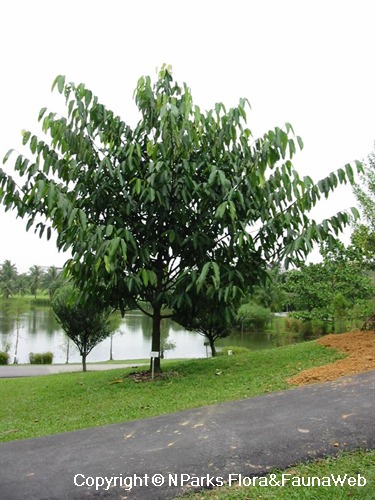
| Plant Growth Form | Tree (Small (6m-15m)) |
| Lifespan (in Singapore) | Perennial |
| Mode of Nutrition | Autotrophic |
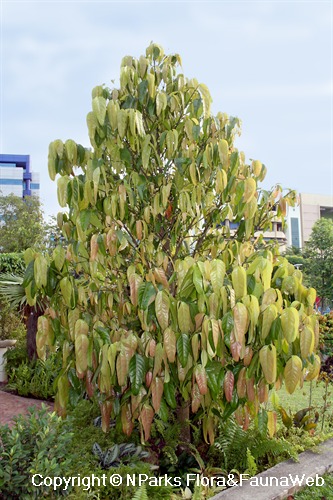
| Plant Shape | Pyramidal |
| Maximum Height | 15 m |
Biogeography
| Native Distribution | Bangladesh, Bhutan, Cambodia, India, Laos, Myanmar, Nepal, Thailand, Vietnam |
|---|---|
| Native Habitat | Terrestrial (Primary Rainforest, Secondary Rainforest) |
| Preferred Climate Zone | Tropical |
| Local Conservation Status | Non-native (Horticultural / Cultivated Only) |
Description and Ethnobotany
| Growth Form | It is a tree, up to 15 m tall, with parts exuding white latex when damaged. |
|---|---|
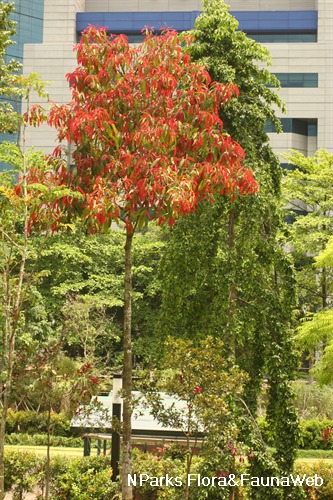
| Crown | Its dense crown is pyramidal in shape. |
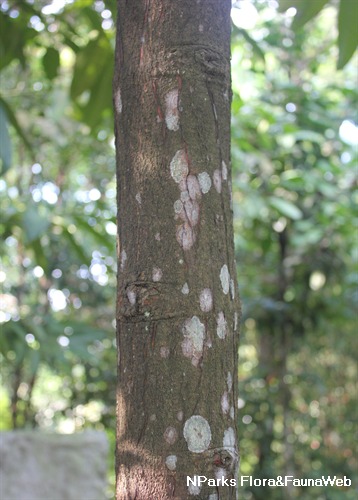
| Trunk | Its trunk is short and straight, with grey-brown bark. |
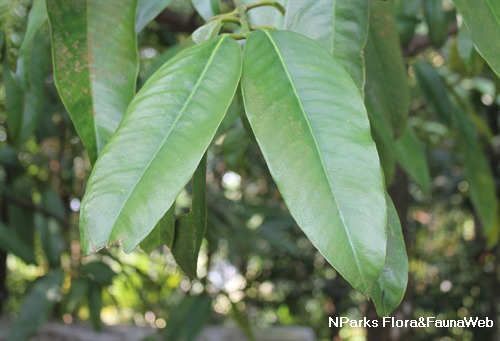
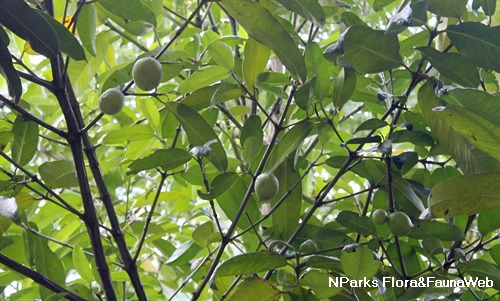
| Foliage | Its oppositely-arranged, stalked leaves have leathery leaf blades that are narrowly oblong, 12-24 cm long and 4-7 cm wide, dark green and shiny on the top surface. |
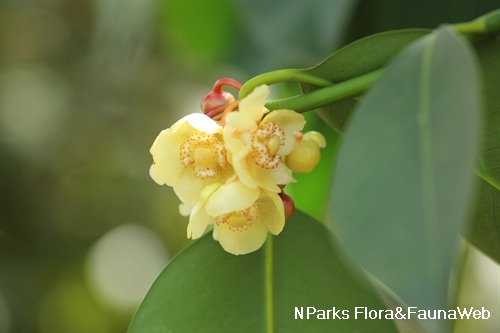
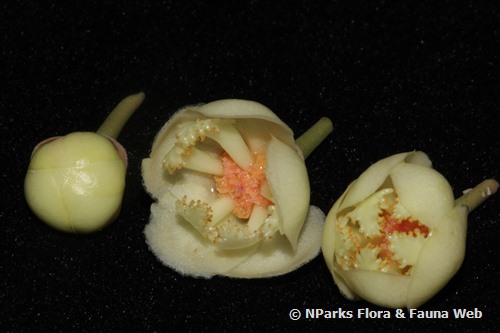
| Flowers | Its male and female flowers are borne on separate plants, or sometimes bisexual flowers are produced. The stalked white flowers are borne in clusters of 4-10, about 1 cm wide. |
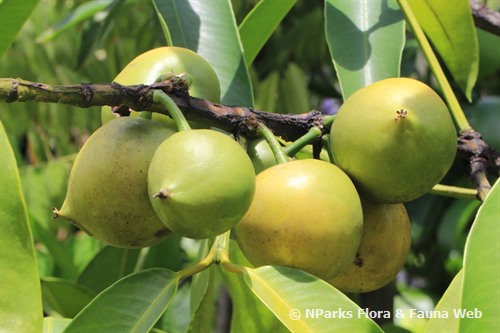
| Fruit | Its fleshy fruits are subglobose berries with a pointed tip that ends with a persistent stigma, up to 9 cm wide, ripening pale orange to dark yellow. |
| Habitat | In the eastern Himalayas, this species occurs in hill forests. |
| Associated Fauna | It fruits are probably eaten and dispersed by small mammals. |
| Cultivation | It can be propagated from seed. |
| Etymology | Latin Garcinia, after Dr Laurent Garcin (1683-1751), a French naturalist with the East India Company; Greek xantho, yellow, chymus, exudate or sap. |
| Ethnobotanical Uses | Edible Plant Parts : Edible Fruits Food (Fruit or Vegetable): The fruits are used to make vinegar, preserves and jams. Medicinal: The dried fruits are used in treating vomiting. Others: The latex is used for dyeing. |
Landscaping Features
| Landscaping | It is suitable for streetscapes, parks and gardens for its dense pyramidal crown. |
|---|---|
| Desirable Plant Features | Ornamental Form |
| Landscape Uses | General, Suitable for Roadsides, Parks & Gardens, Small Gardens |
| Thematic Landscaping | Economic Garden |
Fauna, Pollination and Dispersal
| Pollination Method(s) | Biotic (Fauna) |
|---|---|
| Seed or Spore Dispersal | Biotic (Fauna) |
Plant Care and Propagation
| Light Preference | Full Sun, Semi-Shade |
|---|---|
| Water Preference | Moderate Water |
| Plant Growth Rate | Moderate |
| Rootzone Tolerance | Moist Soils, Well-Drained Soils, Fertile Loamy Soils |
| Propagation Method | Seed |
| Plant Growth Rate Remarks | Slow |
Foliar
| Foliage Retention | Evergreen |
|---|---|
| Mature Foliage Colour(s) | Green |
| Mature Foliage Texture(s) | Glossy / Shiny, Leathery |
| Prominent Young Flush Colour(s) | Green - Light Green |
| Foliar Type | Simple / Unifoliate |
| Foliar Arrangement Along Stem | Opposite |
| Foliar Attachment to Stem | Petiolate |
| Foliar Shape(s) | Non-Palm Foliage (Oblong) |
| Foliar Venation | Pinnate / Net |
| Foliar Margin | Entire |
| Leaf Area Index (LAI) for Green Plot Ratio | 3.0 (Tree - Intermediate Canopy) |
Floral (Angiosperm)
| Flower & Plant Sexuality | Unisexual & Bisexual Flowers(Sub-dioecious) |
| Flower Colour(s) | White |
|---|---|
| Flower Grouping | Cluster / Inflorescence |
| Flower Location | Axillary |
| Flower Symmetry | Radial |
Fruit, Seed and Spore
| Mature Fruit Colour(s) | Orange, Yellow / Golden |
|---|---|
| Mature Fruit Texture(s) | Smooth |
| Fruit Classification | Simple Fruit |
| Fruit Type |
Image Repository
Others
| Master ID | 1638 |
|---|---|
| Species ID | 2931 |
| Flora Disclaimer | The information in this website has been compiled from reliable sources, such as reference works on medicinal plants. It is not a substitute for medical advice or treatment and NParks does not purport to provide any medical advice. Readers should always consult his/her physician before using or consuming a plant for medicinal purposes. |