







Back
Amorphophallus titanum (Becc.) Becc.
| Family Name: | Araceae |
| Synonyms: | Conophallus titanum Becc. |
| Common Name: | Titan Arum, Corpse Flower |
Name
Classifications and Characteristics
| Plant Division | Angiosperms (Flowering Seed Plants) (Monocotyledon) |
|---|---|
| Plant Growth Form | Herbaceous Plant |
| Lifespan (in Singapore) | Perennial |
| Mode of Nutrition | Autotrophic |
Biogeography
| Native Distribution | Western Sumatra |
|---|---|
| Native Habitat | Terrestrial (Primary Rainforest, Secondary Rainforest) |
| Preferred Climate Zone | Tropical |
| Local Conservation Status | Non-native (Horticultural / Cultivated Only) |
Description and Ethnobotany
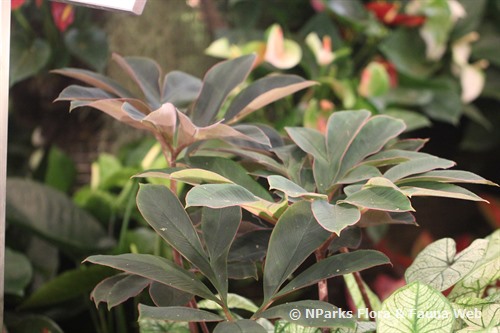
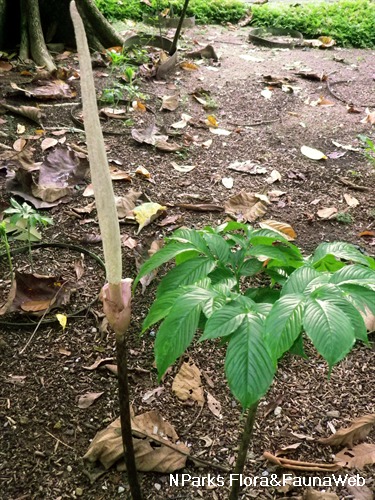
| Foliage | A single leaf emerges on the same spot when the inflorescence flowered and died, grows to about 7 m tall and 7 m across together with its glossy green stalk with cream spots which will divide into three at apex and produces many leaflets. |
|---|---|
| Stems | A modified stem, tuber, spherical shaped. |
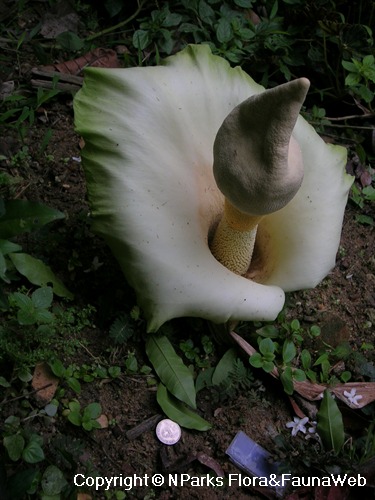
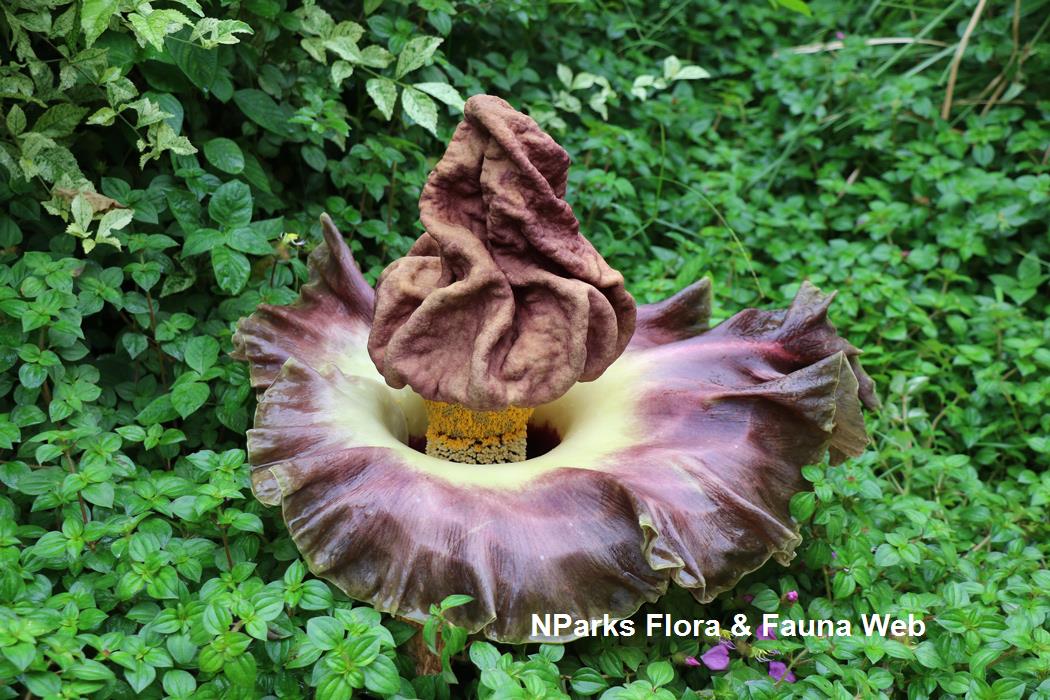
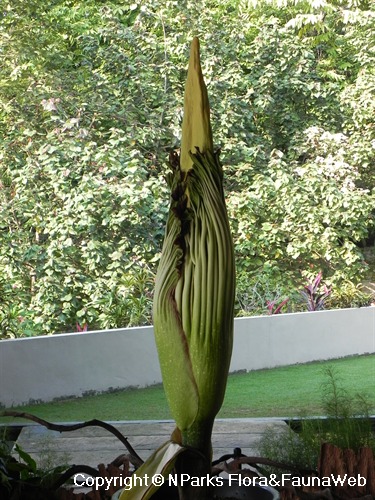
| Flowers | Inflorescence, spathe green-cream colour on the outside while crimson colour on the inside, ribbed sides and frilly edge, measures up to 3 m in circumference; spadix carries flowers whereby a band of male flowers in cream colour is above a ring of pink female flowers. During pollination, the spadix heats up and produces a nauseating smell which gives the common name, 'the corpse flower'. |
| Fruit | Bright scarlet fruits when mature. |
| Etymology | The genus Amorphophallus means deformed-phallus, which refers to its enlarged spadix. |
Landscaping Features
| Desirable Plant Features | Ornamental Flowers, Ornamental Foliage, Ornamental Fruits |
|---|---|
| Landscape Uses | Focal Plant |
| Usage Hazard - Cons | Irritant - Sap, Pungent Scent (Flower), Toxic Upon Ingestion |
| Usage Hazard - Cons Remarks | Irritant Sap/ Toxic Upon Ingestion: All plant parts contain calcium oxalate raphides, which are needle-shaped crystals that can cause irritation to skin, mouth and throat. Keep plants away from children and pets. Pungent Scent (Flowers): The inflorescence emit foul, decaying odour that resembles rotting flesh. The odour also attracts carrion flies, which may pose as a nuisance. |
Fauna, Pollination and Dispersal
| Fauna Pollination Dispersal Associated Fauna | Bird-Attracting Plant (Fruits) |
|---|---|
| Pollination Method(s) | Biotic (Fauna) (Carrion Insects (Carrion Fly, Carrion Beetle)) |
| Seed or Spore Dispersal | Biotic (Fauna) (Vertebrates (Birds)) |
Plant Care and Propagation
| Light Preference | Semi-Shade |
|---|---|
| Water Preference | Moderate Water |
| Plant Growth Rate | Fast to Moderate |
| Rootzone Tolerance | Well-Drained Soils, Fertile Loamy Soils |
| Propagation Method | Seed, Storage Organ (Corm) |
Foliar
| Mature Foliage Colour(s) | Green |
|---|---|
| Foliar Modification | Flower/Fruit Bract |
Non - Foliar and Storage
| Root Type | Underground (Fibrous Root) |
|---|---|
| Specialised Storage Organ(s) | Underground (Corm) |
Floral (Angiosperm)
| Flower & Plant Sexuality | Bisexual Flowers |
| Flower Colour(s) | Cream / Off-White, Pink |
|---|---|
| Flower Grouping | Cluster / Inflorescence |
| Flower Location | Axillary |
| Inflorescence Type | Spathe & Spadix |
| Flower Colour(s) Remarks | Male flowers : cream Female flowers : pink Bract (Spathe) : green with cream-mottled on outside, crimson on inside |
Fruit, Seed and Spore
| Mature Fruit Colour(s) | Red |
|---|
Image Repository
Others
| Master ID | 29223 |
|---|---|
| Species ID | 3532 |
| Flora Disclaimer | The information in this website has been compiled from reliable sources, such as reference works on medicinal plants. It is not a substitute for medical advice or treatment and NParks does not purport to provide any medical advice. Readers should always consult his/her physician before using or consuming a plant for medicinal purposes. |