





Back
Blumeodendron subrotundifolium (Elmer) Merr.
| Family Name: | Euphorbiaceae |
| Common Name: | Gaham Badak, Kaum Bada |
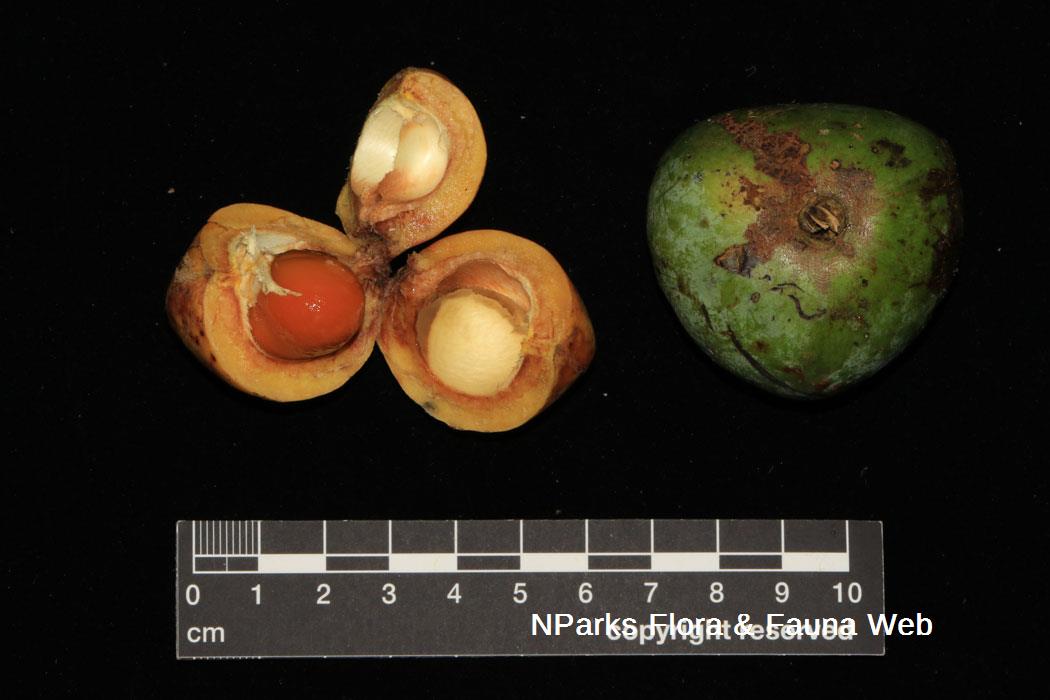
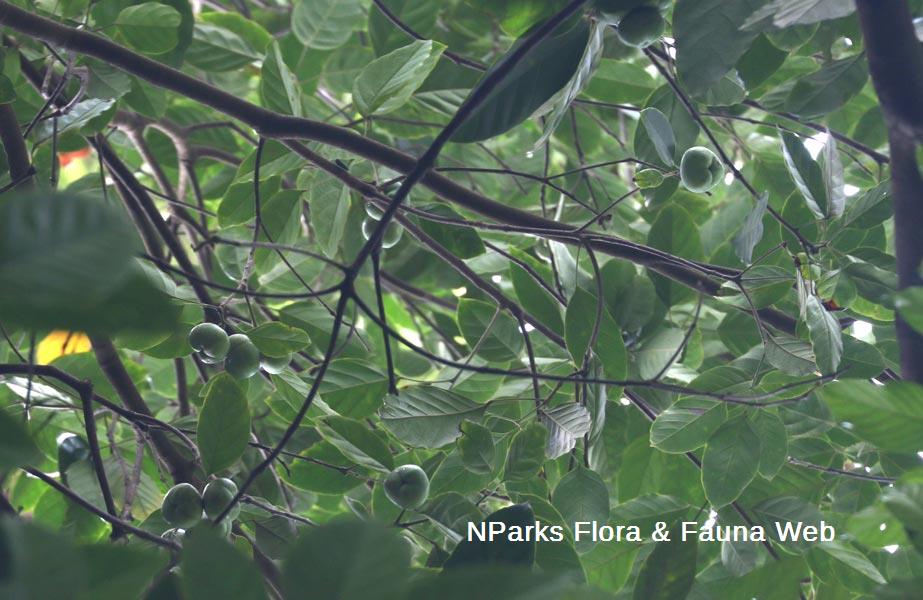
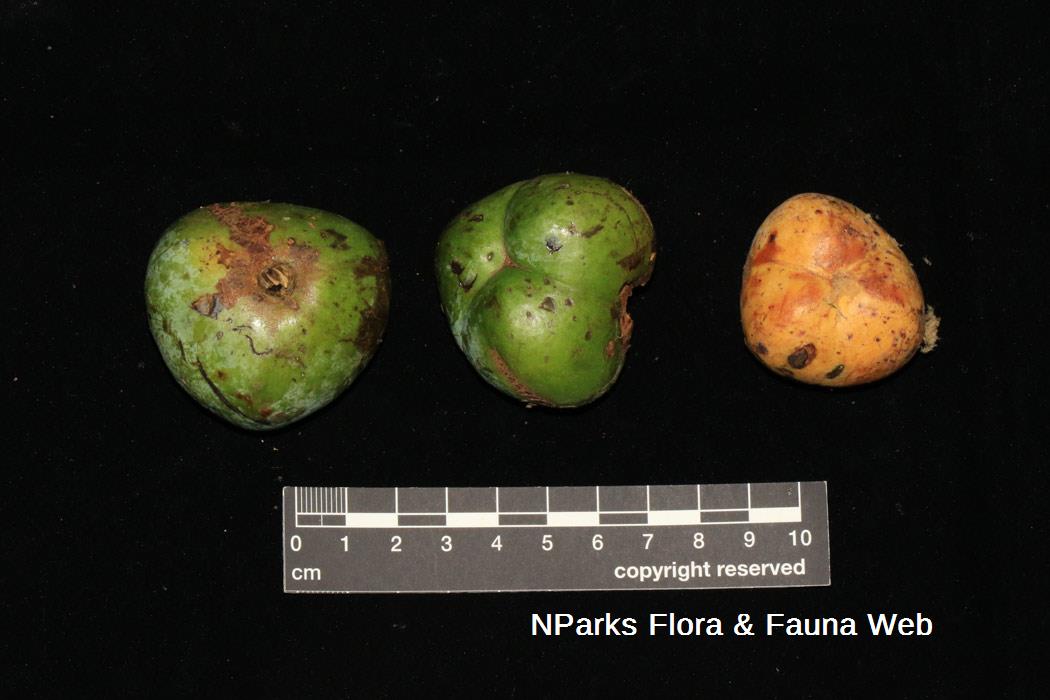
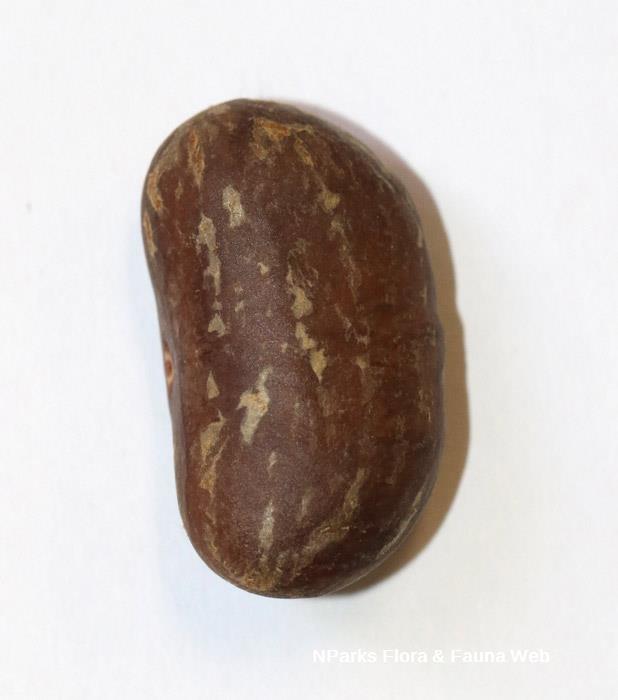
Blumeodendron subrotundifolium, also known as Gaham Badak, is an endangered tree in Singapore that can grow up to 50 m tall. It produces subglobular to ovoid fruits that turn dark blue to black when ripe and split open at maturity. Each fruit contains 2 – 3 bean-like seeds covered with a cream to purple fleshy layer. Its timber is used for interior construction and making concrete moulds.
Name
Classifications and Characteristics
| Plant Division | Angiosperms (Flowering Seed Plants) |
|---|---|
| Plant Growth Form | Tree |
| Lifespan (in Singapore) | Perennial |
| Mode of Nutrition | Autotrophic |
| Maximum Height | 50 m |
Biogeography
| Native Distribution | Peninsular Thailand, Peninsular Malaysia, Singapore, Sumatra, Borneo and the Philippines. |
|---|---|
| Native Habitat | Terrestrial |
| Preferred Climate Zone | Tropical |
| Local Conservation Status | Native to Singapore (Endangered (EN)) |
Description and Ethnobotany
| Growth Form | It is a tree, up to 50 m tall, sometimes fluted or with buttresses, up to 1.5 m. The trunk can reach up to 91 cm diameter. The bark is brown, yellow-brown, to grey, and ranges from fissured, scaly to flaky. |
|---|---|
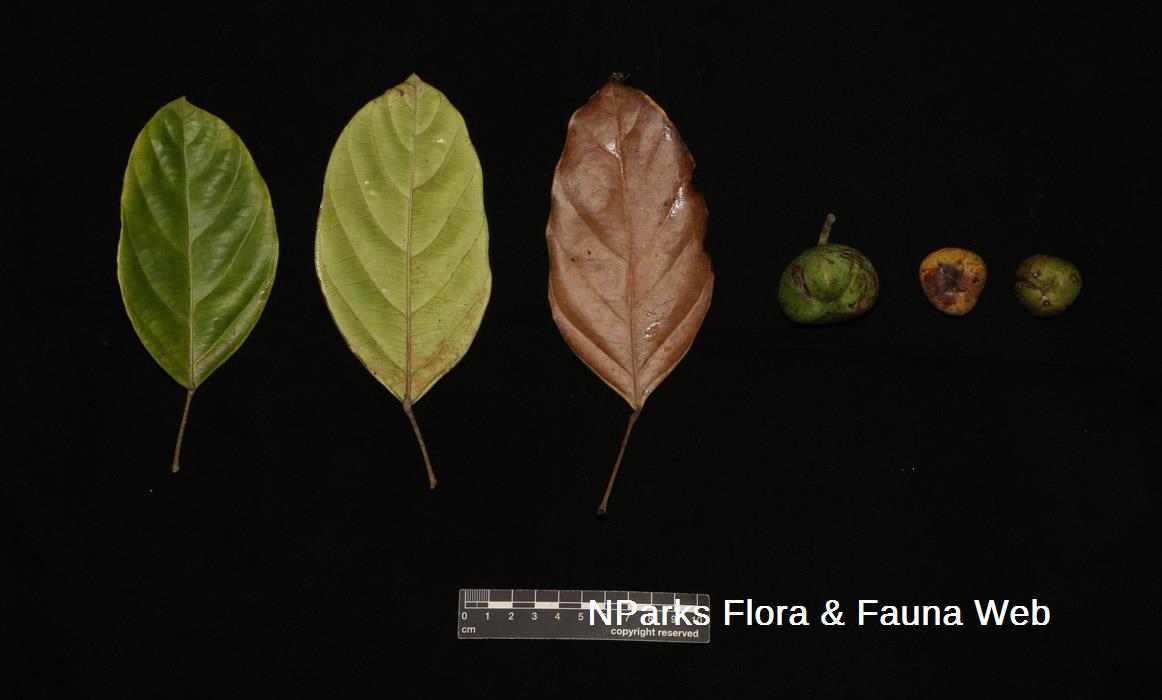
| Foliage | The leaves are elliptic, measuring 6.2 – 46 cm long and 3 – 22 cm wide. They have a leathery texture and in alternate to subopposite arrangement. The leaf tip is acuminate to cuspidate while the leaf base is emarginate, rounded to cuneate. The leaf margin is recurved. Each leaf has 3 or 4 (– 11) pairs of lateral veins with extrafloral nectaries present along the midrib and leaf margin. Both the upper surface and underside are smooth. The leaf stalk (petiole) measures 2.4 – 18.5 cm long and is slightly swollen at the base of the leaf, forming a pulvinus. |
| Flowers | The flowers occur in clusters (thyrses) on the trunk (cauliflorous), branches (ramiflorous), and in the leaf axils. Male inflorescences are longer, reaching up to 4.5 cm, while female inflorescences are shorter, reaching up to 2.3 cm. The flowers are small, with male flowers measuring about 5–6 mm in diameter and female flowers measuring about 1.5–2.2 mm across. Male flowers are yellow and have 25–40 yellow stamens. Female flowers are dull purple with recurved, greenish stigmas. They are only observed during the fruit development stage. |
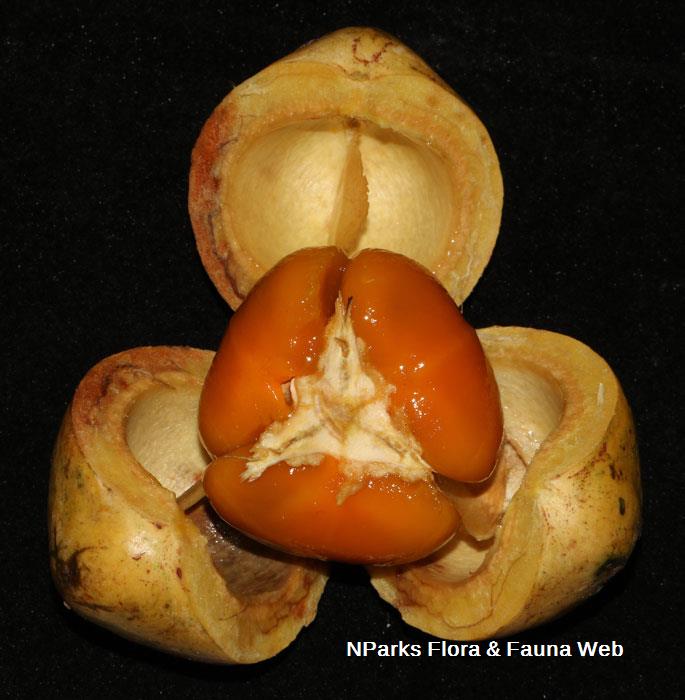
| Fruit | The fruit is subglobular to ovoid, measuring 2.9 – 4.5 cm long and 3.5 – 6 cm wide. It is green when unripe, turning yellow to orange-yellow (or red) when ripe and splits open at maturity. Each fruit contains 2 – 3 seeds. The seeds are bean-like and covered with a cream to purple, fleshy sarcotesta. |
| Habitat | It is found in rainforests, gallery forests, peat swamp forests to submontane forests, up to 1200 m altitude. |
| Associated Fauna | Fruits are dispersed by birds and mammals. |
| Cultivation | It can be propagated by seed. |
| Etymology | The genus epithet commemorates Carl Ludwig von Blume (1796-1862), a pioneering botanist who conducted extensive studies of Southeast Asian flora, particularly in Java, and whose work laid the groundwork for Flora Malesiana. The specific epithet comprises of two parts: subrotundus, in Latin, means almost round, while folium, in Latin, means leaves, referring to leaf shape. |
| Ethnobotanical Uses | Timber & Products: It produces timber, known as Tengkurung, which is used for interior construction and moulds for concrete. |
Fauna, Pollination and Dispersal
| Seed or Spore Dispersal | Biotic (Fauna) |
|---|
Plant Care and Propagation
| Light Preference | Full Sun |
|---|---|
| Water Preference | Moderate Water |
| Plant Growth Rate | Moderate |
Foliar
| Mature Foliage Colour(s) | Green |
|---|---|
| Mature Foliage Texture(s) | Leathery |
Non - Foliar and Storage
| Root Type | Underground |
|---|
Floral (Angiosperm)
| Flower & Plant Sexuality | Unisexual Flowers , Dioecious |
| Flower Grouping | Cluster / Inflorescence |
|---|
| Flower Location | Axillary, Cauliflorous, Terminal |
| Inflorescence Type | Thyrse |
Fruit, Seed and Spore
| Mature Fruit Colour(s) | Yellow / Golden, Red, Orange |
|---|---|
| Seed Quantity Per Fruit | Few (1-5) |
References
| References | Ottens-Treurniet, M.A.D. & van Welzen, P.C. (2016). A revision of the Malesian genus Blumeodendron (Euphorbiaceae). Blumea 61: 64-83. Sosef, M.SM., Hong, L.T., and Prawirohatmodjo, S. (Editors). 1998. Plant Resources of South-East Asia Volume 5 (3). Timber Trees: Lesser known timbers. Leiden: Prosea Foundation. 859 pages. van Welzen, P.C., Middleton, D.J., & Lindsay, S. (2020). Flora of Singapore precursors, 21: New records of Euphorbiaceae for Singapore. Gardens' Bulletin Singapore 72(2): 143–158. |
|---|
Image Repository
Others
| Master ID | 34767 |
|---|---|
| Species ID | 9180 |
| Flora Disclaimer | The information in this website has been compiled from reliable sources, such as reference works on medicinal plants. It is not a substitute for medical advice or treatment and NParks does not purport to provide any medical advice. Readers should always consult his/her physician before using or consuming a plant for medicinal purposes. |