









.jpg)
Back
Nephrolepis acutifolia (Desv.) Christ
| Family Name: | Nephrolepidaceae |
| Synonyms: | Lindsaea acutifolia Desv. |
| Common Name: | Paku Uban Bukit |
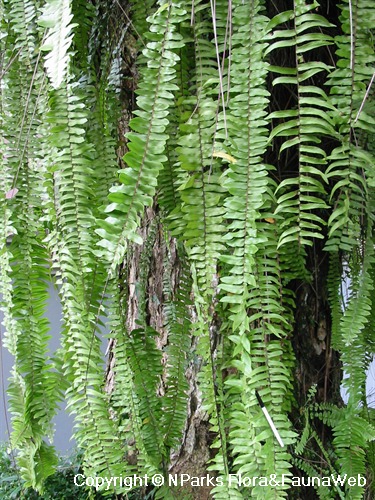
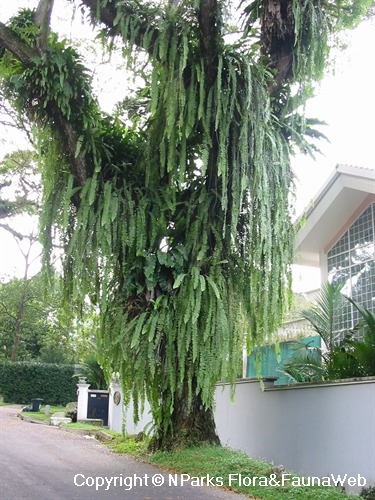
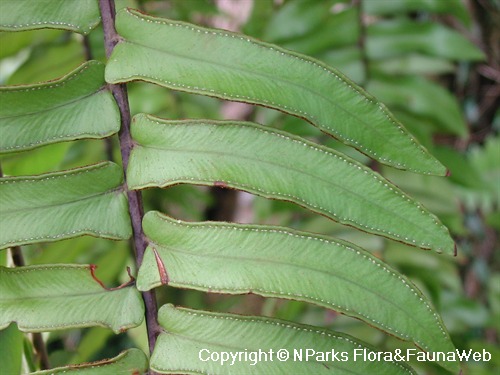
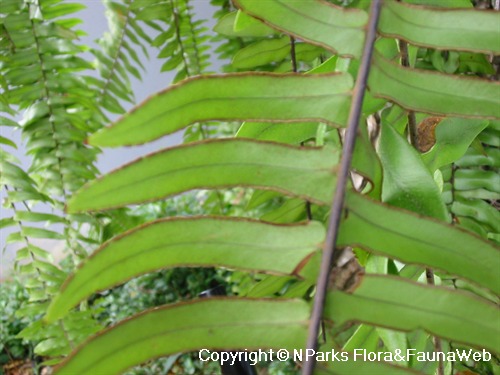
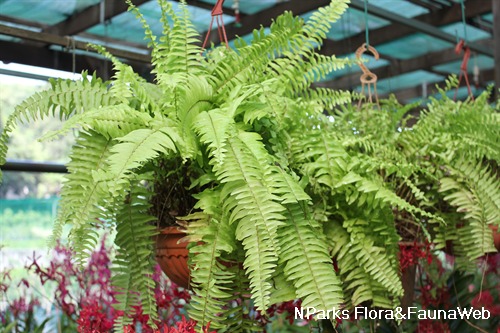
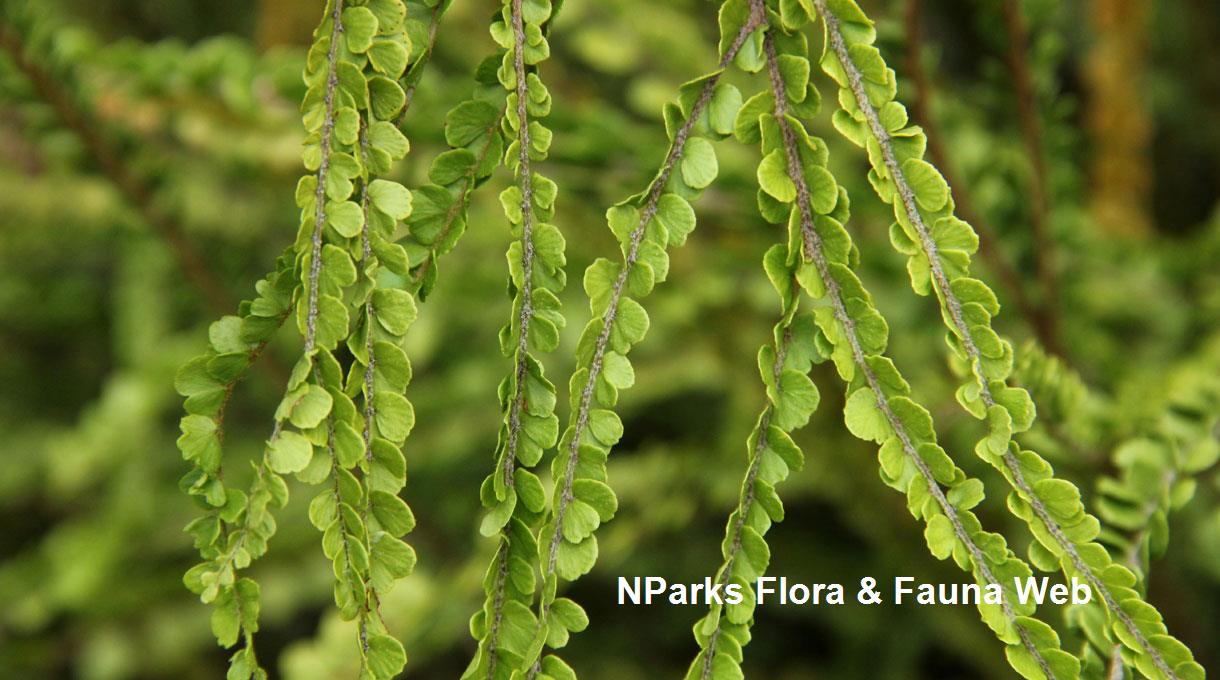
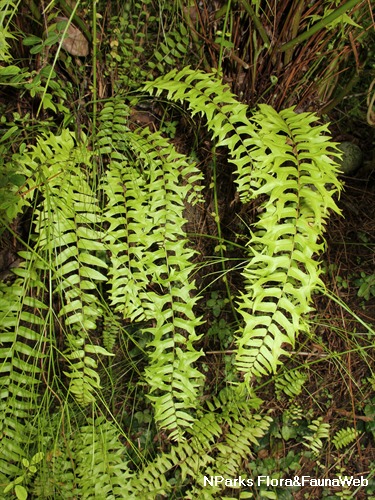
Nephrolepis acutifolia or Paku Uban Bukit is a fern native to Singapore that grows terrestrially or as an epiphyte. Its long, drooping fronds can reach to at least 1.5 m. The leaflets (pinnae) are linear to lance-shaped with a short broad tip and smooth margins. Unlike most Nephrolepis species which produce round or kidney-shaped sori, this species produces line-like sori.
.jpg)
.jpg)
.jpg)
.jpg)
Name
Classifications and Characteristics
| Plant Division | Ferns & Lycophytes (Non-Seed Vascular Plants) (Fern) |
|---|---|
| Lifespan (in Singapore) | Perennial |
| Mode of Nutrition | Autotrophic |
| Plant Shape | Weeping / Pendulous |
| Maximum Height | 1.5 m |
Biogeography
| Native Distribution | Cameroon to Kenya and Mozambique, West Indian Ocean, Thailand to Pacific Islands |
|---|---|
| Native Habitat | Terrestrial (Primary Rainforest, Secondary Rainforest, Coastal Forest, Freshwater Swamp Forest) |
| Preferred Climate Zone | Tropical |
| Local Conservation Status | Native to Singapore (Endangered (EN)) |
Description and Ethnobotany
| Growth Form | It is a fern that can grow terrestrially or as an epiphyte. It produce creeping rhizomes densely packed with scales. |
|---|---|
| Foliage | Its long drooping fronds measures to at least 1.5 m. Each leaflet (pinnae) is linear to lance-shaped with a short broad tip with smooth margins. The base is boxy or heart-shaped to round base, irregular ear-like lobes may be observed. The stalk (stipe) is dark brown coloured, densely covered in scales measuring between 15 - 18 cm long. Scales are brown, woolly, found along the stalk, midrib and underside of the leaflet. |
| Reproductive Parts - non-flowering plant | Sori are produced along the margins on both sides of the leaflets, covered with a protective membrane. |
| Habitat | It occurs at low elevations (sea level up to 200 m). Usually epiphytic, it is also often found on trees and palms and coastal vegetation (on mangroves) and cliff faces. |
| Cultivation | It prefers shallow and well drained media. Propagation can be done by spores or stolons. |
| Etymology | Its genus, Nephrolepis translates to 'kidney-scale' in Greek, in reference to the shape of the indusia (an outgrowth from the frond that serves as a protective covering for the sporangia) of the sori. The species acutifolia translates to 'acute leaves' in Latin, referring to the leaf blades. |
Landscaping Features
| Desirable Plant Features | Ornamental Foliage |
|---|---|
| Landscape Uses | Parks & Gardens, Small Gardens, Suitable for Hanging Baskets |
Fauna, Pollination and Dispersal
| Seed or Spore Dispersal | Abiotic |
|---|
Plant Care and Propagation
| Light Preference | Semi-Shade |
|---|---|
| Water Preference | Moderate Water, Occasional Misting |
| Plant Growth Rate | Fast to Moderate |
| Rootzone Tolerance | Shallow Media, Well-Drained Soils, Moist Soils |
| Propagation Method | Spore, Stolon / Runner |
Foliar
| Foliage Retention | Evergreen |
|---|---|
| Mature Foliage Colour(s) | Green |
| Foliar Type | Compound |
| Foliar Arrangement Along Stem | Basal |
| Foliar Attachment to Stem | Petiolate |
| Foliar Shape(s) | |
| Foliar Venation | Pinnate / Net |
| Foliar Margin | Entire |
| Foliar Apex - Tip | Acute |
| Foliar Base | Cordate, Truncate / Square, Rounded / Obtuse |
Non - Foliar and Storage
| Stem Type & Modification | Herbaceous |
|---|---|
| Root Type | Underground (Fibrous Root) |
| Specialised Storage Organ(s) |
References
| References | Royal Botanic Gardens, Kew (continuously updated). Plants of the World Online | Kew Science. https://powo.science.kew.org/taxon/urn:lsid:ipni.org:names:17046410-1. Accessed 13 July 2022. Hovenkamp, P.H. & Miyamoto, F. (2012). Nephrolepidaceae. Flora Malesiana - Series II, Vol. 4, pp. 97 - 122. National Herbarium of the Netherlands Leiden |
|---|
Image Repository
Others
| Master ID | 257 |
|---|---|
| Species ID | 1553 |
| Flora Disclaimer | The information in this website has been compiled from reliable sources, such as reference works on medicinal plants. It is not a substitute for medical advice or treatment and NParks does not purport to provide any medical advice. Readers should always consult his/her physician before using or consuming a plant for medicinal purposes. |
.jpg)