






Back
Typhonodorum lindleyanum Schott
| Family Name: | Araceae |
| Synonyms: | Typhonodorum madagascariense Engl. |
| Common Name: | Water Banana |
Name
Classifications and Characteristics
| Plant Division | Angiosperms (Flowering Seed Plants) (Monocotyledon) |
|---|---|
| Plant Growth Form | Herbaceous Plant |
| Lifespan (in Singapore) | Perennial |
| Mode of Nutrition | Autotrophic |
| Plant Shape | Fountain (Palm-like) |
| Chromosome Number | 112 |
| Maximum Height | 1.4 m to 4 m |
Biogeography
| Native Distribution | Tanzania, Comoros, Madagascar |
|---|---|
| Native Habitat | Freshwater (Emergent Freshwater) |
| Preferred Climate Zone | Tropical |
| Local Conservation Status | Non-native |
Description and Ethnobotany
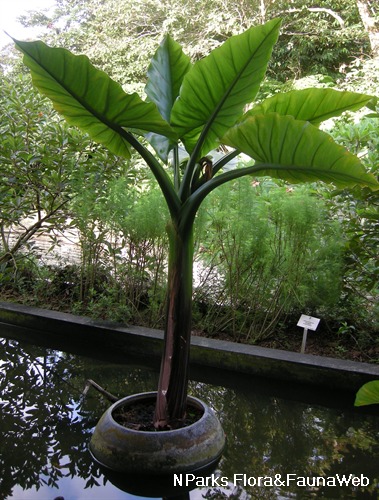
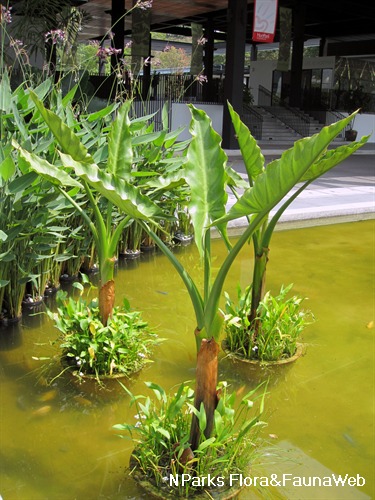
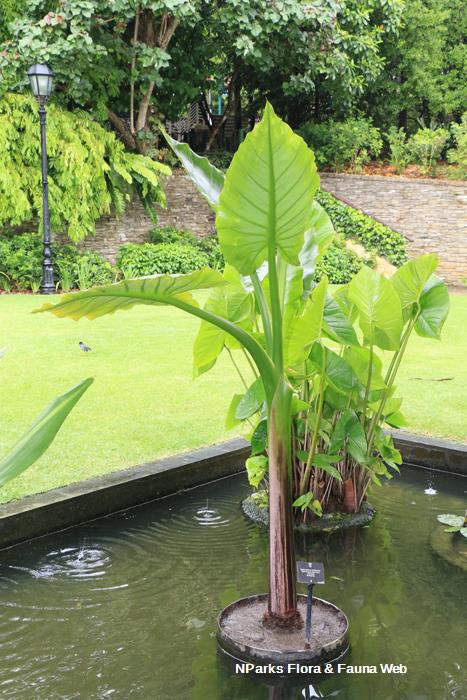
| Growth Form | It is an emergent aquatic herb with an upright form up to 3–4 m and occurs in stands. |
|---|---|
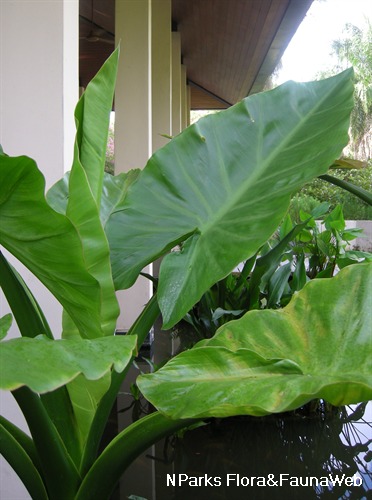
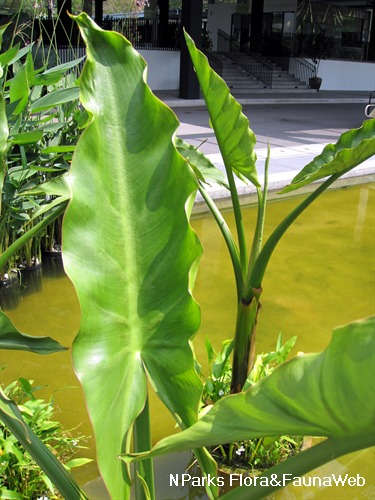
| Foliage | Evergreen leaves, smooth with sub-triangular to sagittate shape, well developed basal ribs with net venation, an undulating, entire edge and an acute apex. The leaves have long petioles and are arranged in a tight spiral to form the pseudo-stem. The base of the pseudo-stem is covered with a aesthetically pleasing brown and pink striped sheath. |
| Stems | The stem of the plant is an underground rhizome. |
| Flowers | The flower of Typhonodorum lindleyanum is a spadix. The spathe is cream coloured and constricted. |
| Fruit | The fruits are in the form of large berries which turn bright yellow when ripe. |
| Habitat | It can be found in shallow water or in marshy places, along rivers, streams, lakes, pond, or lagoons |
| Etymology | The genus is derived from the Greek Typhon 'the personification of stormy winds' and doron'gift'; "gift of the storms". |
Landscaping Features
| Desirable Plant Features | Ornamental Stems, Ornamental Form |
|---|---|
| Landscape Uses | Pond / Lake / River |
| Thematic Landscaping | Water Garden |
| Usage Hazard - Cons | Irritant - Sap |
Fauna, Pollination and Dispersal
| Pollination Method(s) | Biotic (Fauna) |
|---|---|
| Seed or Spore Dispersal | Abiotic (Water) |
Plant Care and Propagation
| Light Preference | Full Sun |
|---|---|
| Water Preference | Lots of Water |
| Rootzone Tolerance | Waterlogged Soils |
| Propagation Method | Division, Viviparious Propagule |
Foliar
| Foliage Retention | Evergreen |
|---|---|
| Mature Foliage Colour(s) | Green |
| Mature Foliage Texture(s) | Smooth |
| Foliar Type | Simple / Unifoliate |
| Foliar Arrangement Along Stem | Spiral |
| Foliar Attachment to Stem | Petiolate |
| Foliar Shape(s) | Non-Palm Foliage |
| Foliar Venation | Pinnate / Net |
| Foliar Margin | Entire - Wavy / Undulate |
| Foliar Apex - Tip | Acute |
Non - Foliar and Storage
| Specialised Storage Organ(s) | Underground (Rhizome) |
|---|
Floral (Angiosperm)
| Flower & Plant Sexuality | Unisexual Flowers |
| Flower Grouping | Cluster / Inflorescence |
|---|---|
| Inflorescence Type | Spathe & Spadix |
Fruit, Seed and Spore
| Mature Fruit Colour(s) | Yellow / Golden |
|---|---|
| Fruit Classification | Simple Fruit |
| Fruit Type | Fleshy Fruit , Non-Accessory Fruit |
Image Repository
Others
| Master ID | 30504 |
|---|---|
| Species ID | 4813 |
| Flora Disclaimer | The information in this website has been compiled from reliable sources, such as reference works on medicinal plants. It is not a substitute for medical advice or treatment and NParks does not purport to provide any medical advice. Readers should always consult his/her physician before using or consuming a plant for medicinal purposes. |