



.jpg)
Back
Aglaia macrocarpa (Miq.) Pannell
| Family Name: | Meliaceae |
| Synonyms: | Aglaia pycnocarpa Miq., Epicharis macrocarpa Miq. |
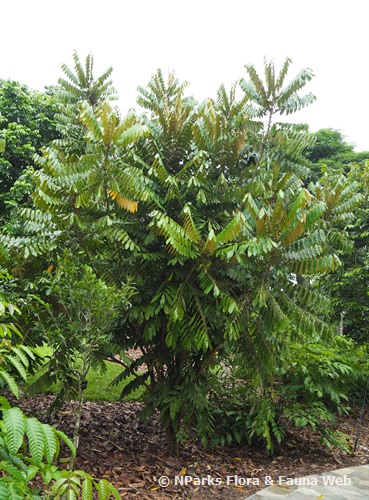
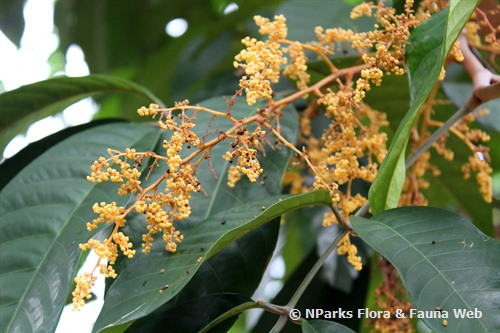
Aglaia macrocarpa is a large tree that can grow to 35 m tall. It has compound leaves with a wrinkled texture, small pear-shaped flowers borne in clusters and bright red to pinkish-yellow fruit. The fruit is a pear-shaped capsule that splits into 3 to 4 lobes upon maturity, revealing its seeds covered completely in a red, orange or white fleshy aril.
.jpg)
.jpg)
.jpg)
.jpg)
Name
Classifications and Characteristics
| Plant Division | Angiosperms (Flowering Seed Plants) (Dicotyledon) |
|---|---|
| Plant Growth Form | Tree (Big (>30m)) |
| Lifespan (in Singapore) | Perennial |
| Mode of Nutrition | Autotrophic |
| Maximum Height | 35 m |
Biogeography
| Native Distribution | Vietnam, Sumatra, Peninsular Malaysia, Singapore, Borneo, the Philippines (Palawan), Java, Sulawesi and Maluku |
|---|---|
| Native Habitat | Terrestrial (Primary Rainforest, Secondary Rainforest, Riverine) |
| Preferred Climate Zone | Tropical, Sub-Tropical / Monsoonal |
| Local Conservation Status | Native to Singapore (Critically Endangered (CR)) |
Description and Ethnobotany
| Growth Form | It is a large tree up to 35 m tall, with reddish-brown bark. Buttresses may be present. |
|---|---|
| Foliage | The leaves are compound pinnate measuring up to 70 cm long. Each leaflet is leathery, egg-shaped, elliptic to broadly lance-shaped, somewhat wrinkled on both sides, measuring 5 - 25 cm long by 2 - 7 cm wide. |
| Stems | Twigs are thick with tips covered in short reddish brown or grey hair-like scales. |
| Flowers | Flowers are borne in an inflorescence, up to 30 cm long and 20 cm wide. The flowering shoots are covered in hair-like scales similar to those on the twigs. Each flower is small, pear-shaped, 3-petalled, measuring 2 - 3.5 mm long by 1.6 mm wide. |
| Fruit | The fruit is a bright red, orange or pinkish-yellow, pear-shaped capsule, measuring at 6 - 7.5 cm long and 3.5 - 7.3 cm wide. Upon maturity, the capsule splits into 3 to 4 lobes and each cavity can contains up to 1 seed. Seeds are enclosed within a red, orange or white fleshy aril. |
| Habitat | Occurs in lowland and hill dipterocarp forest up to 1500 m altitude. |
| Cultivation | It can be propagated by seed. |
| Etymology | The species epithet, 'macrocarpa' refers to the size of the fruit, made up of the greek words, 'makros' meaning large and 'karpos' meaning fruit. |
Fauna, Pollination and Dispersal
| Seed or Spore Dispersal | Biotic (Fauna) |
|---|
Plant Care and Propagation
| Light Preference | Full Sun |
|---|---|
| Water Preference | Moderate Water |
| Plant Growth Rate | Slow |
| Rootzone Tolerance | Fertile Loamy Soils, Moist Soils, Well-Drained Soils |
| Propagation Method | Seed |
Foliar
| Foliage Retention | Evergreen |
|---|---|
| Mature Foliage Colour(s) | Green |
| Foliar Type | Compound (Odd-Pinnate) |
| Foliar Arrangement Along Stem | Spiral |
| Foliar Attachment to Stem | Petiolate |
| Foliar Shape(s) | Non-Palm Foliage (Elliptical, Oblanceolate, Obovate, Ovate) |
| Foliar Venation | Pinnate / Net |
| Foliar Margin | Entire |
| Foliar Apex - Tip | Acuminate, Caudate |
| Foliar Base | Cordate, Rounded / Obtuse |
Non - Foliar and Storage
| Stem Type & Modification | Woody |
|---|---|
| Root Type | Underground (Tap Root) |
Floral (Angiosperm)
| Flower & Plant Sexuality | Bisexual Flowers , Bisexual Flowers |
| Flower Colour(s) | Yellow / Golden |
|---|
| Flower Grouping | Cluster / Inflorescence |
| Flower Location | Axillary |
| Flower Symmetry | Radial |
Fruit, Seed and Spore
| Mature Fruit Colour(s) | Pink, Red, Orange |
|---|---|
| Fruit Classification | Simple Fruit |
| Fruit Type | Dehiscent Dry Fruit , Capsule |
| Seed Quantity Per Fruit | Few (1-5) |
References
| References | Mabberley, D., Pannell, C.M. & Edmonds, J.M. (2013). Meliaceae. In: Kiew, R., Chung, R.C.K., Saw, L.G. & Soepadmo, E. (eds) Flora of Peninsular Malaysia, ser. II, vol. 4, pp. 47- 265. Selangor: Forest Research Institue Malaysia. |
|---|
Image Repository
Others
| Master ID | 32170 |
|---|---|
| Species ID | 6576 |
| Flora Disclaimer | The information in this website has been compiled from reliable sources, such as reference works on medicinal plants. It is not a substitute for medical advice or treatment and NParks does not purport to provide any medical advice. Readers should always consult his/her physician before using or consuming a plant for medicinal purposes. |