



Back
Cyperus mindorensis (Steud.) Huygh
| Family Name: | Cyperaceae |
| Synonyms: | Kyllinga mindorensis Steud., Kyllinga nemoralis (J.R.Forst. & G.Forst.) Dandy ex Hutch. & Dalziel, Kyllinga monocephala Stokes, Cyperus leucocephalus Hassk., Kyllinga cephalotes Druce |
| Common Name: | White Kyllinga, Whitehead Spikesedge, White Water Sedge, 单穗水蜈蚣 |
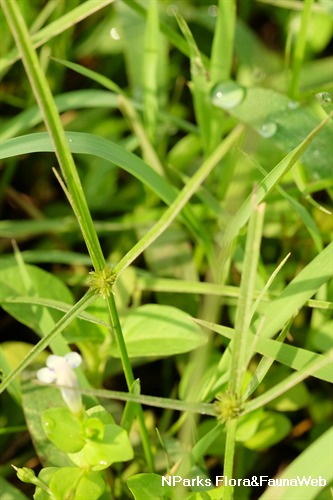
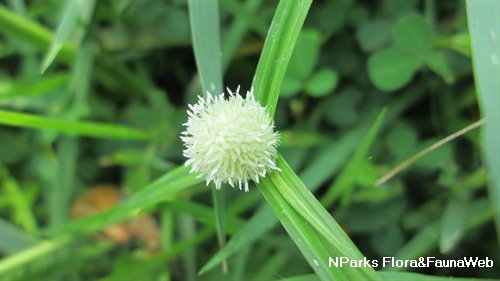
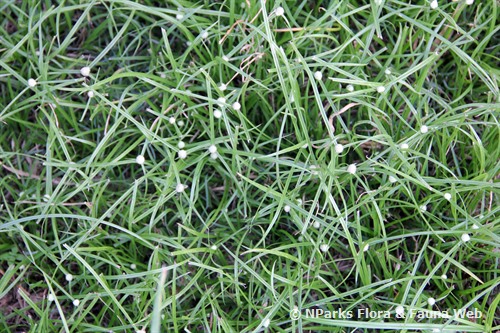
Cyperus mindorensis, commonly known as White Kyllinga, is a small, rhizomatous sedge that is native to grasslands, waysides and forest margins in the Old World Tropics, including Singapore. It produces linear, grass-like leaves and a globose inflorescence made up of white-bracted flowers.
Name
Classifications and Characteristics
| Plant Division | Angiosperms (Flowering Seed Plants) (Monocotyledon) |
|---|---|
| Plant Growth Form | Grass or Grass-like Plant (Sedge (Cyperaceae)) |
| Lifespan (in Singapore) | Perennial |
| Mode of Nutrition | Autotrophic |
Biogeography
| Native Distribution | Gulf of Guinea Islands, St. Helena, West Tropical Africa (Guinea, Liberia, Ivory Coast, Ghana, Togo, Benin, Nigeria), West-Central Tropical Africa (Cameroon, Central African Republic, Gabon, Congo, DR Congo), East Tropical Africa (Uganda, Tanzania), Mozambique, KwaZulu–Natal, ComorosMadagascar, Seychelles, Réunion, Mauritius, Socotra, Transcaucasus, Pakistan, India, Sri Lanka, Laccadive Islands, Bangladesh East & West Himalayas, Nepal, China South-Central, China Southeast, Taiwan, Japan (Ryukyu Islands, Volcano Islands, Bonin Islands), Myanmar, Laos, Vietnam, Cambodia, Thailand, Peninsular Malaysia, Singapore, Borneo, Philippines, Sumatra, Java, Sulawesi, Maluku, Lesser Sunda Island, New Guinea, Australia (Queensland), Bismarck Archipelago, Solomon Islands, Mariana Islands, Caroline Islands, Gilbert Islands, Vanuatu, New Caledonia, Wallis-Futuna Islands, Samoa, Tonga, Tokelau-Manihiki, Cook Islands, Tubuai Islands, Society Island, Tuamotu |
|---|---|
| Native Habitat | Terrestrial (Grassland / Savannah/ Scrubland, Disturbed Area / Open Ground) |
| Preferred Climate Zone | Tropical |
| Local Conservation Status | Native to Singapore (Least Concern (LC)) |
Description and Ethnobotany
| Growth Form | It is a perennial sedge, up to 10–45 cm tall, with a creeping growth habit. |
|---|---|
| Foliage | The leaves are linear, measuring up to 1–16 cm long × 2–5 mm wide. The leaf sheaths are brown to purplish-brown, reaching up to 1–9 cm in length. |
| Stems | The culms (aboveground stems of grasses and grass-like monocots) are smooth, clustered or spaced apart, each reaching 10–45 cm long × 1–1.5 mm in diameter, and triquetrous (with three sharp angles) in cross-section. The underground stems (rhizomes) are long and creeping, ending in single or tufted flowering clusters. |
| Flowers | The pompom-like compound inflorescence is a globose head, consisting of 1–4 globose spikes. Each spike is composed of several egg-shaped spikelets, which are made up of 1–2 flowers. The flowers are known as florets, consisting of heavily reduced petals and sepals, three anthers, and two stigmas, all subtended by five distichous (arranged alternately in two ranks) glumes (scale-like bracts at the base of florets in sedges) that turn from white to pale brown. The compound inflorescence is subtended by 3–4 green, involucral bracts, each measuring up to 50 cm long. The flowering stem is hollow and triquetrous in cross-section. |
| Fruit | The fruit is a nutlet (achenes in literature) that is oblong or approximately round and shaped like a lens from the side. It measures up to 1.2–1.5 mm long × 0.5–0.7 mm wide, and turns brownish upon maturity. |
| Habitat | It can be found in open or slightly shaded grasslands, waysides and forest margins, up to 1000 m above sea level. |
| Cultivation | This species is generally considered a weed and not cultivated. |
| Etymology | The genus Cyperus is derived from the Greek name for a sedge. The specific epithet mindorensis means "from Mindoro", an island of the Philippines. |
| Ethnobotanical Uses | Medicinal: A decoction of the rhizomes is used to treat fever, while the entire plant is used to treat sprains and bruises. |
Landscaping Features
| Usage Hazard - Cons | Invasive / Potentially Invasive |
|---|
Plant Care and Propagation
| Light Preference | Full Sun |
|---|---|
| Water Preference | Lots of Water |
| Plant Growth Rate | Fast |
| Rootzone Tolerance | Poor Infertile Soils, Rootbound Conditions, Heavy Clay Soils |
| Propagation Method | Seed, Stolon / Runner |
Foliar
| Foliage Retention | Evergreen |
|---|---|
| Mature Foliage Colour(s) | Green |
| Mature Foliage Texture(s) | Smooth |
| Foliar Modification | Flower/Fruit Bract |
| Foliar Type | Simple / Unifoliate |
| Foliar Arrangement Along Stem | Spiral |
| Foliar Attachment to Stem | Sessile |
| Foliar Shape(s) | Non-Palm Foliage (Linear) |
| Foliar Venation | Parallel |
| Foliar Margin | Entire |
| Foliar Apex - Tip | Acute |
| Leaf Area Index (LAI) for Green Plot Ratio | 2.0 (Turfgrass) |
Non - Foliar and Storage
| Root Type | Underground (Fibrous Root) |
|---|
Floral (Angiosperm)
| Flower & Plant Sexuality | Bisexual Flowers |
| Flower Colour(s) | White |
|---|---|
| Flower Texture(s) | Smooth |
| Flower Grouping | Cluster / Inflorescence |
| Flower Location | Terminal |
| Inflorescence Type | Spikelet / Pseudospikelet / Compound Spike |
| Flowering Period | Free-Flowering |
Fruit, Seed and Spore
| Mature Fruit Colour(s) | Brown |
|---|---|
| Fruit Classification | Simple Fruit |
| Fruit Type | Indehiscent Dry Fruit , Achene |
References
| References | Simpson, D.A. (2019). Cyperaceae. Flora of Singapore, Volume 7. Singapore: National Parks Board. pp 37-211. |
|---|
Image Repository
Others
| Master ID | 32603 |
|---|---|
| Species ID | 7015 |
| Flora Disclaimer | The information in this website has been compiled from reliable sources, such as reference works on medicinal plants. It is not a substitute for medical advice or treatment and NParks does not purport to provide any medical advice. Readers should always consult his/her physician before using or consuming a plant for medicinal purposes. |