



Back
Cyperus brevifolius (Rottb.) Hassk.
| Family Name: | Cyperaceae |
| Synonyms: | Kyllinga brevifolia Rottb., Cyperus cruciformis |
| Common Name: | Short-leaved Kyllinga, Shortleaf Spikesedge, Green Kyllinga |
Name
Classifications and Characteristics
| Plant Division | Angiosperms (Flowering Seed Plants) (Monocotyledon) |
|---|---|
| Plant Growth Form | Grass or Grass-like Plant (Sedge (Cyperaceae)) |
| Lifespan (in Singapore) | Perennial |
| Mode of Nutrition | Autotrophic |
| Maximum Height | 0.07 m to 0.3 m |
Biogeography
| Native Distribution | Pantropical |
|---|---|
| Native Habitat | Terrestrial (Disturbed Area / Open Ground, Agricultural Land, Grassland / Savannah/ Scrubland), Shoreline (Sandy Beach) |
| Preferred Climate Zone | Tropical |
| Local Conservation Status | Native to Singapore (Vulnerable (VU)) |
Description and Ethnobotany
| Growth Form | It is a perennial sedge up to 0.3 m tall. |
|---|---|
| Foliage | A few basal leaves occur at the base of the flowering stem (known as a culm). The 2-3 mm wide, linear leaves are usually shorter than the culm and have membranous leaf sheaths which are brown or purplish brown. |
| Stems | The rhizome (an underground horizontal stem) is thin and long. It produces the flowering stems in small clusters or along the length of the rhizome with varying amounts of spacing. |
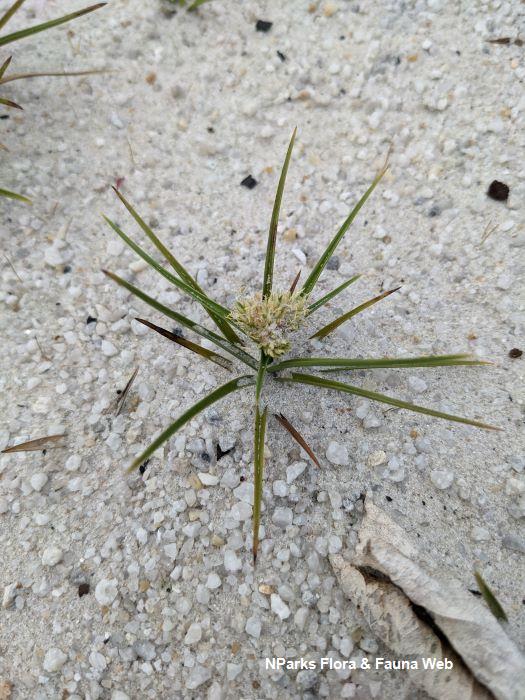
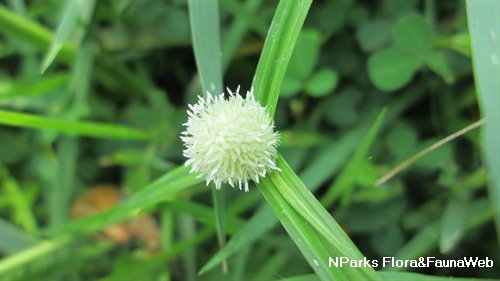
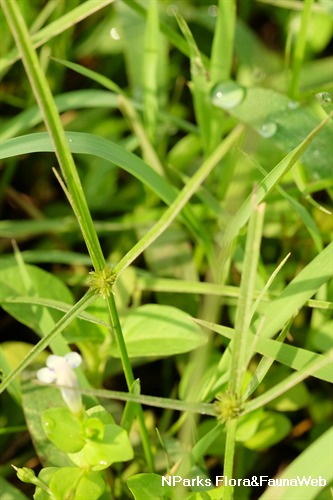
| Flowers | The inflorescence is shaped like a round to slightly egg-shaped pompom which is light green and turning yellowish green at maturity (5-10 mm in diameter). It is composed of oblong to lance-shaped, flattened spikelets (3-3.5 mm long, 1 mm wide) which each have 4 glumes. At the base of the inflorescence, there are 3 leaf-like bracts of unequal size which are radially distributed from the inflorescence. |
| Fruit | The dry, indehiscent, 1-seeded fruit is known as an achene. The brown, lentil-shaped (biconvex, flattened disk shape) fruit is 1.5 mm long. |
| Habitat | It can be found in wet to dry grasslands, waysides, sandy areas near seashores, as well as marings of paddy fields and forest plantations. |
| Etymology | The genus Cyperus is Greek name for a sedge. The specific epithet brevifolius is Latin for 'short-leaved'. |
Plant Care and Propagation
| Light Preference | Full Sun |
|---|---|
| Water Preference | Lots of Water |
Foliar
| Mature Foliage Colour(s) | Green |
|---|---|
| Foliar Type | Simple / Unifoliate |
| Foliar Arrangement Along Stem | Basal |
| Foliar Attachment to Stem | Sessile |
| Foliar Shape(s) | Non-Palm Foliage (Linear) |
| Foliar Venation | Parallel |
| Foliar Margin | Entire |
| Foliar Apex - Tip | Acuminate |
| Foliar Base | Clasping |
Floral (Angiosperm)
| Flower Colour(s) | Green - Light Green |
|---|---|
| Flower Grouping | Cluster / Inflorescence |
| Flower Location | Terminal |
| Inflorescence Type | Spikelet / Pseudospikelet / Compound Spike |
Fruit, Seed and Spore
| Mature Fruit Colour(s) | Brown |
|---|---|
| Fruit Classification | Simple Fruit |
| Fruit Type | Indehiscent Dry Fruit , Achene |
Image Repository
Others
| Master ID | 32604 |
|---|---|
| Species ID | 7016 |
| Flora Disclaimer | The information in this website has been compiled from reliable sources, such as reference works on medicinal plants. It is not a substitute for medical advice or treatment and NParks does not purport to provide any medical advice. Readers should always consult his/her physician before using or consuming a plant for medicinal purposes. |