





Back
Holmskioldia sanguinea 'Mandarin Rouge'
| Family Name: | Lamiaceae (Labiatae) |
| Common Name: | Red Chinese Hat |
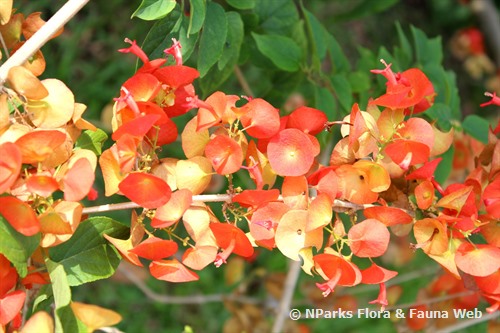
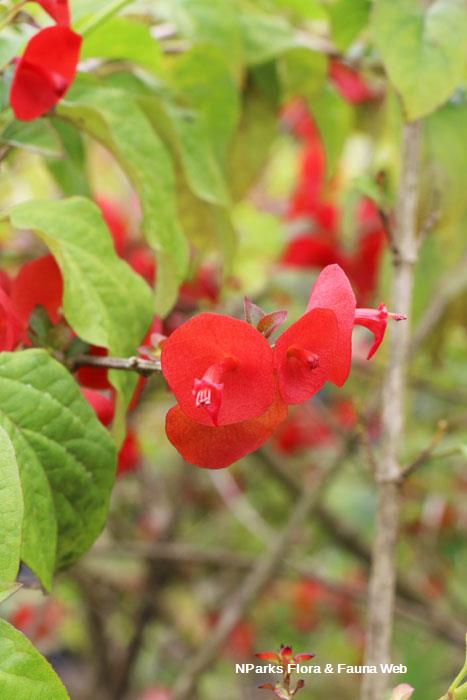
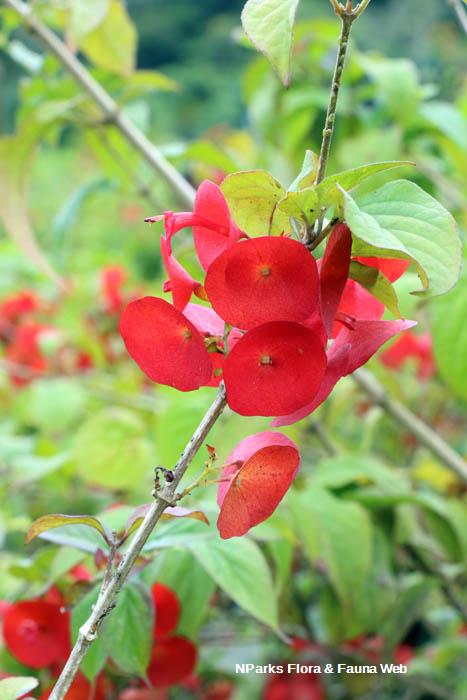
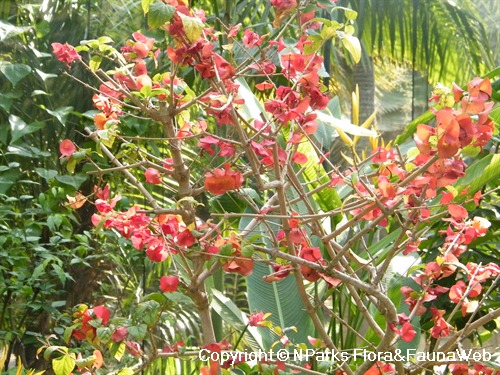
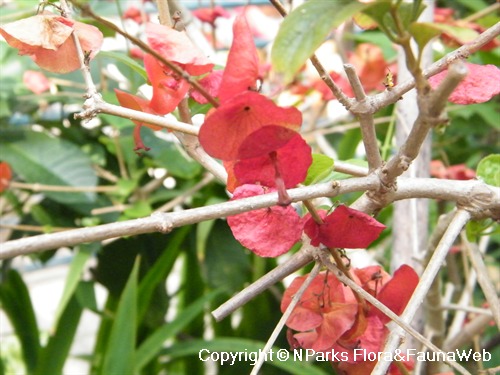
Holmskioldia sanguinea 'Mandarin Rouge' is the red cultivar of the Chinese Hat plant, producing clusters of distinctive cup-and-saucer shaped flowers. It flowers best under full sun with moderate watering and fertile loamy soil. This climbing shrub makes an excellent specimen plant, or hedge for screening in parks and gardens for its cascading feature.
Name
Classifications and Characteristics
| Plant Division | Angiosperms (Flowering Seed Plants) (Dicotyledon) |
|---|---|
| Plant Growth Form | Shrub, Climber |
| Lifespan (in Singapore) | Perennial |
| Mode of Nutrition | Autotrophic |
| Plant Shape | Shrubby, Irregular |
Biogeography
| Native Habitat | Terrestrial |
|---|---|
| Preferred Climate Zone | Tropical, Sub-Tropical / Monsoonal |
| Local Conservation Status | Non-native (Horticultural / Cultivated Only) |
Description and Ethnobotany
| Growth Form | A scandent shrub to climber. |
|---|---|
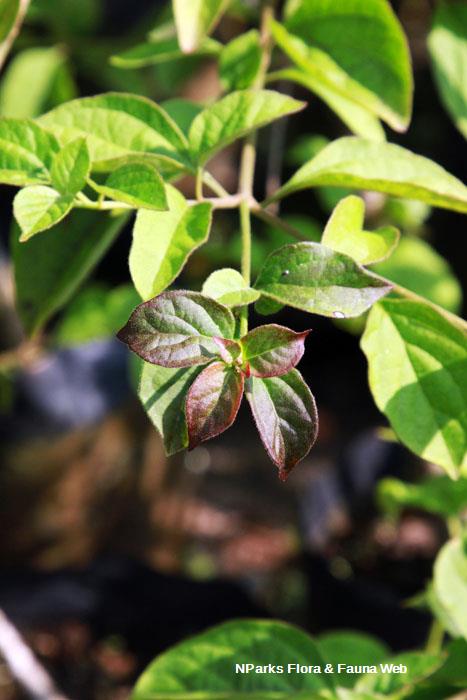
| Foliage | The leaves are ovate to elliptic-ovate with a dentate edge, arranged oppositely along the stem. The leaf blade has truncate base and acuminate leaf tip. The leaf texture is smooth to pubescent (covered in fine, short hair). |
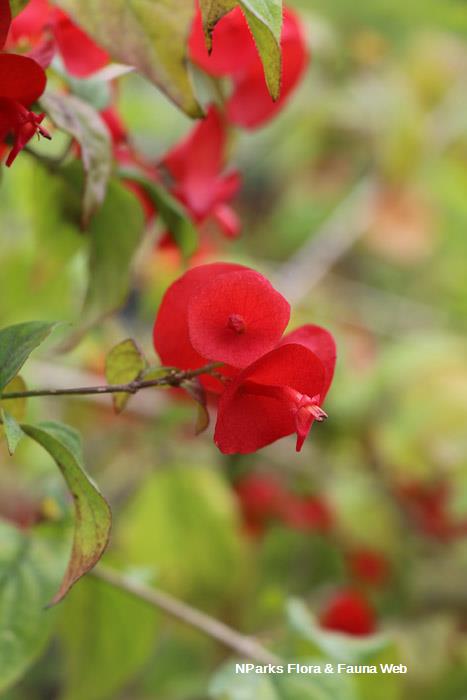
| Flowers | The showy flower has deep red petals and calyx. The calyx is enlarged to form a broad umbrella-like 'hat'. The flowers are trumpet-shaped with curved corolla tube, widening outwards to form 5 unequal lobes. The flowers are borne on axillary cymes. |
| Fruit | Drupe, deeply 4-lobed but not seen in local cultivation. |
| Etymology | The genus Holmskioldia is named for Theodore Holmskjold (1732-1794), a Danish physician and botanist. The specific epithet sanguinea means blood-red, with reference to the red flowers. |
Landscaping Features
| Landscaping | It is suitable for cultivation in the parks and gardens for its beautiful red flowers, resembling cups and saucers. |
|---|---|
| Desirable Plant Features | Ornamental Flowers |
| Landscape Uses | General, Hedge / Screening, Parks & Gardens |
Plant Care and Propagation
| Light Preference | Full Sun |
|---|---|
| Water Preference | Moderate Water, Little Water |
| Plant Growth Rate | Fast to Moderate |
| Rootzone Tolerance | Fertile Loamy Soils, Well-Drained Soils, Moist Soils |
| Pruning | It requires regular pruning to prevent stems from becoming too elongated. |
| Propagation Method | Stem Cutting (Hardwood, Semi-Hardwood), Root Cutting, Air-Layering |
Foliar
| Foliage Retention | Evergreen |
|---|---|
| Mature Foliage Colour(s) | Green |
| Mature Foliage Texture(s) | Smooth, Velvety / Furry / Tomentose |
| Prominent Young Flush Colour(s) | Green |
| Young Flush Texture(s) | Smooth |
| Foliar Type | Simple / Unifoliate |
| Foliar Arrangement Along Stem | Opposite |
| Foliar Attachment to Stem | Petiolate |
| Foliar Shape(s) | Non-Palm Foliage (Ovate, Elliptical) |
| Foliar Venation | Pinnate / Net |
| Foliar Margin | Serrate / Toothed |
| Foliar Apex - Tip | Acuminate |
| Foliar Base | Truncate / Square |
Floral (Angiosperm)
| Flower & Plant Sexuality | Bisexual Flowers |
| Flower Colour(s) | Red |
|---|---|
| Flower Texture(s) | Smooth |
| Flower Grouping | Cluster / Inflorescence |
| Flower Location | Axillary |
| Flower Symmetry | Bilateral |
| Individual Flower Shape | Trumpet-shaped, Tubular |
| Inflorescence Type | Cyme |
| Flowering Period | Free-Flowering |
| Flowering Habit | Polycarpic |
Fruit, Seed and Spore
| Fruit Type | Fleshy Fruit , Drupe |
Image Repository
Others
| Master ID | 30576 |
|---|---|
| Species ID | 4885 |
| Flora Disclaimer | The information in this website has been compiled from reliable sources, such as reference works on medicinal plants. It is not a substitute for medical advice or treatment and NParks does not purport to provide any medical advice. Readers should always consult his/her physician before using or consuming a plant for medicinal purposes. |