






Back
Dendrobium leonis (Lindl.) Rchb.f.
| Family Name: | Orchidaceae |
| Common Name: | The Lion-like Dendrobium |
Name
Classifications and Characteristics
| Plant Division | Angiosperms (Flowering Seed Plants) (Monocotyledon) |
|---|---|
| Plant Growth Form | Epiphyte, Herbaceous Plant |
| Lifespan (in Singapore) | Perennial |
| Mode of Nutrition | Autotrophic |
| Plant Shape | Open |
| Maximum Height | 25 cm |
| Maximum Plant Spread / Crown Width | 25 cm |
Biogeography
| Native Distribution | Myanmar, Laos, Vietnam, Cambodia, Thailand, Peninsular Malaysia, Singapore, Borneo and Sumatra |
|---|---|
| Native Habitat | Terrestrial (Primary Rainforest) |
| Preferred Climate Zone | Tropical |
| Local Conservation Status | Native to Singapore (Critically Endangered (CR)) |
Description and Ethnobotany
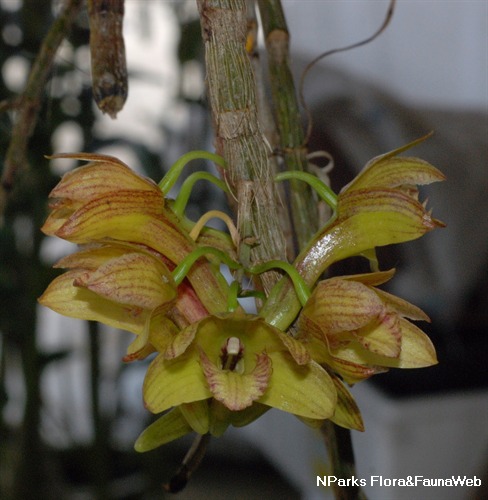
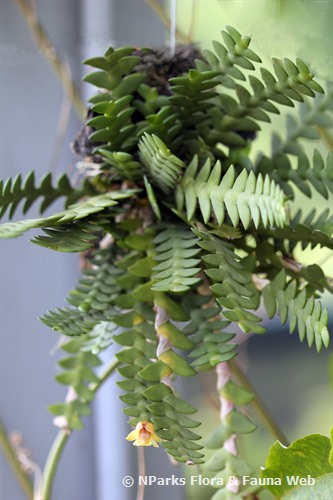
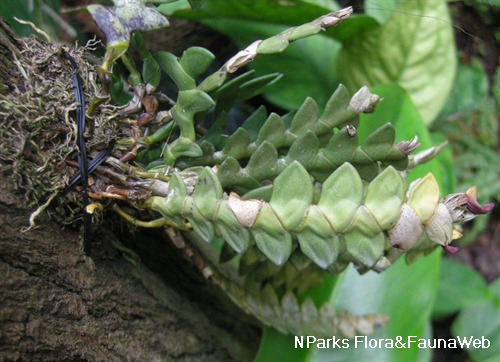
| Growth Form | A lowland epiphytic orchid with multiple tufted stems and can grow up to 25 cm in length. |
|---|---|
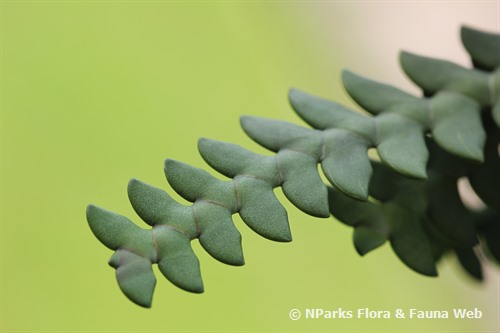
| Foliage | The leaves are thick and laterally flattened, no groove seen on the upper leaf surface and are smooth and very stiff. Leaves are triangular-shaped and arranged in alternating rows. |
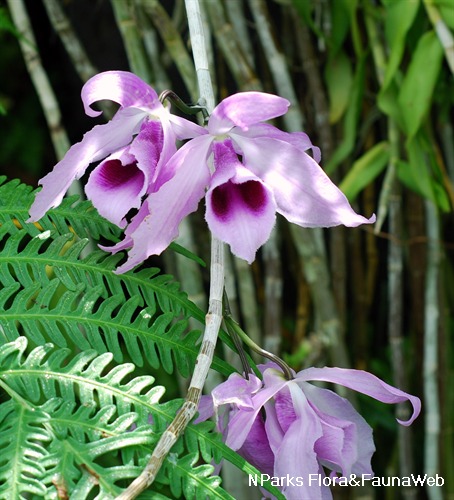
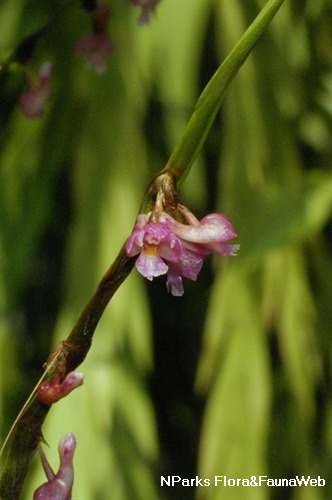
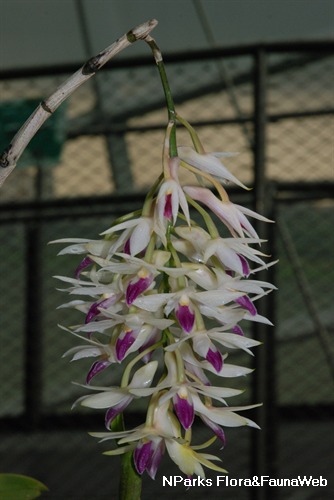
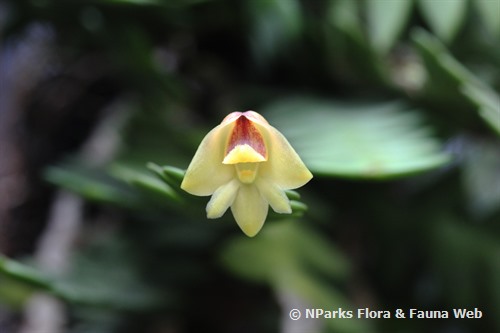
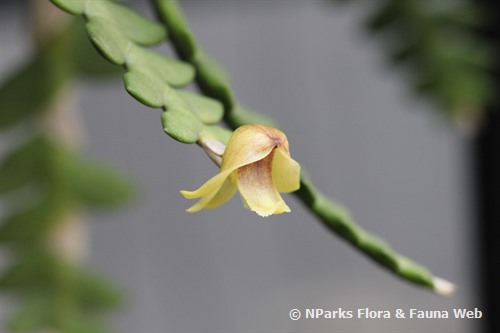
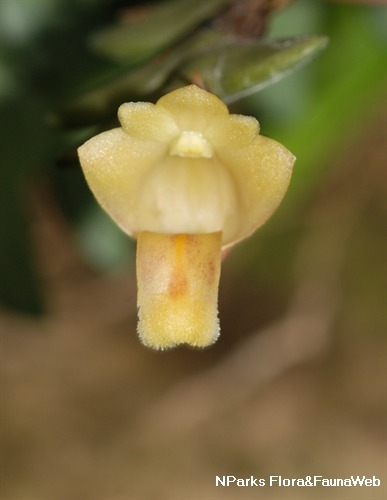
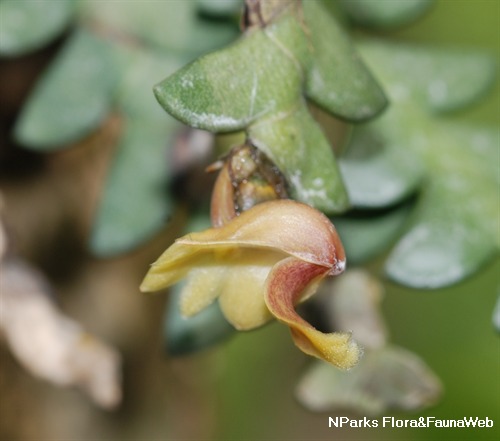
| Flowers | Flowers are occur at the stem apex and are single-flowered, originating from a tuft of scarious bracts. Flower size ranges from 1.3 to 2.0cm. The flower tepals are pale green or yellow with the lip being a very pale green and flushed with dark purple. Flowers have sweet, vanilla-like fragrance. |
| Habitat | It is found growing as epiphyte or occasionally lithophyte on limestone cliffs, in warm, humid lowland forests at elevation of sea level to 1100 m. |
| Etymology | The genus name Dendrobium is derived from greek ‘dendros’ meaning tree and ‘bios’ meaning life, referring to the epiphytic nature of the members of the genus. The species leonis means lion-like, referring to the lion’s maw. |
| Ethnobotanical Uses | Medicinal: The plant is used to treat headache in Thailand. |
Landscaping Features
| Desirable Plant Features | Ornamental Flowers, Ornamental Foliage, Fragrant (Flowers) |
|---|---|
| Landscape Uses | Parks & Gardens |
Plant Care and Propagation
| Light Preference | Semi-Shade |
|---|---|
| Water Preference | Little Water, Occasional Misting |
| Plant Growth Rate | Moderate |
| Rootzone Tolerance | Well-Drained Soils |
| Potential Problems | No serious pest or disease problems. |
| Propagation Method | Division |
Foliar
| Foliage Retention | Evergreen |
|---|---|
| Mature Foliage Colour(s) | Green |
| Mature Foliage Texture(s) | Thick |
| Prominent Young Flush Colour(s) | Green |
| Young Flush Texture(s) | Thick |
| Foliar Type | Simple / Unifoliate |
| Foliar Arrangement Along Stem | Alternate |
| Foliar Attachment to Stem | Sessile |
| Foliar Shape(s) | Non-Palm Foliage |
| Foliar Venation | Parallel |
| Foliar Margin | Entire |
| Foliar Apex - Tip | Acute |
| Foliar Base | Clasping |
Floral (Angiosperm)
| Flower & Plant Sexuality | Bisexual Flowers |
| Flower Colour(s) | Yellow / Golden |
|---|---|
| Flower Texture(s) | Thick / Fleshy |
| Flower Grouping | Solitary |
| Flower Location | Axillary |
| Flower Symmetry | Bilateral |
| Individual Flower Shape | Labiate / Lipped |
| Flowering Period | A Few Times Yearly |
Image Repository
Others
| Master ID | 30648 |
|---|---|
| Species ID | 4957 |
| Flora Disclaimer | The information in this website has been compiled from reliable sources, such as reference works on medicinal plants. It is not a substitute for medical advice or treatment and NParks does not purport to provide any medical advice. Readers should always consult his/her physician before using or consuming a plant for medicinal purposes. |