




_wt(1).jpg)
Back
Celosia argentea Plumosa Group
| Family Name: | Amaranthaceae |
| Common Name: | Plumed Celosia, Feather Celosia, Feathered Amaranth, 凤尾草, 凤尾鸡冠花 |
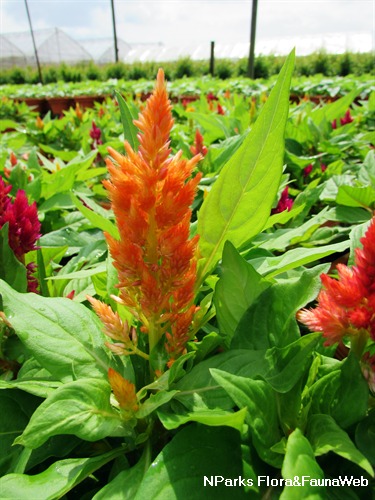
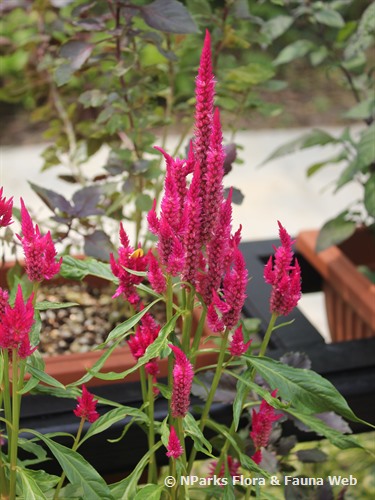
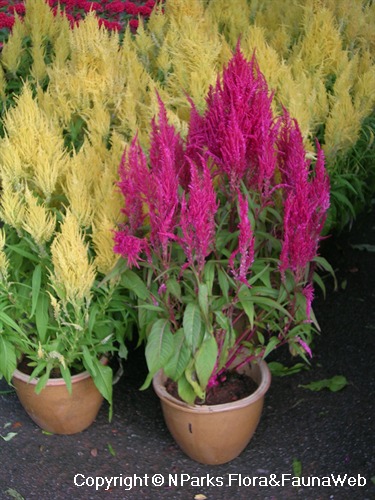
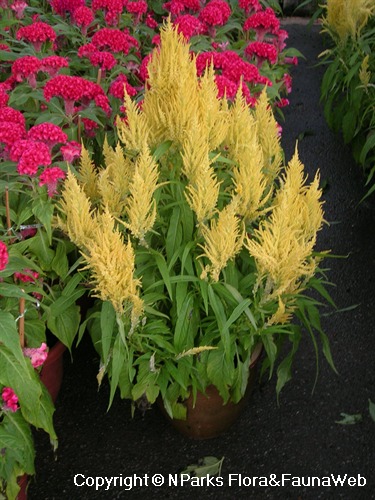
Celosia argentea Plumosa Group, commonly known as Plumed Celosia, is a popular herbaceous plant during Chinese New Year for its striking red or yellow inflorescences. It thrives in full sun with well-drained soil and is favoured both as vibrant garden plants and long-lasting cut flowers.
Name
Classifications and Characteristics
| Plant Division | Angiosperms (Flowering Seed Plants) (Dicotyledon) |
|---|---|
| Plant Growth Form | Herbaceous Plant |
| Lifespan (in Singapore) | Annual |
| Mode of Nutrition | Autotrophic |
| Plant Shape | Columnar |
| Maximum Height | 0.2 m to 1 m |
| Maximum Plant Spread / Crown Width | 0.2 m to 0.6 m |
Biogeography
| Preferred Climate Zone | Tropical, Sub-Tropical / Monsoonal |
|---|---|
| Local Conservation Status | Non-native (Horticultural / Cultivated Only) |
| CITES Protection | False |
Description and Ethnobotany
| Growth Form | Annual herbaceous plant up to 1 m tall with erect growth form. |
|---|---|
| Foliage | Lance-shaped to elliptic leaves occur in alternate arrangement (one leaf per node along the stem). |
| Flowers | Inflorescence is shaped like a feathery, narrow pyramid up to 25 cm long. |
| Fruit | Small, egg-shaped fruit is known as a utricle (3‒3.5 mm long). It contains many, round, black seeds. |
| Taxonomy | This plant is sometimes referred to as Celosia argentea var. plumosa in the horticultural trade, but that is a synonym for Celosia argentea. |
| Cultivation | This low maintenance plant grows best under full sun in well-drained soil that is rich in organic matter. Removing mature, faded flowers helps to prolong blooming by re-directing plant resources to creating new blooms rather than producing seed. Large plants should be staked and protected from strong wind. |
Landscaping Features
| Desirable Plant Features | Ornamental Flowers |
|---|---|
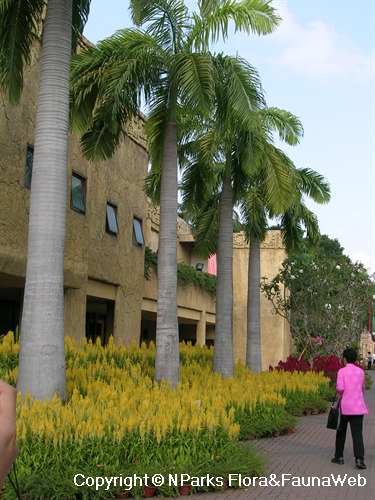
| Landscape Uses | Container Planting, Flowerbed / Border |
Plant Care and Propagation
| Light Preference | Full Sun |
|---|---|
| Water Preference | Moderate Water |
| Plant Growth Rate | Fast |
| Rootzone Tolerance | Fertile Loamy Soils, Well-Drained Soils |
| Maintenance Requirements | Low |
| Propagation Method | Seed |
Foliar
| Mature Foliage Colour(s) | Green |
|---|---|
| Mature Foliage Texture(s) | Smooth |
| Foliar Type | Simple / Unifoliate |
| Foliar Arrangement Along Stem | Alternate |
| Foliar Shape(s) | Non-Palm Foliage (Lanceolate) |
| Foliar Venation | Pinnate / Net |
| Foliar Margin | Entire |
| Foliar Apex - Tip | Acuminate |
Non - Foliar and Storage
| Stem Type & Modification | Herbaceous |
|---|
Floral (Angiosperm)
| Flower & Plant Sexuality | Bisexual Flowers |
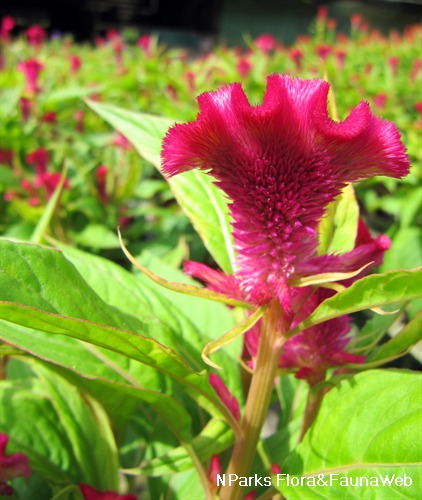
| Flower Colour(s) | Red, Yellow / Golden, Orange, Cream / Off-White, Purple |
|---|---|
| Flower Grouping | Cluster / Inflorescence |
| Flower Location | Terminal |
| Flower Lifespan on Plant | Several Weeks |
Image Repository
Others
| Master ID | 500 |
|---|---|
| Species ID | 1796 |
| Flora Disclaimer | The information in this website has been compiled from reliable sources, such as reference works on medicinal plants. It is not a substitute for medical advice or treatment and NParks does not purport to provide any medical advice. Readers should always consult his/her physician before using or consuming a plant for medicinal purposes. |