
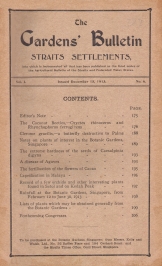
Year of Publication: 1939, Vol. 10 (01) (The Gardens' Bulletin, Straits Settlements)
Date Published
10 January 1939
Corner, E. J. H.
Notes on the Systematy and Distribution of Malayan Phanerogams, I [Page 1 - 55]
Notes on the Systematy and Distribution of Malayan Phanerogams, I [Page 1 - 55]
Abstract:
No abstract
Download PDF (
18321KB
)
about
No abstract
Corner, E. J. H.
Notes on the Systematy and Distribution of Malayan Pahnerogams, II [Page 56 - 81]
Notes on the Systematy and Distribution of Malayan Pahnerogams, II [Page 56 - 81]
Abstract:
Throughout the Malayan region, from Sumatra to New Guinea, there are two vollage-trees that are called in Malay "nangka" and "chempedak". The first is better known as the Jack ( from its Indian name "jaka"): for the other we must at present borrow from the Malay beause there is no alternative. In Malaya we also have a wild form of Chempedak that is scattered in the high forest throughout the mainland from the lowlands to an altitude of 4,000ft: it is called "Bangkong" or, in Johore, "barok"but only the first is well-known and that only in the middle of the country. I shall refer to it as the Wild Chempedak. Now I use these vernacular names purposely because, until these pages have been read, I do not see how anyone, be the botanist or not, European or Asiatic, can know what are the specific differences between the plants or what may be their botanical names. The best recent descriptions of them are those given by Bakhuizen van den Brink in Ochse's two books. There are, however, about two dozen distinctions most of which have not been described and it appears that a post-Linnean study of the Chempedak-fruit has never been made, leastways not published: indeed, for what one may read about it in botanical literature, the Chempedak may be likened to a Dodo. The most informative and authoritative descriptions are those on the "Nanka" and "Tsjampedaha" written by Rumphius in 1690 though not published until 1750 (Herb. Amboin. tom. I.) and that on the "Tsjakamaram" published by Governor Rheede in 1682 (Hort. Malab., III), though, being pre-linnean, one would assign to them only a historical value. As for the wild Chempedak, what is yet written concerning it is little more than the record. Since I began this investigation, however, I have been fortunate in finding a fruiting tree in the East of Johore, several such trees by the Tahan River in Pahang. I have thus been able to study the Wild Chempedak critically. In the first part of this paper I have compared these plants as fully as possible and, in the second part, I have argued what must be their correct botanical names. As the results are somewhat momentous and I have no doubt that what I have discovered will not be acceptable to many, I have investigated the problem with the greatest care. For nearly 150 years the Jack has been called Artocarpus integrifolia Linn. f. but the name was changed recently to A. integra (Thunb.) Merrill without any reason. In checking the alteration, I found that the original descriptions of both names referred to the Chempedak and I can now add that the type-specimen of both is the Chempedak. The name A. integra or, correctly, A. integer which has been used in error for the Jack must now be given to the Chempedak and for the Jack one must resuscitate its earliest legitimate synonym which is A. heterophylla Lam. or, correctly A. heterophyllus. It is evident that not merely has the botany of these common plants being neglected but no systematist has ever referred critically to the original description of A. integer or A. integrifolia and the type of both names has never been re-examined: oranges and lemons, as it were, have been confounded. For the Wild Chempedak I have made the new variety A. integer var. silvestris.
Download PDF (
34835KB
)
about
Throughout the Malayan region, from Sumatra to New Guinea, there are two vollage-trees that are called in Malay "nangka" and "chempedak". The first is better known as the Jack ( from its Indian name "jaka"): for the other we must at present borrow from the Malay beause there is no alternative. In Malaya we also have a wild form of Chempedak that is scattered in the high forest throughout the mainland from the lowlands to an altitude of 4,000ft: it is called "Bangkong" or, in Johore, "barok"but only the first is well-known and that only in the middle of the country. I shall refer to it as the Wild Chempedak. Now I use these vernacular names purposely because, until these pages have been read, I do not see how anyone, be the botanist or not, European or Asiatic, can know what are the specific differences between the plants or what may be their botanical names. The best recent descriptions of them are those given by Bakhuizen van den Brink in Ochse's two books. There are, however, about two dozen distinctions most of which have not been described and it appears that a post-Linnean study of the Chempedak-fruit has never been made, leastways not published: indeed, for what one may read about it in botanical literature, the Chempedak may be likened to a Dodo. The most informative and authoritative descriptions are those on the "Nanka" and "Tsjampedaha" written by Rumphius in 1690 though not published until 1750 (Herb. Amboin. tom. I.) and that on the "Tsjakamaram" published by Governor Rheede in 1682 (Hort. Malab., III), though, being pre-linnean, one would assign to them only a historical value. As for the wild Chempedak, what is yet written concerning it is little more than the record. Since I began this investigation, however, I have been fortunate in finding a fruiting tree in the East of Johore, several such trees by the Tahan River in Pahang. I have thus been able to study the Wild Chempedak critically. In the first part of this paper I have compared these plants as fully as possible and, in the second part, I have argued what must be their correct botanical names. As the results are somewhat momentous and I have no doubt that what I have discovered will not be acceptable to many, I have investigated the problem with the greatest care. For nearly 150 years the Jack has been called Artocarpus integrifolia Linn. f. but the name was changed recently to A. integra (Thunb.) Merrill without any reason. In checking the alteration, I found that the original descriptions of both names referred to the Chempedak and I can now add that the type-specimen of both is the Chempedak. The name A. integra or, correctly, A. integer which has been used in error for the Jack must now be given to the Chempedak and for the Jack one must resuscitate its earliest legitimate synonym which is A. heterophylla Lam. or, correctly A. heterophyllus. It is evident that not merely has the botany of these common plants being neglected but no systematist has ever referred critically to the original description of A. integer or A. integrifolia and the type of both names has never been re-examined: oranges and lemons, as it were, have been confounded. For the Wild Chempedak I have made the new variety A. integer var. silvestris.
Corner, E. J. H.
A Revision of Ficus, Subgenus Synoecia [Page 82 - 161]
A Revision of Ficus, Subgenus Synoecia [Page 82 - 161]
Abstract:
When King's monograph of Ficus appeared fifty years ago, there were six species of Synoecia. Eleven others have since been described, one from Formosa, eight from Philippines and two from Borneo. That from Formosa, F. terasoensis, has already been identified with the Philippine F. megacarpa. I now find that F. megacarpa is a leaf-variety of the widespread F. callicarpa and that five more of the Philippines novelties have been misplaced in Synoecia: four belong to Eusyce, and one has already been transferred to Urostigna. Of these eleven, there remain, as proved species, only two from the Philippines, namely F. Bordenii and F. cataupi, and one from Borneo, F. tawaensis: concerning F. Simiae, of Borneo, I am uncertain (p. 145). In 1932 and 1933, the late Mr. C. E. Carr, F.L.S., collected for seven months on Mt. Kinabalu in British North Borneo. At my request he made a special study of wild figs, taking careful field-notes on the colours of the receptacles and preserving material in spirit as well as dried. He collected five species of Synoecia, four of which I describe as new in this paper, namely F. barba-jovis, F. Carri, F. dens-echini and F. tulipifera. The importance of this magnificent collection was at once evident from my own studies on the Malayan species; it has led me to revise the subgenus. A fifth new species, F. grandiflora, I describe from a collection of Mr. amd Mrs. J. Clemens, also from Kinabalu. I am obliged also to make four new varieties of F. callicarpa. When thus pruned and extended, the subgenus contains 13 good species, two doubtful species (F. Simiae and F. singalana ) and four varieties. To the descriptions, themselves, I have added several critical diagnostic characters, particularly of the flowers and leaves, that have been overlooked but without which the affinity of the species cannot be ascertained. Indeed, previous descriptions of the species convey little idea of their decisive character. I have arranged the species in what seems to be their natural order (p. 95), but our knowledge of the subgenus is very imperfect. That the number of species could have been doubled in the last ten years and that all these novelties should have come from one part of British North Borneo reflect sadly on our ignorance of the flora of large areas of the Malay Archipelago. Because they are big climbers, the species have doubtless escaped the attention of field botanists, for no other sort of plant is more difficult to collect. The uncertain specificity of F. callicarpa and F. punctata shows, too, the need of many more collections of these common plants from such countries as Sumatra, Borneo and Celebes, Palawan, Timor, Flores and the Moluccas. There is undoubtedly a variation afoot which suggests the persistent evolution of the species. In spite of its expansion Synoecia, as understood by King, remains a most natural subgenus. Its area of distribution must also indicate the natural limit of the greater part of the Malaysian flora (p. 91). When the distribution of the species is better known it will provide some critical evidence for the history of the Archipelago. For the completion of this revision I was permitted to borrow the rich collections in the Herbaria at Buitenzorg, Manila and Calcutta, and I express my thanks to the Directors of these institutions, to Dr. D. F. van Slooten of Buitenzorg, Dr. E. Quisumbing of Manila and to Mr. J. D. Srinivasan of Calcutta, for their unstinted assistance. I have to thank also Mr. C. E. C. Fischer, of Kew Herbarium for kindly examining the type-specimen of F. Scratchleyana at the British Museum, and Dr. T. Sata of Taihoku Imperial University, Formosa, for a specimen of F. terasoensis. In the citation of collections under each species only the collections that I have examined are mentioned.
Download PDF (
21774KB
)
about
When King's monograph of Ficus appeared fifty years ago, there were six species of Synoecia. Eleven others have since been described, one from Formosa, eight from Philippines and two from Borneo. That from Formosa, F. terasoensis, has already been identified with the Philippine F. megacarpa. I now find that F. megacarpa is a leaf-variety of the widespread F. callicarpa and that five more of the Philippines novelties have been misplaced in Synoecia: four belong to Eusyce, and one has already been transferred to Urostigna. Of these eleven, there remain, as proved species, only two from the Philippines, namely F. Bordenii and F. cataupi, and one from Borneo, F. tawaensis: concerning F. Simiae, of Borneo, I am uncertain (p. 145). In 1932 and 1933, the late Mr. C. E. Carr, F.L.S., collected for seven months on Mt. Kinabalu in British North Borneo. At my request he made a special study of wild figs, taking careful field-notes on the colours of the receptacles and preserving material in spirit as well as dried. He collected five species of Synoecia, four of which I describe as new in this paper, namely F. barba-jovis, F. Carri, F. dens-echini and F. tulipifera. The importance of this magnificent collection was at once evident from my own studies on the Malayan species; it has led me to revise the subgenus. A fifth new species, F. grandiflora, I describe from a collection of Mr. amd Mrs. J. Clemens, also from Kinabalu. I am obliged also to make four new varieties of F. callicarpa. When thus pruned and extended, the subgenus contains 13 good species, two doubtful species (F. Simiae and F. singalana ) and four varieties. To the descriptions, themselves, I have added several critical diagnostic characters, particularly of the flowers and leaves, that have been overlooked but without which the affinity of the species cannot be ascertained. Indeed, previous descriptions of the species convey little idea of their decisive character. I have arranged the species in what seems to be their natural order (p. 95), but our knowledge of the subgenus is very imperfect. That the number of species could have been doubled in the last ten years and that all these novelties should have come from one part of British North Borneo reflect sadly on our ignorance of the flora of large areas of the Malay Archipelago. Because they are big climbers, the species have doubtless escaped the attention of field botanists, for no other sort of plant is more difficult to collect. The uncertain specificity of F. callicarpa and F. punctata shows, too, the need of many more collections of these common plants from such countries as Sumatra, Borneo and Celebes, Palawan, Timor, Flores and the Moluccas. There is undoubtedly a variation afoot which suggests the persistent evolution of the species. In spite of its expansion Synoecia, as understood by King, remains a most natural subgenus. Its area of distribution must also indicate the natural limit of the greater part of the Malaysian flora (p. 91). When the distribution of the species is better known it will provide some critical evidence for the history of the Archipelago. For the completion of this revision I was permitted to borrow the rich collections in the Herbaria at Buitenzorg, Manila and Calcutta, and I express my thanks to the Directors of these institutions, to Dr. D. F. van Slooten of Buitenzorg, Dr. E. Quisumbing of Manila and to Mr. J. D. Srinivasan of Calcutta, for their unstinted assistance. I have to thank also Mr. C. E. C. Fischer, of Kew Herbarium for kindly examining the type-specimen of F. Scratchleyana at the British Museum, and Dr. T. Sata of Taihoku Imperial University, Formosa, for a specimen of F. terasoensis. In the citation of collections under each species only the collections that I have examined are mentioned.
Furtado, C. X.
Validating Botanical Names by Referring to Invalid Literature [Page 162 - 172]
Validating Botanical Names by Referring to Invalid Literature [Page 162 - 172]
Abstract:
Two recent papers, one on Epipogium by Dr. T. A. SPRAGUE and Miss M. L. GREEN (Kew Bull. 1937, pp. 475 - 476) and the other on Pterocarpus by Mr. H. K. AIRY-SHAW (Kew Bull. 1937 pp. 477 - 479), have created what seems to me to be an undesirable precedent for validating botanical names by reference to pre-1753 literature. This procedure, at one time considered legitimate, was later rejected in order that the Linnean genera might retain the sense given to them in Species Plantarum ed. 1 (1753) - often an impossibility if reference by LINNAEUS to pre-1753 literature were admitted as valid. That to revert to this procedure now would violate the provision of the Rules of Botanical Nomenclature (ed. 3, 1935) and lead to many difficulties is clearly demonstrated by a consideration of the two above-mentioned cases.
Download PDF (
14714KB
)
about
Two recent papers, one on Epipogium by Dr. T. A. SPRAGUE and Miss M. L. GREEN (Kew Bull. 1937, pp. 475 - 476) and the other on Pterocarpus by Mr. H. K. AIRY-SHAW (Kew Bull. 1937 pp. 477 - 479), have created what seems to me to be an undesirable precedent for validating botanical names by reference to pre-1753 literature. This procedure, at one time considered legitimate, was later rejected in order that the Linnean genera might retain the sense given to them in Species Plantarum ed. 1 (1753) - often an impossibility if reference by LINNAEUS to pre-1753 literature were admitted as valid. That to revert to this procedure now would violate the provision of the Rules of Botanical Nomenclature (ed. 3, 1935) and lead to many difficulties is clearly demonstrated by a consideration of the two above-mentioned cases.
Furtado, C. X.
The Typification of Bombax, Gosssampinus and Salmalia [Page 173 - 181]
The Typification of Bombax, Gosssampinus and Salmalia [Page 173 - 181]
Abstract:
In Species Plantarum (1753) under the generic name Bombax, LINNAEUS described three species: B. ceiba, B. pentandrum and B. religiosum. The last two were soon transferred to two different genera, Ceiba and Cochlospermum, yielding the new combinations Ceiba pentandra (L) GAERTN. and Cochlospermum religiosum (L) ALSTON respectively. No one has disputed these transferences; consequently the genus must be typified on B. Ceiba L., the only original species now remaining in it. But this view concerning the typification has been contested as illicit, and moreover it goes against the lectotype-species recommended in the Rules. Now this lectotype-species, B. malabaricum DC., was published in 1824, many years after the genus and its original three species; and if it is accepted as the lectotype for the genus, botanists will have to reject Bombax L. (1753) sensu strictissimo with B. ceiba L (1753) sensu stricto as the lectotype, and to accept Bombax L. (1735) sensu International Rules (1935) with B. malabaricum DC (1824) as the standard species. A claim has also been made that, though Salmalia SCHOTT et ENDLICHER (1832) and Gossampinus HAM. (1827) are rival names to Bombax L. (1753) sensu International Rules (1935), there are no such rival names for Bombax L. (1753) sensu strictissimo with Bombax Ceiba L. as the lectotype, except Eriotheca SCHOTT et ENDL. (1832) and Bombacopsis PITT. (1916), which generic names, apart from their being little used and younger than Bombax, cannot be considered as being absolute synonyms of Bombax L. sensu strictissimo. Since any change in the lectotype-species of Bombax affects the nomenclature of some species and genera of Malayan importance, I have enquired into the typification of the genera Bombax, Gossampinus and Salmalia. The results show: (1) that the typification of Bombax made by SCHOTT and ENDLICHER (Metel. 1832), and later by Dr. BAKHUIZEN (Bull. Jard. Bot. Buitenz. VI, 1924, pp. 161 - 240 ), is the correct one; (2) that the typification recommended in the Rules cannot be accepted; (3) that, unless the evidence produced below is wrong, the name Gossampinus cannot be maintened except as a synonym of Ceiba; and (4) that Salmalia SCHOTT et ENDL. (1832) is the legitimate name for Gossampinus HAM. sensu BAKHUIZEN (1924). The reasons for these conclusions are set forth below.
Download PDF (
12935KB
)
about
In Species Plantarum (1753) under the generic name Bombax, LINNAEUS described three species: B. ceiba, B. pentandrum and B. religiosum. The last two were soon transferred to two different genera, Ceiba and Cochlospermum, yielding the new combinations Ceiba pentandra (L) GAERTN. and Cochlospermum religiosum (L) ALSTON respectively. No one has disputed these transferences; consequently the genus must be typified on B. Ceiba L., the only original species now remaining in it. But this view concerning the typification has been contested as illicit, and moreover it goes against the lectotype-species recommended in the Rules. Now this lectotype-species, B. malabaricum DC., was published in 1824, many years after the genus and its original three species; and if it is accepted as the lectotype for the genus, botanists will have to reject Bombax L. (1753) sensu strictissimo with B. ceiba L (1753) sensu stricto as the lectotype, and to accept Bombax L. (1735) sensu International Rules (1935) with B. malabaricum DC (1824) as the standard species. A claim has also been made that, though Salmalia SCHOTT et ENDLICHER (1832) and Gossampinus HAM. (1827) are rival names to Bombax L. (1753) sensu International Rules (1935), there are no such rival names for Bombax L. (1753) sensu strictissimo with Bombax Ceiba L. as the lectotype, except Eriotheca SCHOTT et ENDL. (1832) and Bombacopsis PITT. (1916), which generic names, apart from their being little used and younger than Bombax, cannot be considered as being absolute synonyms of Bombax L. sensu strictissimo. Since any change in the lectotype-species of Bombax affects the nomenclature of some species and genera of Malayan importance, I have enquired into the typification of the genera Bombax, Gossampinus and Salmalia. The results show: (1) that the typification of Bombax made by SCHOTT and ENDLICHER (Metel. 1832), and later by Dr. BAKHUIZEN (Bull. Jard. Bot. Buitenz. VI, 1924, pp. 161 - 240 ), is the correct one; (2) that the typification recommended in the Rules cannot be accepted; (3) that, unless the evidence produced below is wrong, the name Gossampinus cannot be maintened except as a synonym of Ceiba; and (4) that Salmalia SCHOTT et ENDL. (1832) is the legitimate name for Gossampinus HAM. sensu BAKHUIZEN (1924). The reasons for these conclusions are set forth below.
Uittien, H.
A New Mapania ( Cyperaceae ) from the Malay Peninsula [Page 182 - 182]
A New Mapania ( Cyperaceae ) from the Malay Peninsula [Page 182 - 182]
Abstract:
No abstract
No abstract

Year of Publication: 1938, Vol. 09 (04) (The Gardens' Bulletin, Straits Settlements)
Date Published
31 March 1938
Symington, C.F.
Notes on Malayan Dipterocarpaceae IV (with plates 17 - 27 and Index) [Page 319 - 354]
Notes on Malayan Dipterocarpaceae IV (with plates 17 - 27 and Index) [Page 319 - 354]
Abstract:
This paper deals with rather a motely collection of species. In the first place I have tackled certain problems that have arisen in the course of preliminary botanical study in anticipation of wood-technological work on Dipterocarpus and Hopea from the Malay Peninsula. Thanks to the good work of Dr. van Slooten, the botany of Dipterocarpus is in reasonably good order, and with the notes here supplied on D. gracilis Bl. and D. chartaceus Sym. there is not much more essential critical work to be done on our species at this stage. With Hopea we are less fortunate. In this paper I have tackled one of the major problems connected with H. Pierrei and other species in the section Dryobalanoides, but there is yet much to be done in this rather difficult section of the genus. Next I have given a note on the Richetia group of Shorea, the object of which is to bring together a group of species of obvious natural affinity. This involves the transfer of several species of Balanocarpus to Shorea, with concommitant name changes. I regret the necessity for these changes, but it is a necessity, and my apologies should rather be for not having made the changes sooner. A problem that is becoming more evident and pressing with increasing knowledge is that of the delimitation of specific and lesser groups. If, for example, we consider only the species occurring on the west side of the Malay Peninsula, we find the specific limits are on the whole clearly defined, and the variations within a species are insufficiently constant to suggest the presence of definable sub-species, varieties, or other forms. We were to extend our investigation to the whole of the Malay Peninsula, things would not be quite so simple and, were the whole possible range of distribution of our dipterocarps considered, the delimitation of species would become a very acute problem. For example, there are several dipterocarps in Brunei that, on the usual morphological evidence, are clearly much more closely related to certain Malay Peninsula species than to any other described forms. Yet in some character or characters, possibly vegetative ones usually considered of little importance, they do differ distinctly and constantly. Should these Brunei trees be considered as species distinct from their Malay Peninsula counterparts; as varieties, forms, or some lesser groups; or are the differences so slight as to be unworthy of definition? These are obviously questions which can be adequately answered only in the light of very extensive knowledge of concepts and variations of groups within the family; premature decisions are likely to necessitate undesirable alterations in the future. Some problems with practical issues involved, however, cannot be postponed indefinitely, and one such problem, concerning Shorea assamica, is tackled in this paper. The problem of specific definition arises again in this paper in connection with Parashorea malaanonan and its variety here described as var. tomentella. P. malaanonan introduced another matter of general interest, conveniently described as "the treatment of doubtful interpretations". For example, I am faced with deciding whether or not to accept Merrill's interpretation of Blanco's Mocanera malaanona. I do not consider Merrill was justified in his interpretation, but the evidence is insufficient to prove him wrong. In the circumstances, and because the name Parashorea malaanonan is now well established in botanical and forestry literature, it seems desirable to accept Merrill's interpretation. But the position cannot be considered satisfactory, and it seems appropriate here to plead with those who undertake interpretations of this nature to treat the names as nomina dubia or nomina ambigua unless the evidence is incontrovertible. The descritpion of new species from Borneo, commenced in the last paper of this series, is continued here, the following species being described and figured - Shorea acuminatissima, S. xanthophylla, S. sandakanensis, and S. Smithiana. The paper is concluded with a description of Vatica diospyroides (one of several interesting new dipterocarps from Dr. Kerr's Siamese collections) and a note on two dipterocarps collected by the Oxford University Exploration Club in Borneo but omitted from the collection submitted to me in 1934 (vide Gard. Bull. S.S. 8 : 1 ). I should like to thank the many botanists and forest officers who have continued to give me their valued assistance and co-operation. I am also indebted to the Director of the Bureau of Science, Manila who afforded me the opportunity of studying the Philippine collections of dipterocarps during a visit to Manila in December 1935, and to the Director of the Royal Botanic Gardens, Kew who again extended to me the hospitality of the Herbarium during my leave in 1936.
Download PDF (
13785KB
)
about
This paper deals with rather a motely collection of species. In the first place I have tackled certain problems that have arisen in the course of preliminary botanical study in anticipation of wood-technological work on Dipterocarpus and Hopea from the Malay Peninsula. Thanks to the good work of Dr. van Slooten, the botany of Dipterocarpus is in reasonably good order, and with the notes here supplied on D. gracilis Bl. and D. chartaceus Sym. there is not much more essential critical work to be done on our species at this stage. With Hopea we are less fortunate. In this paper I have tackled one of the major problems connected with H. Pierrei and other species in the section Dryobalanoides, but there is yet much to be done in this rather difficult section of the genus. Next I have given a note on the Richetia group of Shorea, the object of which is to bring together a group of species of obvious natural affinity. This involves the transfer of several species of Balanocarpus to Shorea, with concommitant name changes. I regret the necessity for these changes, but it is a necessity, and my apologies should rather be for not having made the changes sooner. A problem that is becoming more evident and pressing with increasing knowledge is that of the delimitation of specific and lesser groups. If, for example, we consider only the species occurring on the west side of the Malay Peninsula, we find the specific limits are on the whole clearly defined, and the variations within a species are insufficiently constant to suggest the presence of definable sub-species, varieties, or other forms. We were to extend our investigation to the whole of the Malay Peninsula, things would not be quite so simple and, were the whole possible range of distribution of our dipterocarps considered, the delimitation of species would become a very acute problem. For example, there are several dipterocarps in Brunei that, on the usual morphological evidence, are clearly much more closely related to certain Malay Peninsula species than to any other described forms. Yet in some character or characters, possibly vegetative ones usually considered of little importance, they do differ distinctly and constantly. Should these Brunei trees be considered as species distinct from their Malay Peninsula counterparts; as varieties, forms, or some lesser groups; or are the differences so slight as to be unworthy of definition? These are obviously questions which can be adequately answered only in the light of very extensive knowledge of concepts and variations of groups within the family; premature decisions are likely to necessitate undesirable alterations in the future. Some problems with practical issues involved, however, cannot be postponed indefinitely, and one such problem, concerning Shorea assamica, is tackled in this paper. The problem of specific definition arises again in this paper in connection with Parashorea malaanonan and its variety here described as var. tomentella. P. malaanonan introduced another matter of general interest, conveniently described as "the treatment of doubtful interpretations". For example, I am faced with deciding whether or not to accept Merrill's interpretation of Blanco's Mocanera malaanona. I do not consider Merrill was justified in his interpretation, but the evidence is insufficient to prove him wrong. In the circumstances, and because the name Parashorea malaanonan is now well established in botanical and forestry literature, it seems desirable to accept Merrill's interpretation. But the position cannot be considered satisfactory, and it seems appropriate here to plead with those who undertake interpretations of this nature to treat the names as nomina dubia or nomina ambigua unless the evidence is incontrovertible. The descritpion of new species from Borneo, commenced in the last paper of this series, is continued here, the following species being described and figured - Shorea acuminatissima, S. xanthophylla, S. sandakanensis, and S. Smithiana. The paper is concluded with a description of Vatica diospyroides (one of several interesting new dipterocarps from Dr. Kerr's Siamese collections) and a note on two dipterocarps collected by the Oxford University Exploration Club in Borneo but omitted from the collection submitted to me in 1934 (vide Gard. Bull. S.S. 8 : 1 ). I should like to thank the many botanists and forest officers who have continued to give me their valued assistance and co-operation. I am also indebted to the Director of the Bureau of Science, Manila who afforded me the opportunity of studying the Philippine collections of dipterocarps during a visit to Manila in December 1935, and to the Director of the Royal Botanic Gardens, Kew who again extended to me the hospitality of the Herbarium during my leave in 1936.
Holttum, R. E.
A redefinition of the genus Teratophyllum (with plates 28 - 30) [Page 355 - 358]
A redefinition of the genus Teratophyllum (with plates 28 - 30) [Page 355 - 358]
Abstract:
When Kuhn published the original diagnosis of the genus Teratophyllum in 1869 he included in it the bipinnate species previously known as Polybotrya articulata J. Sm. and Polybotrya Wilkesiana Brack. These differ notably in several characters from the other species of the genus; so much so that when I prepared an account of Teratophyllum in 1932 (this Bulletin, vol. 5, pp. 277-304) I excluded them as possibly referable to a distinct genus. Copeland has included them in Lomagramma, but all known species of Lomagramma have characteristic features of spores and venation which are quite different from those of the two species in question ( this Bulletin, Vol. 9, p. 194). I have now examined a number of specimens, and have come to the conclusion that the best treatment is to unite them to Teratophyllum as proposed by Kuhn. His daignosis however omits a number of important points, and I have prepared a new one which includes what seem to me the essential features of the genus. The genus as so defined consists of two sections. The first and larger section comprises those species dealt with in my former paper; the second section has hitherto not received adequate description, and I give below as full account of its species as the material at present available allows. I am grateful to the authorities in charge of various herbaria for the loan of specimens, or for permission to examine specimens. The herbaria in question are cited as follows: Brisbane (Br.), British Museum (B.M.), Buitenzorg (B.), Kew (K.), Philippine National Museum (M.), Singggpore (S.), U. S. National Herbarium (W.).
Download PDF (
12933KB
)
about
When Kuhn published the original diagnosis of the genus Teratophyllum in 1869 he included in it the bipinnate species previously known as Polybotrya articulata J. Sm. and Polybotrya Wilkesiana Brack. These differ notably in several characters from the other species of the genus; so much so that when I prepared an account of Teratophyllum in 1932 (this Bulletin, vol. 5, pp. 277-304) I excluded them as possibly referable to a distinct genus. Copeland has included them in Lomagramma, but all known species of Lomagramma have characteristic features of spores and venation which are quite different from those of the two species in question ( this Bulletin, Vol. 9, p. 194). I have now examined a number of specimens, and have come to the conclusion that the best treatment is to unite them to Teratophyllum as proposed by Kuhn. His daignosis however omits a number of important points, and I have prepared a new one which includes what seem to me the essential features of the genus. The genus as so defined consists of two sections. The first and larger section comprises those species dealt with in my former paper; the second section has hitherto not received adequate description, and I give below as full account of its species as the material at present available allows. I am grateful to the authorities in charge of various herbaria for the loan of specimens, or for permission to examine specimens. The herbaria in question are cited as follows: Brisbane (Br.), British Museum (B.M.), Buitenzorg (B.), Kew (K.), Philippine National Museum (M.), Singggpore (S.), U. S. National Herbarium (W.).

Year of Publication: 1937, Vol. 09 (03) (The Gardens' Bulletin, Straits Settlements)
Date Published
09 October 1937
Furtado, C. X.
A commentary on the laws of Botanical Nomenclature (with Index) [Page 223 - 284]
A commentary on the laws of Botanical Nomenclature (with Index) [Page 223 - 284]
Abstract:
Since the main object of the International Rules of Botanical Nomenclature, ed. 3 (1935) is to ensure simplicity and finality in the names and to prevent more than one intepretation to a given name sensu stricto, it is unfortunate that there should exist a good deal of misconception and dissatisfaction over the Rules. But, for the existence of this state of affairs, the Rules themselves cannot be enitrely exonerated from blame. The terms valid and legitimate with their respective derivatives, which have a great importance in botanical nomenclature, have define and used equivocally in the Rules; and some nomenclatural points, where definite instructions are absolutely needed to avoid confusions and equivocations, are left ambiguous. The result is that practices contrary to the spirit of Rules seem admissible under the letter of the Rules. Already in a small footnote in the Gardens' Bulletin, S.S. Vol. VIII, 1935, p. 341, I first drew the attention of botanists to the need of making a clear distinction between the two terms, legitimate (= legal) and valid. In the same publication (1.c. p.336), I pointed out the necessity of prohibiting the acceptance of a newer interpretation of a name, the type of which is not exrant, without showing any adequate botanical reasons for the rejection of earlier interpretation. But as the nomenclatorial laws are of very great importance to systematists, and as in neither of my previous communications have I developed my ideas on the subject to any great length, I make no apology to revert to it here.
Download PDF (
18910KB
)
about
Since the main object of the International Rules of Botanical Nomenclature, ed. 3 (1935) is to ensure simplicity and finality in the names and to prevent more than one intepretation to a given name sensu stricto, it is unfortunate that there should exist a good deal of misconception and dissatisfaction over the Rules. But, for the existence of this state of affairs, the Rules themselves cannot be enitrely exonerated from blame. The terms valid and legitimate with their respective derivatives, which have a great importance in botanical nomenclature, have define and used equivocally in the Rules; and some nomenclatural points, where definite instructions are absolutely needed to avoid confusions and equivocations, are left ambiguous. The result is that practices contrary to the spirit of Rules seem admissible under the letter of the Rules. Already in a small footnote in the Gardens' Bulletin, S.S. Vol. VIII, 1935, p. 341, I first drew the attention of botanists to the need of making a clear distinction between the two terms, legitimate (= legal) and valid. In the same publication (1.c. p.336), I pointed out the necessity of prohibiting the acceptance of a newer interpretation of a name, the type of which is not exrant, without showing any adequate botanical reasons for the rejection of earlier interpretation. But as the nomenclatorial laws are of very great importance to systematists, and as in neither of my previous communications have I developed my ideas on the subject to any great length, I make no apology to revert to it here.
Furtado, C. X.
The Nomenclature of Types (with Index) [Page 285 - 309]
The Nomenclature of Types (with Index) [Page 285 - 309]
Abstract:
Not many years ago, when I first became interested in systematic botany, I experienced considerable difficulty in comprehending the full implication of the terms "Type" and "Co-Type". And although systematic boatnists have now accepted the principle of the "Type basis Concept", a perusal of recent taxonomical papers combined with a personal inspection of the labelling of specimens in some of the well-known herbaria in Europe leads me to conclude that systematists are not yet agreed on a uniform system of naming both type specimens with their duplicates as well as those specimens that are almost as valuable to taxonomists as the type themselves. This disagreement is all the more surprising when one realises that systematists would be the first to admit the value of uniformity in the naming of type specimens for taxonomic reference. So great, however, is the confusion at present reigning concerning the nomenclature of some kinds of types that it is more than bears out the remark made by Dr. Agnes Chase, the well-known agrostologist, with reference to plant nomenclature in general. "Paradoxical as it may sound, it is the effort made during the last twenty years or so to bring about stability and uniformity in the use of names that has caused such a bewildering diversity". Now in the following summary I have gathered together most of the important terms used to designate type-specimens in the hope that this compilation may provoke the interest of herbarium-keepers in the matter. Obviously, by adopting a uniform system of naming the type material in their charge, herbarium-keepers would increase considerably the value of the specimens. For the sake of clearness I have had to define again a few old terms and add a few new ones. One apology I have to make: I cannot now cite authority for every one of the terms adopted in this paper. This is because the compilation was originally for my own instruction only. However, most of the terms here discussed can be found in Dr. B. D. Jackson's Glossary of Botanical Terms, 4th. Ed. (1928).
Download PDF (
33350KB
)
about
Not many years ago, when I first became interested in systematic botany, I experienced considerable difficulty in comprehending the full implication of the terms "Type" and "Co-Type". And although systematic boatnists have now accepted the principle of the "Type basis Concept", a perusal of recent taxonomical papers combined with a personal inspection of the labelling of specimens in some of the well-known herbaria in Europe leads me to conclude that systematists are not yet agreed on a uniform system of naming both type specimens with their duplicates as well as those specimens that are almost as valuable to taxonomists as the type themselves. This disagreement is all the more surprising when one realises that systematists would be the first to admit the value of uniformity in the naming of type specimens for taxonomic reference. So great, however, is the confusion at present reigning concerning the nomenclature of some kinds of types that it is more than bears out the remark made by Dr. Agnes Chase, the well-known agrostologist, with reference to plant nomenclature in general. "Paradoxical as it may sound, it is the effort made during the last twenty years or so to bring about stability and uniformity in the use of names that has caused such a bewildering diversity". Now in the following summary I have gathered together most of the important terms used to designate type-specimens in the hope that this compilation may provoke the interest of herbarium-keepers in the matter. Obviously, by adopting a uniform system of naming the type material in their charge, herbarium-keepers would increase considerably the value of the specimens. For the sake of clearness I have had to define again a few old terms and add a few new ones. One apology I have to make: I cannot now cite authority for every one of the terms adopted in this paper. This is because the compilation was originally for my own instruction only. However, most of the terms here discussed can be found in Dr. B. D. Jackson's Glossary of Botanical Terms, 4th. Ed. (1928).
Furtado, C. X.
Asterisks in LINNAEUS'S Species Plantarum [Page 310 - 318]
Asterisks in LINNAEUS'S Species Plantarum [Page 310 - 318]
Abstract:
In the Journal of Botany, IXXXV, 1937, p. 78, Mr. T. A. SPRAGUE and Mr. A. W. EXELL have conjointly published a note drawing the attention of botanists to the significance of asterisks in LINNAEUS'S Species Plantarum ed. I (1753). They have shown that the use of asterisks was explained by Linnaeus himself in the following paragraph in the preface of the second edition of his work: "DESCRIPTIONS* tantum in obscuris adhibere necessem fuit, easque sine ambagibus. ut obtinerem compendium tironibus gratum". This paragraph without the asterisk, is the verbatim reprint from the first edition of Linnaeus's Species Plantarum. Consequently Mr. Sprague and Mr. Exell assume that the asterisk was accidently omitted after the word DESCRIPTIONES in the first edition of the work. They translate the paragraph as follows : "Only in doubtful cases was it necessary to cite descriptions, and those, straightforward ones, so that I might keep the handbook suitable for beginners." While agreeing with the explanation of the omission of the asterisk from the first edition of the Species Plantarum, I find myself compelled to dispute this translation and, therefore, to reconsider the conclusion of these authors on the significance of the asterisk. The translation appears to me misleading, because it is too free and removed from its context, and is therefore decidedly ambiguous. Linnaeus cited descriptions for nearly every species, but no one imagines that he considered them all doubtful. Is "compendium" really a "handbook" ? And what can be meant by the indefinite phrase "doubtful cases"? Are we to suppose that Linnaeus was doubtful of every species in the synonymy of which he employed an asterisk, or that he was merely doubtful of the unasterisked citations under it; or that he considered the citations with an asterisk to some extent doubtful though supplying a straight-forward descrition, while those without an asterisk were not at all doubtful? It is clear that the translation of the phrase "in obscuris" and the interpretation of the asterisk may be matters of considerate taxonomic importance, for on them will depend the procedure for interpreting a Linnean species with an asterisked citation. In view of this uncertainty I have undertaken an inquiry into the problem. My conclusions are these: 1. The paragraph should be read: "Only in the case of obscure plants was it necessary to indicate with an asterisk such descriptions as were straight-forward, so that I might keep the compendium suitable for beginners." Note :- (a) "obscure" does not mean doubtful (see section 2, subsection V, p. 314). (b) "Compendium" means the list of synonyms or citations, i.e. the synopsis of the species under consideration (see section 2, subsection V, p. 315). 2 LINNAEUS did not mean to invest the asterisks with the force of indicators for discriminating between the synonyms (citations). The asterisks were meant as a guide for beginners, and all synonyms, whether with or without an asterisk, were equally important for the experienced botanist. The evidence for my conclusion is set forth below.
Download PDF (
9994KB
)
about
In the Journal of Botany, IXXXV, 1937, p. 78, Mr. T. A. SPRAGUE and Mr. A. W. EXELL have conjointly published a note drawing the attention of botanists to the significance of asterisks in LINNAEUS'S Species Plantarum ed. I (1753). They have shown that the use of asterisks was explained by Linnaeus himself in the following paragraph in the preface of the second edition of his work: "DESCRIPTIONS* tantum in obscuris adhibere necessem fuit, easque sine ambagibus. ut obtinerem compendium tironibus gratum". This paragraph without the asterisk, is the verbatim reprint from the first edition of Linnaeus's Species Plantarum. Consequently Mr. Sprague and Mr. Exell assume that the asterisk was accidently omitted after the word DESCRIPTIONES in the first edition of the work. They translate the paragraph as follows : "Only in doubtful cases was it necessary to cite descriptions, and those, straightforward ones, so that I might keep the handbook suitable for beginners." While agreeing with the explanation of the omission of the asterisk from the first edition of the Species Plantarum, I find myself compelled to dispute this translation and, therefore, to reconsider the conclusion of these authors on the significance of the asterisk. The translation appears to me misleading, because it is too free and removed from its context, and is therefore decidedly ambiguous. Linnaeus cited descriptions for nearly every species, but no one imagines that he considered them all doubtful. Is "compendium" really a "handbook" ? And what can be meant by the indefinite phrase "doubtful cases"? Are we to suppose that Linnaeus was doubtful of every species in the synonymy of which he employed an asterisk, or that he was merely doubtful of the unasterisked citations under it; or that he considered the citations with an asterisk to some extent doubtful though supplying a straight-forward descrition, while those without an asterisk were not at all doubtful? It is clear that the translation of the phrase "in obscuris" and the interpretation of the asterisk may be matters of considerate taxonomic importance, for on them will depend the procedure for interpreting a Linnean species with an asterisked citation. In view of this uncertainty I have undertaken an inquiry into the problem. My conclusions are these: 1. The paragraph should be read: "Only in the case of obscure plants was it necessary to indicate with an asterisk such descriptions as were straight-forward, so that I might keep the compendium suitable for beginners." Note :- (a) "obscure" does not mean doubtful (see section 2, subsection V, p. 314). (b) "Compendium" means the list of synonyms or citations, i.e. the synopsis of the species under consideration (see section 2, subsection V, p. 315). 2 LINNAEUS did not mean to invest the asterisks with the force of indicators for discriminating between the synonyms (citations). The asterisks were meant as a guide for beginners, and all synonyms, whether with or without an asterisk, were equally important for the experienced botanist. The evidence for my conclusion is set forth below.
Year of Publication: 1937, Vol. 09 (02) (The Gardens' Bulletin, Straits Settlements)
Date Published
04 May 1937
Holttum, R. E.
Notes on Malayan ferns, with descriptions of five new species [Page 119 - 138]
Notes on Malayan ferns, with descriptions of five new species [Page 119 - 138]
Abstract:
At various times during the past few years I have collected notes on ferns of the Malay Peninsula, and have gathered them together here, with descriptions of five new species, Davallia dimorpha, Diplazium insigne, D. latisquamatum, D. subintegrum, and D. velutinum. The larger Diplaziums, inhabiting the mountain valleys from about 2,000 ft. upwards, still require much field study, and also careful comparison with the species of neighbouring countries. There are certainly several further additions to be made to the Peninsula species of this genus. The notes here published are various kinds. Most are additions to the recorded fern flora of the Peninsula, chiefly based on recent collections, but in some cases on redetermination of old collections. Some are critical notes on nomenclature, based either on my own study of type specimens, or copied from other sources, which are duly acknowledged. There are also field notes on many species, based on my own observations.
Download PDF (
25136KB
)
about
At various times during the past few years I have collected notes on ferns of the Malay Peninsula, and have gathered them together here, with descriptions of five new species, Davallia dimorpha, Diplazium insigne, D. latisquamatum, D. subintegrum, and D. velutinum. The larger Diplaziums, inhabiting the mountain valleys from about 2,000 ft. upwards, still require much field study, and also careful comparison with the species of neighbouring countries. There are certainly several further additions to be made to the Peninsula species of this genus. The notes here published are various kinds. Most are additions to the recorded fern flora of the Peninsula, chiefly based on recent collections, but in some cases on redetermination of old collections. Some are critical notes on nomenclature, based either on my own study of type specimens, or copied from other sources, which are duly acknowledged. There are also field notes on many species, based on my own observations.
Holttum, R. E.
Further notes on Stenochlaena, Lomariopsis and Teratophyllum [Page 139 - 144]
Further notes on Stenochlaena, Lomariopsis and Teratophyllum [Page 139 - 144]
Abstract:
In this Bulletin, Vol. 5, nos. 9 - 11 (1932), I gave an account of the above genera, based on all the material then available to me. It subsequently appeared that the bulk of the specimens of "Stenochlaena" from the Herbarium of the Bureau of Science, Manila, had previously been sent to the U.S. National Herbarium on loan and were not with the material I had for study from Manila in 1932. Some of the Philippine collections were represented by duplicates at Buitenzorg, and in the Singapore herbarium, but a great many were not. I was therefore very glad of the opportunity of examining the full Manila collections, which has been possible through the courtesy of Dr. W. R. Maxon of the U. S. National Herbarium and Dr. Quisumbing of the Philippine National Herbarium. At the same time, Dr. Maxon sent me on loan the specimens from the U. S. National Herbarium, which in some cases supplied further information. The result of the examination of these additional specimens is that I am able to add a few notes about the Philippine species of the three genera, and I am able also to correct a misapplication of the name Lomariopsis leptocarpa. My thanks are due to Dr. Maxon and Dr. Quisumbing, and also to the authorities of the herbaria at Kew and the British Museum, where I discovered some further specimens during my leave to Europe in 1934. This paper contains the new combination Teratophyllum leptocarpum (Fee) Holttum.
Download PDF (
7182KB
)
about
In this Bulletin, Vol. 5, nos. 9 - 11 (1932), I gave an account of the above genera, based on all the material then available to me. It subsequently appeared that the bulk of the specimens of "Stenochlaena" from the Herbarium of the Bureau of Science, Manila, had previously been sent to the U.S. National Herbarium on loan and were not with the material I had for study from Manila in 1932. Some of the Philippine collections were represented by duplicates at Buitenzorg, and in the Singapore herbarium, but a great many were not. I was therefore very glad of the opportunity of examining the full Manila collections, which has been possible through the courtesy of Dr. W. R. Maxon of the U. S. National Herbarium and Dr. Quisumbing of the Philippine National Herbarium. At the same time, Dr. Maxon sent me on loan the specimens from the U. S. National Herbarium, which in some cases supplied further information. The result of the examination of these additional specimens is that I am able to add a few notes about the Philippine species of the three genera, and I am able also to correct a misapplication of the name Lomariopsis leptocarpa. My thanks are due to Dr. Maxon and Dr. Quisumbing, and also to the authorities of the herbaria at Kew and the British Museum, where I discovered some further specimens during my leave to Europe in 1934. This paper contains the new combination Teratophyllum leptocarpum (Fee) Holttum.
Croizat, Leon
An early tertiary relict in Malaya, Euphorbia Ridleyi [Page 145 - 151]
An early tertiary relict in Malaya, Euphorbia Ridleyi [Page 145 - 151]
Abstract:
No abstract
Download PDF (
9398KB
)
about
No abstract
Furtado, C. X.
Palmae Malesicae VI (with Index) [Page 152 - 181]
Palmae Malesicae VI (with Index) [Page 152 - 181]
Abstract:
This paper embodies some results obtained in the course of my study of rattans belonging to the genus Daemonorops of the section CYMBOSPATHAE. My inquiry is based mainly on the herbarium material, but I have also had opportunities of studying some few species in the field and the results of these also are embodied herein. Both these investigations have strenghtened my previous conviction that much of the vagueness hitherto observable in the specific circumscription of many species is due to the inadequacy of the herbarium material coupled with its faulty numbering. The two aspects of the subject I have already touched on in previous papers (cf. Gard. Bull. S. S. VIII, 1935, pp. 241 - 261, and 339 - 367). But so important is this matter to the systematist that I make no apology for reverting to it here. If the systematist is to clear up the status of the doubtful species and to devise a simpler means of classifying rattans, a large series of herbarium specimens, prepared according to the needs of the systematist, becomes an indespensible preliminary, and part of this preliminary is the issuing of detailed instructions to plant collectors. The opinion that normally the genus Daemonorops is monoecious with unisexual spadices, is herein shown to be fallacious. All the specimens so far seen go to support Beccari's contention that the genus is dioecious, the male-like acolyte of the female being a neuter flower. In some species, however, of the section CYMBOSPATHAE the male plant seems to play no part in the development of the fruit, the female plant itself being apparently pathenogenetic. Further observations are needed to verify this apparent parthogenesis in Daemonorops. My inquiry into the systematics of the Malayan species of Daemonorops of the section herein treated was much simplified by obtaining on loan authentic specimens of Griffith's species from the herbarium of the Royal Botanic Gardens, Calcutta, and some critical specimens from the herbarium of the Botanical Gardens, Buitenzorg. It is my pleasant duty here to record my indebtedness to the respective Directors, of the two instituitions named, for their kindness in allowing the loan. The results obtained may be summarised as follows :-
(1) New Species : (a) D. angustispathus and D. Curtisii from the Malay peninsula ; and (b) D. javanicus from Java.
(2) New Records: (a) for the Malay Peninsula : D. melanochaetes; (b) for Borneo : D. hygrophilus (doubtful) and (c) for Sumatra : D. hygrophilus, D. Lewisianus and D. pseudosepal.
(3) New Interpretations : D. intermedius (Griff.) Mart., D. Lewisianus (Griff.) Mart., D. malaccensis Mart., and D. monticolus (Griff.) Mart., all of which are indigenous and endemic in the Malay Peninsula. These interpretations have been based on the authentic specimens, (when available in the Calcutta herbarium), as well as on the description and the drawings published by Griffith. (4) New Synonyms (Species newly reduced to the synonymy) : D. aciculatus Ridl., D. bakauensis Becc., D. carcharodon Ridl., D. congestus Ridl., D. imbellis Becc., D. intermedius var. nudipes Becc., D. malaccensis Mart., D. microthamnus Becc., D. monticolus var. pinangianus Becc., D. petiolaris Mart., and D. Schmidianus Becc. The possibility of D. fissus var. cinnamomeus Becc., being identical with D. hygrophilus is indicated.
Download PDF (
9231KB
)
about
This paper embodies some results obtained in the course of my study of rattans belonging to the genus Daemonorops of the section CYMBOSPATHAE. My inquiry is based mainly on the herbarium material, but I have also had opportunities of studying some few species in the field and the results of these also are embodied herein. Both these investigations have strenghtened my previous conviction that much of the vagueness hitherto observable in the specific circumscription of many species is due to the inadequacy of the herbarium material coupled with its faulty numbering. The two aspects of the subject I have already touched on in previous papers (cf. Gard. Bull. S. S. VIII, 1935, pp. 241 - 261, and 339 - 367). But so important is this matter to the systematist that I make no apology for reverting to it here. If the systematist is to clear up the status of the doubtful species and to devise a simpler means of classifying rattans, a large series of herbarium specimens, prepared according to the needs of the systematist, becomes an indespensible preliminary, and part of this preliminary is the issuing of detailed instructions to plant collectors. The opinion that normally the genus Daemonorops is monoecious with unisexual spadices, is herein shown to be fallacious. All the specimens so far seen go to support Beccari's contention that the genus is dioecious, the male-like acolyte of the female being a neuter flower. In some species, however, of the section CYMBOSPATHAE the male plant seems to play no part in the development of the fruit, the female plant itself being apparently pathenogenetic. Further observations are needed to verify this apparent parthogenesis in Daemonorops. My inquiry into the systematics of the Malayan species of Daemonorops of the section herein treated was much simplified by obtaining on loan authentic specimens of Griffith's species from the herbarium of the Royal Botanic Gardens, Calcutta, and some critical specimens from the herbarium of the Botanical Gardens, Buitenzorg. It is my pleasant duty here to record my indebtedness to the respective Directors, of the two instituitions named, for their kindness in allowing the loan. The results obtained may be summarised as follows :-
(1) New Species : (a) D. angustispathus and D. Curtisii from the Malay peninsula ; and (b) D. javanicus from Java.
(2) New Records: (a) for the Malay Peninsula : D. melanochaetes; (b) for Borneo : D. hygrophilus (doubtful) and (c) for Sumatra : D. hygrophilus, D. Lewisianus and D. pseudosepal.
(3) New Interpretations : D. intermedius (Griff.) Mart., D. Lewisianus (Griff.) Mart., D. malaccensis Mart., and D. monticolus (Griff.) Mart., all of which are indigenous and endemic in the Malay Peninsula. These interpretations have been based on the authentic specimens, (when available in the Calcutta herbarium), as well as on the description and the drawings published by Griffith. (4) New Synonyms (Species newly reduced to the synonymy) : D. aciculatus Ridl., D. bakauensis Becc., D. carcharodon Ridl., D. congestus Ridl., D. imbellis Becc., D. intermedius var. nudipes Becc., D. malaccensis Mart., D. microthamnus Becc., D. monticolus var. pinangianus Becc., D. petiolaris Mart., and D. Schmidianus Becc. The possibility of D. fissus var. cinnamomeus Becc., being identical with D. hygrophilus is indicated.
Furtado, C. X.
Palmae Malesicae VII [Page 182 - 186]
Palmae Malesicae VII [Page 182 - 186]
Abstract:
Early this year (1936) I noticed cultivated in the Botanic Gardens, Buitenzorg, Java, two Calami showing some characters that are rather infrequent in the genus, and on further study both proved to be new. The one, C. Steenisii - named in honour to Dr. C. G. G. J. van Steenis of the Buitenzorg Herbarium, who had taken a great deal of trouble to facilitate my studies during my visit to the gardens - is recorded to have been introduced from New Guinea, and possesses so many anomalous characters that it cannot be made to fit in any of the sixteen groups into which the genus Calamus has been divided by Beccari ( Ann. Roy. Bot. Gard., Calcutta, XI, 1908, pp. 64 - 69 ),though it shows, at the same time, several marks of affinity to some of the New -Guinean species belonging to Group V (vide infra). The second, described here as C. inopitatus, is of unknown origin. It is a stemless palm produces leaflets which are covered in the under surface with minute pinkish tomentum, both of which characters are not common in the genus. It is closely related to C. Burckianus Becc. from Java, a member of Group II of Beccari and possibly also stemless.
Download PDF (
5979KB
)
about
Early this year (1936) I noticed cultivated in the Botanic Gardens, Buitenzorg, Java, two Calami showing some characters that are rather infrequent in the genus, and on further study both proved to be new. The one, C. Steenisii - named in honour to Dr. C. G. G. J. van Steenis of the Buitenzorg Herbarium, who had taken a great deal of trouble to facilitate my studies during my visit to the gardens - is recorded to have been introduced from New Guinea, and possesses so many anomalous characters that it cannot be made to fit in any of the sixteen groups into which the genus Calamus has been divided by Beccari ( Ann. Roy. Bot. Gard., Calcutta, XI, 1908, pp. 64 - 69 ),though it shows, at the same time, several marks of affinity to some of the New -Guinean species belonging to Group V (vide infra). The second, described here as C. inopitatus, is of unknown origin. It is a stemless palm produces leaflets which are covered in the under surface with minute pinkish tomentum, both of which characters are not common in the genus. It is closely related to C. Burckianus Becc. from Java, a member of Group II of Beccari and possibly also stemless.

Year of Publication: 1935, Vol. 09 (1) (The Gardens' Bulletin, Straits Settlements)
Date Published
20 December 1935
Dedication of the Bulletin to Mr. H. N. Ridley (with one plate)
Dedication of the Bulletin to Mr. H. N. Ridley (with one plate) [Page 1 - 1]
Dedication of the Bulletin to Mr. H. N. Ridley (with one plate) [Page 1 - 1]
Abstract:
No abstract
Download PDF (
6419KB
)
about
No abstract
Henderson, M. R. and C. G. G. J Van Steenis
Bibliography of the works of H. N. Ridley, from 1872 - 1935 [Page 2 - 28]
Bibliography of the works of H. N. Ridley, from 1872 - 1935 [Page 2 - 28]
Abstract:
The bibliography has been made as complete as possible, but as Mr. Ridley has published, over a long period, a very large amount of material covering a very wide field of pure and applied botany, the compilers realise that a number of papers may have been overlooked. During 63 years of activity Mr. Ridley has published, according to his bibliography, more than 500 books, papers and notes, amounting to nearly 10,000 printed pages. Amongst the more important works may be mentioned his various papers on Monocotyledons, on which he was a well known authority; and his various articles on plant dispersal, resulting in his monumental "Dispersal of Plants throughout the World", published when he was 75, an age at which most authors are content to enjoy a well earned rest. His life-work, however, has beeen devoted to Malayan botany, to the knowledge of which he has contributed largely, both as a writer and as a keen collector.
Download PDF (
6419KB
)
about
The bibliography has been made as complete as possible, but as Mr. Ridley has published, over a long period, a very large amount of material covering a very wide field of pure and applied botany, the compilers realise that a number of papers may have been overlooked. During 63 years of activity Mr. Ridley has published, according to his bibliography, more than 500 books, papers and notes, amounting to nearly 10,000 printed pages. Amongst the more important works may be mentioned his various papers on Monocotyledons, on which he was a well known authority; and his various articles on plant dispersal, resulting in his monumental "Dispersal of Plants throughout the World", published when he was 75, an age at which most authors are content to enjoy a well earned rest. His life-work, however, has beeen devoted to Malayan botany, to the knowledge of which he has contributed largely, both as a writer and as a keen collector.
Anonymous
A list of plants named in honour of Mr. H. N. Ridley [Page 29 - 30]
A list of plants named in honour of Mr. H. N. Ridley [Page 29 - 30]
Abstract:
No abstract
Download PDF (
3208KB
)
about
No abstract
South, F. W.
Mr. Ridley's work on tropical agriculture [Page 31 - 38]
Mr. Ridley's work on tropical agriculture [Page 31 - 38]
Abstract:
Mr. H. N. Ridley, C.M.G., F.R.S., was Director of Gardens, Straits Settlements from 1888 to 1911 and for the period 1888 to 1894 was also Director of Forests, Straits Settlements. Probably but few people at the present time realise how great a debt Malaya as a whole owes to Ridley for his services in laying a sure foundation for that agricultural development which subsequently brought so much prosperity to this country. The work which Ridley did during his period of service in Malaya was only rendered possible by his tireless energy and enthusiasm and his wide knowledge of biology, including both botany and zoology. He specialised more particularly in botany, including in that term pure botany as a science and botany as applied to forestry and agriculture, but his knowledge of zoology enabled him to render further services to agriculturists by devising measures for the control of insect pests of various crops. For about twelve years of his service Ridley with his staff of two or three European Officers serving as Superintendents or Assistant Superintendents of Gardens and Forests in Singapore, Malacca and Penang, represented the only organisation in the Colony or the Native States, as they were then known, to which agriculturists could apply for technical advice and assistance. The need for such assistance naturally increased steadily throughout this period, since it covers the early extension of large scale agriculture in the Malay States. When it is remembered that the whole period of his service corresponds closely with that of the growth of rubber industry in this country from its earliest infancy to the great boom of 1910-1911, it becomes possible to realise how great were the calls made on Ridley and his staff. The demands from the agricultural community for planting material Para rubber and for advice on every aspect of this new and quite unknown crop occupied in themselves a large share of the time of ridley and his assistants. In spite, however, of the demands of the growing rubber industry and the claims of the more purely scientific aspect of botany as represented by the maintenance of the Botanic Gardens in Singapore and the collection, identification and description of local plants, Ridley was able to carry out work on a range of plants which comprised most of the actual or potential tropical crops known. Ridley's work on rubber is dealt with in a separate article in this number, so that the remarks which follow deal only with some of his work on the other crops.
Download PDF (
2460KB
)
about
Mr. H. N. Ridley, C.M.G., F.R.S., was Director of Gardens, Straits Settlements from 1888 to 1911 and for the period 1888 to 1894 was also Director of Forests, Straits Settlements. Probably but few people at the present time realise how great a debt Malaya as a whole owes to Ridley for his services in laying a sure foundation for that agricultural development which subsequently brought so much prosperity to this country. The work which Ridley did during his period of service in Malaya was only rendered possible by his tireless energy and enthusiasm and his wide knowledge of biology, including both botany and zoology. He specialised more particularly in botany, including in that term pure botany as a science and botany as applied to forestry and agriculture, but his knowledge of zoology enabled him to render further services to agriculturists by devising measures for the control of insect pests of various crops. For about twelve years of his service Ridley with his staff of two or three European Officers serving as Superintendents or Assistant Superintendents of Gardens and Forests in Singapore, Malacca and Penang, represented the only organisation in the Colony or the Native States, as they were then known, to which agriculturists could apply for technical advice and assistance. The need for such assistance naturally increased steadily throughout this period, since it covers the early extension of large scale agriculture in the Malay States. When it is remembered that the whole period of his service corresponds closely with that of the growth of rubber industry in this country from its earliest infancy to the great boom of 1910-1911, it becomes possible to realise how great were the calls made on Ridley and his staff. The demands from the agricultural community for planting material Para rubber and for advice on every aspect of this new and quite unknown crop occupied in themselves a large share of the time of ridley and his assistants. In spite, however, of the demands of the growing rubber industry and the claims of the more purely scientific aspect of botany as represented by the maintenance of the Botanic Gardens in Singapore and the collection, identification and description of local plants, Ridley was able to carry out work on a range of plants which comprised most of the actual or potential tropical crops known. Ridley's work on rubber is dealt with in a separate article in this number, so that the remarks which follow deal only with some of his work on the other crops.
Eaton, B. J.
Mr. Ridley and Rubber [Page 39 - 41]
Mr. Ridley and Rubber [Page 39 - 41]
Abstract:
No abstract
Download PDF (
3848KB
)
about
No abstract
Anonymous
Mr. Ridley and Forestry in Malaya [Page 42 - 43]
Mr. Ridley and Forestry in Malaya [Page 42 - 43]
Abstract:
No abstract
Download PDF (
2277KB
)
about
No abstract
Slooten, D. F. Van
Mr. H. N. Ridley and the flora of the Netherlands Indies [Page 44 - 48]
Mr. H. N. Ridley and the flora of the Netherlands Indies [Page 44 - 48]
Abstract:
No abstract
Download PDF (
6423KB
)
about
No abstract
Merrill, E. D.
Some Malaysian phytogeographical problems [Page 49 - 57]
Some Malaysian phytogeographical problems [Page 49 - 57]
Abstract:
No abstract
Download PDF (
2798KB
)
about
No abstract
Doctors Van Leeuwen, W. M.
The dispersal of plants by fruit-eating bats [Page 58 - 63]
The dispersal of plants by fruit-eating bats [Page 58 - 63]
Abstract:
No abstract
Download PDF (
7371KB
)
about
No abstract
Steenis, C. G. G. J. Van
Open-air hot houses in the tropics at 3100 metres altitude ( with plate 1) [Page 64 - 69]
Open-air hot houses in the tropics at 3100 metres altitude ( with plate 1) [Page 64 - 69]
Abstract:
No abstract
Download PDF (
8121KB
)
about
No abstract
Backer, C. A.
Semeiocardium Zoll., as misinterpreted genus of Balsaminaceae (with plate 2) [Page 70 - 72]
Semeiocardium Zoll., as misinterpreted genus of Balsaminaceae (with plate 2) [Page 70 - 72]
Abstract:
In the Natuurkundig Tijdschrift voor Nederlandsch Indie XVII (1858 - 59), pp. 243 seq. the celebrated ichtryologist P. Bleeker published a letter, dated 8 August, 1858, written to him by the Swiss botanist-collector Heinrich Zollinger, then residing in the Dutch Indies, on the Natural History of Madura, a small island north of the eastern part of Java. In this letter Zollinger describes a trip made that year by him over the island in the company of N. A. Th. Arriens, then Resident ( i.e. Commissioner) of Madura. On page 245 of his description Zollinger says: " A new genus of the family Balsaminaceae is perhaps the most important discovery. The plant grows on calcareous rocks between 600 and 800 feet above sea level and has entirely the structure of the common Balsams. Instead of a spur one of the petals bears a short sack ending in two obtuse points. The same petal (this is an error ; see description below) is provided at its apex with a beautiful cordate standard. On account of this character I have called the plant "Semeiocardium arriensii. To my regret I found only two ripe seeds which, however, did not germinate." Here matters rested until J. K. Hasskarl in 1863 (Annales Musei Botanici Lugduno-Batavi, I, pp. 142 seq.) gave a monograph of Indian Polygalaceae. He examined i.a. the type-specimen of Semeiocardium arriensii collected by Zollinger (No. 3956) bearing on its ticket the note "corolla 4-color ; vexillum cordatum, "cyaneum, albido-marginatum ; saccus bifidus, luteus, purpureo-"maculatus". The flowers of Zollinger's specimen being clearly in a bad state of preservation Hasskarl not only could not find the sack or spur but moreover was led into the error of mistaking the plant for Polygalacea. The genus Semeiocardium, of which he gave no diagnosis was retained by him and he brought to it, besides S. arriensii Zoll., three species from British India. Of S. arriensii he gave a diagnosis, but his description of the inflorescences, flowers, fruits and seeds, apparently taken from another specimen, is entirely erroneous. In Hooker's Flora of British India I, 201 (1872) Alfred W. Bennett reduced the three Indian species of Semeiocardium to Polygala triphylla Ham., a plant which does not occur in Java, nor in Madura. He did not mention Semeiocardium arriensii. R. Chodat in his Monographia Polygalacearum, 2me parite (Memoires de la Societe de Physique et d'Histoire Naturelle de Geneve XXXI, Seconde Partie, 1892/93, p. 41), apparently not having seen good specimens of Semeiocardium arriensii considered Semeiocardium to be a section of Polygala. To this section he reckoned, besides Polygala triphylla Ham., only the insufficiently known P. cardiocarpa Kurz. Semeiocardium arriensii Zoll. was reduced by him to Polygala triphylla. I myself, having seen only very bad materials, committed the same mistake in my Schoolflora voor Java (1911), p. 77. But in 1915 I had, thanks to Dr. J. C. Koningsberger, then Director of Buitenzorg Botanical Gardens and an ardent promotor of the floristic investigation of Java and surrounding islands, the occasion of making a botanical trip to Madura. On this trip I had the good fortune to re-discover the plant evidently meant by Zollinger, who was, after all, much too able a botanist to make a mistake a Balsaminacea for a Polygalacea. The plant showed the characters mentioned by Zollinger in his short description, and which grew indeed on calcareous rocks, proved to be a true Balsaminacea, nearly related to Impatiens but differing from this genus (see below) by the 2 lateral and the 2 posticous petals being all of them connate into a rather large, bifid standard, and by the 4-celled (not 5-celled) ovary. In 1919 a slightly differing form of the same species was discovered by me in the Kangean Archipelago (east of Madura). I succeeded in bringing over living plants and seeds to the Buitenzorg Botanical Gardens. The seed germinated poorly, but seeds thrown out by cultivated plants germinated now and then, always on rocks. In 1930 plants, offspring of those raised from seeds collected in Kangean, were still living in the Buitenzorg Gardens. I give below a description of the genus and the species, based on living plants.
Download PDF (
4548KB
)
about
In the Natuurkundig Tijdschrift voor Nederlandsch Indie XVII (1858 - 59), pp. 243 seq. the celebrated ichtryologist P. Bleeker published a letter, dated 8 August, 1858, written to him by the Swiss botanist-collector Heinrich Zollinger, then residing in the Dutch Indies, on the Natural History of Madura, a small island north of the eastern part of Java. In this letter Zollinger describes a trip made that year by him over the island in the company of N. A. Th. Arriens, then Resident ( i.e. Commissioner) of Madura. On page 245 of his description Zollinger says: " A new genus of the family Balsaminaceae is perhaps the most important discovery. The plant grows on calcareous rocks between 600 and 800 feet above sea level and has entirely the structure of the common Balsams. Instead of a spur one of the petals bears a short sack ending in two obtuse points. The same petal (this is an error ; see description below) is provided at its apex with a beautiful cordate standard. On account of this character I have called the plant "Semeiocardium arriensii. To my regret I found only two ripe seeds which, however, did not germinate." Here matters rested until J. K. Hasskarl in 1863 (Annales Musei Botanici Lugduno-Batavi, I, pp. 142 seq.) gave a monograph of Indian Polygalaceae. He examined i.a. the type-specimen of Semeiocardium arriensii collected by Zollinger (No. 3956) bearing on its ticket the note "corolla 4-color ; vexillum cordatum, "cyaneum, albido-marginatum ; saccus bifidus, luteus, purpureo-"maculatus". The flowers of Zollinger's specimen being clearly in a bad state of preservation Hasskarl not only could not find the sack or spur but moreover was led into the error of mistaking the plant for Polygalacea. The genus Semeiocardium, of which he gave no diagnosis was retained by him and he brought to it, besides S. arriensii Zoll., three species from British India. Of S. arriensii he gave a diagnosis, but his description of the inflorescences, flowers, fruits and seeds, apparently taken from another specimen, is entirely erroneous. In Hooker's Flora of British India I, 201 (1872) Alfred W. Bennett reduced the three Indian species of Semeiocardium to Polygala triphylla Ham., a plant which does not occur in Java, nor in Madura. He did not mention Semeiocardium arriensii. R. Chodat in his Monographia Polygalacearum, 2me parite (Memoires de la Societe de Physique et d'Histoire Naturelle de Geneve XXXI, Seconde Partie, 1892/93, p. 41), apparently not having seen good specimens of Semeiocardium arriensii considered Semeiocardium to be a section of Polygala. To this section he reckoned, besides Polygala triphylla Ham., only the insufficiently known P. cardiocarpa Kurz. Semeiocardium arriensii Zoll. was reduced by him to Polygala triphylla. I myself, having seen only very bad materials, committed the same mistake in my Schoolflora voor Java (1911), p. 77. But in 1915 I had, thanks to Dr. J. C. Koningsberger, then Director of Buitenzorg Botanical Gardens and an ardent promotor of the floristic investigation of Java and surrounding islands, the occasion of making a botanical trip to Madura. On this trip I had the good fortune to re-discover the plant evidently meant by Zollinger, who was, after all, much too able a botanist to make a mistake a Balsaminacea for a Polygalacea. The plant showed the characters mentioned by Zollinger in his short description, and which grew indeed on calcareous rocks, proved to be a true Balsaminacea, nearly related to Impatiens but differing from this genus (see below) by the 2 lateral and the 2 posticous petals being all of them connate into a rather large, bifid standard, and by the 4-celled (not 5-celled) ovary. In 1919 a slightly differing form of the same species was discovered by me in the Kangean Archipelago (east of Madura). I succeeded in bringing over living plants and seeds to the Buitenzorg Botanical Gardens. The seed germinated poorly, but seeds thrown out by cultivated plants germinated now and then, always on rocks. In 1930 plants, offspring of those raised from seeds collected in Kangean, were still living in the Buitenzorg Gardens. I give below a description of the genus and the species, based on living plants.
Holttum, R. E.
The flowering of Tembusu trees (Fagraea fragrans ROXB.) in Singapore 1928 - 1935 [Page 73 - 78]
The flowering of Tembusu trees (Fagraea fragrans ROXB.) in Singapore 1928 - 1935 [Page 73 - 78]
Abstract:
In Singapore there is an almost regular general heavy flowering of trees of Fagraea fragrans Roxb. in May. This flowering is shown to follow about four months after the break in the wet season which usually occurs some time in January. Observations of rainfall for ten days before the break in the weather, and for a week or more afterwards, are given; the fluctuations of date of this break are followed closely by fluctuations in the date of the general flowering of Cyrtophyllum trees.
Download PDF (
7122KB
)
about
In Singapore there is an almost regular general heavy flowering of trees of Fagraea fragrans Roxb. in May. This flowering is shown to follow about four months after the break in the wet season which usually occurs some time in January. Observations of rainfall for ten days before the break in the weather, and for a week or more afterwards, are given; the fluctuations of date of this break are followed closely by fluctuations in the date of the general flowering of Cyrtophyllum trees.
Corner, E. J. H.
The seasonal fruiting of Agarics in Malaya [Page 79 - 88]
The seasonal fruiting of Agarics in Malaya [Page 79 - 88]
Abstract:
There is no day in Malaya when the fruit-body of some agaric cannot be found in the high forest, but twice each year, in the south at least, there is a season of three months when a "run of fungus" develops like the autumn crop in temperate countries. Fruit-bodies, never seen at other times, then appear in great numbers with a succession of early, mid- and late season forms. The forest may be so full of toadstools of all sizes, shapes, colours, in troops on the ground and on fallen wood and in myriads on dead leaves and sticks, that one cannot step without treading on them, and each kind has its season of but a few days or a week when it is in full fruit. I learnt of these seasons first in the Gardens Jungle, over the few acres of which I searched almost daily in the year 1929, and then from repeated collecting in the forests of Singapore and south Johore and from occasional visits to more distant parts of the country. In the Gardens Jungle, also, I set myself to discover the exact times of inception of fruit-bodies but their periods of development and maturiity so that I could determine the life of different kinds of fruit-body and the climate stimulus to which their mycelia responded. I have collected much information on nearly a hundred species but only a few general facts can be mentioned in this place.
Download PDF (
2963KB
)
about
There is no day in Malaya when the fruit-body of some agaric cannot be found in the high forest, but twice each year, in the south at least, there is a season of three months when a "run of fungus" develops like the autumn crop in temperate countries. Fruit-bodies, never seen at other times, then appear in great numbers with a succession of early, mid- and late season forms. The forest may be so full of toadstools of all sizes, shapes, colours, in troops on the ground and on fallen wood and in myriads on dead leaves and sticks, that one cannot step without treading on them, and each kind has its season of but a few days or a week when it is in full fruit. I learnt of these seasons first in the Gardens Jungle, over the few acres of which I searched almost daily in the year 1929, and then from repeated collecting in the forests of Singapore and south Johore and from occasional visits to more distant parts of the country. In the Gardens Jungle, also, I set myself to discover the exact times of inception of fruit-bodies but their periods of development and maturiity so that I could determine the life of different kinds of fruit-body and the climate stimulus to which their mycelia responded. I have collected much information on nearly a hundred species but only a few general facts can be mentioned in this place.
Smith, J. J.
A few orchids from the Malayan Archipelago [Page 89 - 92]
A few orchids from the Malayan Archipelago [Page 89 - 92]
Abstract:
No abstract
Download PDF (
5417KB
)
about
No abstract
Henderson, M. R.
The epiphytic flora of Dipterocarpus oblongifolius Bl. ("Neram") [Page 93 - 97]
The epiphytic flora of Dipterocarpus oblongifolius Bl. ("Neram") [Page 93 - 97]
Abstract:
No abstract
Download PDF (
5451KB
)
about
No abstract
Lam, H. J.
Phylogeny of single features (Madhuca Ridleyi n. sp.) (with plates 3 - 7 ) [Page 98 - 112]
Phylogeny of single features (Madhuca Ridleyi n. sp.) (with plates 3 - 7 ) [Page 98 - 112]
Abstract:
After some theoretical considerations on modern phylogenetical taxonomy as a discipline, dealing with morphological as well as geographical evolution and newly influenced by Genetics, it is stated that next to Paleobotany two categories of data may be considered important for our ideas on Phylogeny, viz. the present distribution of species and that of features. This is illustrated by examples taken from the Eumadhuceae, a group of East-Asiatic to Polynesian Sapotaceae. It is shown that the former Sunda-land is the most probable place of origin of this group and that the species have migrated both westward (India, Ceylon, Indochina) and eastward (Polynesia). Evidence for this suggestion is found in the distribution and evolution of certain features, especially in the reduction of the number of carpels in both directions mentioned. The paper was stimulated by the discovery of Madhuca-species, M. Ridleyi, from British Malaya, the gynaecium of which shows the highest number of carpels known in the whole group. A decription of this species is added.
Download PDF (
3474KB
)
about
After some theoretical considerations on modern phylogenetical taxonomy as a discipline, dealing with morphological as well as geographical evolution and newly influenced by Genetics, it is stated that next to Paleobotany two categories of data may be considered important for our ideas on Phylogeny, viz. the present distribution of species and that of features. This is illustrated by examples taken from the Eumadhuceae, a group of East-Asiatic to Polynesian Sapotaceae. It is shown that the former Sunda-land is the most probable place of origin of this group and that the species have migrated both westward (India, Ceylon, Indochina) and eastward (Polynesia). Evidence for this suggestion is found in the distribution and evolution of certain features, especially in the reduction of the number of carpels in both directions mentioned. The paper was stimulated by the discovery of Madhuca-species, M. Ridleyi, from British Malaya, the gynaecium of which shows the highest number of carpels known in the whole group. A decription of this species is added.
Furtado, C. X.
Chonemorpha macrophylla and allied species [Page 113 - 118]
Chonemorpha macrophylla and allied species [Page 113 - 118]
Abstract:
Although Chonemorpha macrophylla G. Don is the type of the genus as currently interpreted, it is a species whose limits are not yet clearly defined, with the result that more than one species are included under that specific name, and this holds good even after the exclusion of the Philippine and Javanese material that was previously referred here. It is true that Ridley, acting on Stapf's suggestions on this matter, had (in Agric. Bull. Straits & Fed. Malay States X, 1911, pp. 146 - 148) created two new specific epithets, C. penangensis and C. Rheedei, hoping to straighten out the matter. But as he did not bring out fully the chief characters that distinguish the three species, his paper did not succeed in making matters much clearer, and moreover his paper with Stapf's suggestions being published in a periodical of purely agricultural and local interest, failed to attract the attention of horticulturists and systematists even to the fact that C. macrophylla as then interpreted was being regarded as mixed species. It is not surprising therefore that the two Supplements to Index Kewensis for 1911-15 and 1916-20, published respectively in 1921 and 1926, were issued without including Ridley's two new species, their inclusion not appearing until 1929 when the Supplement for 1921-25 was issued and when presumably the compliers' attention was drawn to Ridley's paper through a reference made to it in Ridley's Flora II, 1923. In the hope, therefore, that the circumscription of C. macrophylla G. Don may become clear, and that the separation of the species usually confused with it may be easier. I have prepared the Key and the Enumeration given below. This paper not being a complete revision of the genus, I limit myself to giving only those synonyms and references which I consider may be useful to interpret the species correctly. I have also described a new species C. assamensis, based on a specimen from Assam. The species are so variable as regards to hairiness and size of the leaves that it is not easy to distinguish them on that character. The general outline of the leaves, the comparative size of the corolla and the hairiness, size and shape of the calyx are more stable characters and so advantage is taken of them in framing the key. The hairiness of the pistil is apparently a useful character in separating these species, and may form an important basis in subdividing such polymorphous species as C. macrophylla and C. mollis; but the material at my disposal was so meagre in flowers that I did not feel myself justified to detach flowers from the authentic specimens for the purpose of dissection. From the enumeration given below it will be evident that the success of my inquiry into the various species commonly referred to C. macrophylla is due principally to the rich material preserved in the herbarium of the Royal Botanic Gardens, Calcutta. My thanks are therefore due to the Director of that instituition for the loan of the specimens.
Download PDF (
5181KB
)
about
Although Chonemorpha macrophylla G. Don is the type of the genus as currently interpreted, it is a species whose limits are not yet clearly defined, with the result that more than one species are included under that specific name, and this holds good even after the exclusion of the Philippine and Javanese material that was previously referred here. It is true that Ridley, acting on Stapf's suggestions on this matter, had (in Agric. Bull. Straits & Fed. Malay States X, 1911, pp. 146 - 148) created two new specific epithets, C. penangensis and C. Rheedei, hoping to straighten out the matter. But as he did not bring out fully the chief characters that distinguish the three species, his paper did not succeed in making matters much clearer, and moreover his paper with Stapf's suggestions being published in a periodical of purely agricultural and local interest, failed to attract the attention of horticulturists and systematists even to the fact that C. macrophylla as then interpreted was being regarded as mixed species. It is not surprising therefore that the two Supplements to Index Kewensis for 1911-15 and 1916-20, published respectively in 1921 and 1926, were issued without including Ridley's two new species, their inclusion not appearing until 1929 when the Supplement for 1921-25 was issued and when presumably the compliers' attention was drawn to Ridley's paper through a reference made to it in Ridley's Flora II, 1923. In the hope, therefore, that the circumscription of C. macrophylla G. Don may become clear, and that the separation of the species usually confused with it may be easier. I have prepared the Key and the Enumeration given below. This paper not being a complete revision of the genus, I limit myself to giving only those synonyms and references which I consider may be useful to interpret the species correctly. I have also described a new species C. assamensis, based on a specimen from Assam. The species are so variable as regards to hairiness and size of the leaves that it is not easy to distinguish them on that character. The general outline of the leaves, the comparative size of the corolla and the hairiness, size and shape of the calyx are more stable characters and so advantage is taken of them in framing the key. The hairiness of the pistil is apparently a useful character in separating these species, and may form an important basis in subdividing such polymorphous species as C. macrophylla and C. mollis; but the material at my disposal was so meagre in flowers that I did not feel myself justified to detach flowers from the authentic specimens for the purpose of dissection. From the enumeration given below it will be evident that the success of my inquiry into the various species commonly referred to C. macrophylla is due principally to the rich material preserved in the herbarium of the Royal Botanic Gardens, Calcutta. My thanks are therefore due to the Director of that instituition for the loan of the specimens.
Our Other Websites